Tat Ink
Tat Ink is an innovative AI-powered platform that transforms your tattoo ideas into unique, high-resolution designs in seconds. …
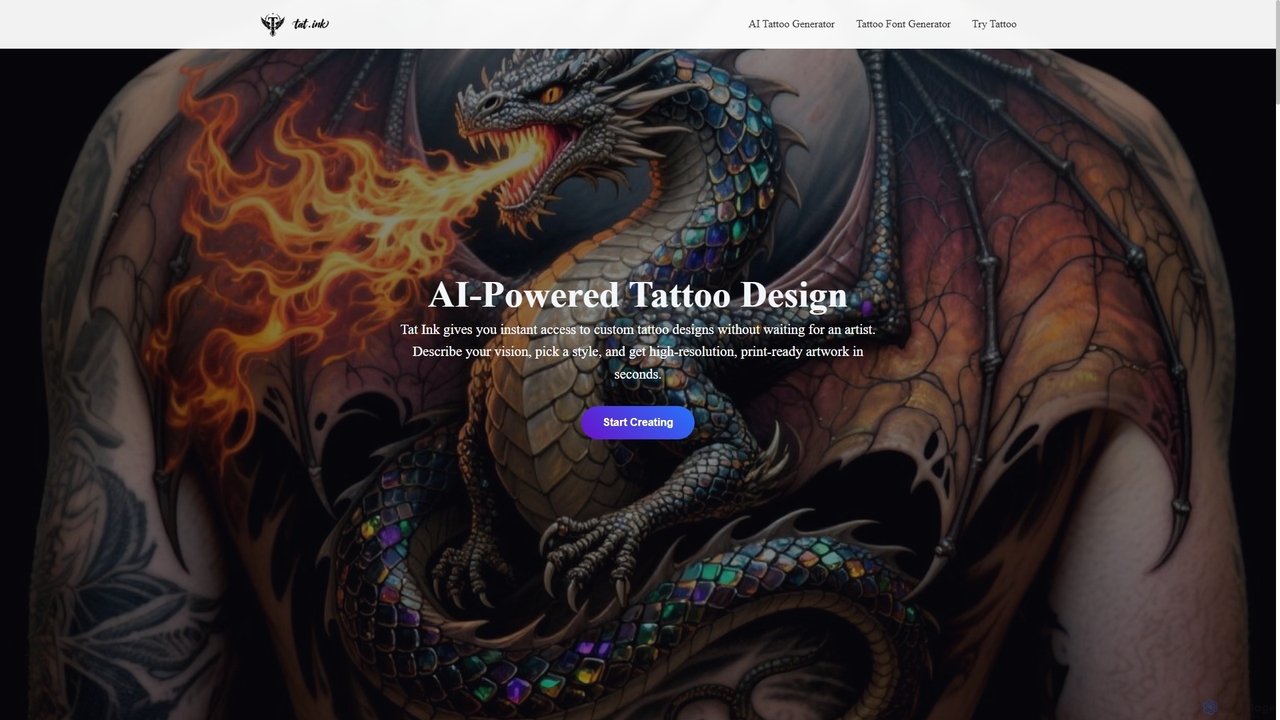
Tat Ink is an innovative AI-powered platform that transforms your tattoo ideas into unique, high-resolution designs in seconds. It offers an AI tattoo generator, a vast idea explorer, a versatile font generator, and a realistic virtual try-on feature, allowing users to visualize custom ink on their skin before commitment. Perfect for enthusiasts, artists, and designers seeking creative inspiration and personalized body art.
About Idea Generation
AI Idea Generation tools are a specialized type of creative assistant designed to spark and develop new concepts. These tools leverage large language models (LLMs) and semantic analysis to transform simple prompts into a wide array of creative suggestions, questions, and associated topics. Their primary value lies in helping users overcome creative blocks, explore unconventional perspectives, and accelerate the initial brainstorming phase of any project. This makes them highly effective for generating novel ideas for content, products, marketing campaigns, and strategic planning.
Core Features
- Topic Expansion: Takes a core keyword or phrase and generates a network of related sub-topics, questions, and content angles.
- Conceptual Brainstorming: Produces unique concepts, analogies, and metaphors based on user-defined constraints or themes.
- Mind Map Generation: Visually organizes generated ideas into structured mind maps, showing relationships between concepts.
- Problem Reframing: Suggests alternative ways to view a problem or challenge, unlocking new solution pathways.
- Persona-Based Ideation: Generates ideas tailored to the perspective and needs of a specific target audience or user persona.
Use Cases
These tools are widely used by content creators, marketers, product managers, and entrepreneurs. For instance, a marketer can generate a month's worth of blog post titles from a single keyword. A product team can brainstorm new app features by defining a user problem. An author can use it to develop plot points and character arcs when facing writer's block.
How to Choose
When selecting an Idea Generation tool, consider the diversity and quality of its output; some tools produce more original ideas than others. Evaluate its input flexibility—can it handle simple keywords, long descriptions, or even URLs? Also, assess its organizational features, such as the ability to create lists, mind maps, or export data to other applications. Finally, consider the user interface and how intuitively it allows you to explore and refine the generated ideas.

Idea GenerationUse Cases
Brainstorming Content Marketing Topics
A content marketer for a SaaS company needs to create a content calendar for the next quarter but is running out of fresh ideas for their niche topic, 'customer data platforms'. Using an AI Idea Generation tool, they input the core keyword. The tool instantly generates over 50 potential blog post titles, categorizes them into clusters like 'Implementation Guides', 'Comparison with CRM', and 'Future Trends', and even suggests related long-tail keywords for each topic. This process reduces brainstorming time from days to minutes and provides a structured, SEO-informed content plan.
Developing New Product Features
A product manager is tasked with improving user engagement for a mobile fitness app. Instead of traditional brainstorming sessions, the team uses an AI Idea Generation tool. They input the core problem: 'Users lose motivation after 30 days.' The AI generates ideas from various perspectives, such as 'Gamification elements like badges and leaderboards,' 'Personalized challenges based on user progress,' and 'Social features to connect with friends.' This provides a diverse set of actionable concepts, allowing the team to prioritize and prototype features that directly address the user retention problem.
Generating Startup Business Ideas
An aspiring entrepreneur is passionate about sustainable living but struggles to find a unique business niche. They use an AI Idea Generation tool and input prompts like 'eco-friendly urban solutions' and 'circular economy for households'. The tool generates a list of potential business models, including 'Subscription box for zero-waste home products,' 'A platform connecting local farmers with urban consumers for surplus produce,' and 'Repair and upcycling service for electronics.' This helps the entrepreneur move from a broad passion to concrete, viable business concepts worthy of further research.
Overcoming Writer's Block for a Novel
A novelist is stuck in the middle of their story, unsure of the next plot twist. They use an AI Idea Generation tool, inputting a summary of the plot so far and their main character's dilemma. The AI generates several potential turning points, such as 'An unexpected ally with a hidden agenda appears,' 'The protagonist discovers their main goal was based on a lie,' or 'A natural disaster forces all characters into a new, shared conflict.' These suggestions act as creative prompts, helping the author break through their block and explore new narrative directions without dictating the exact outcome.
Formulating Academic Research Questions
A graduate student is beginning their thesis in sociology and needs to narrow down a broad topic like 'social media's impact on community'. They use an AI Idea Generation tool to explore sub-niches. By inputting the topic, the tool generates specific, researchable questions such as: 'How does algorithmic content curation on TikTok affect political polarization in Gen Z?', 'What is the correlation between the decline of local newspapers and the rise of online neighborhood groups?', or 'Does the use of ephemeral media (e.g., Stories) change the nature of social capital?' This helps the student identify a focused, original, and compelling research question to build their thesis around.
Discovering Unique Marketing Campaign Angles
A marketing team is launching a new energy drink in a saturated market. To stand out, they use an AI Idea Generation tool to find unconventional angles. They input details about the drink (natural ingredients, no sugar crash) and their target audience (young professionals). The tool suggests campaigns focused not on extreme sports, but on 'creative fuel for deep work sessions,' 'the perfect 3 PM slump-buster for the office,' or 'a healthy alternative for late-night study sessions.' This shifts their strategy from competing with established brands on their terms to creating a new, relatable niche.