MinionArts
MinionArts is an AI-powered production studio that transforms scripts into professional-quality episodic video content in minutes. Designed for …
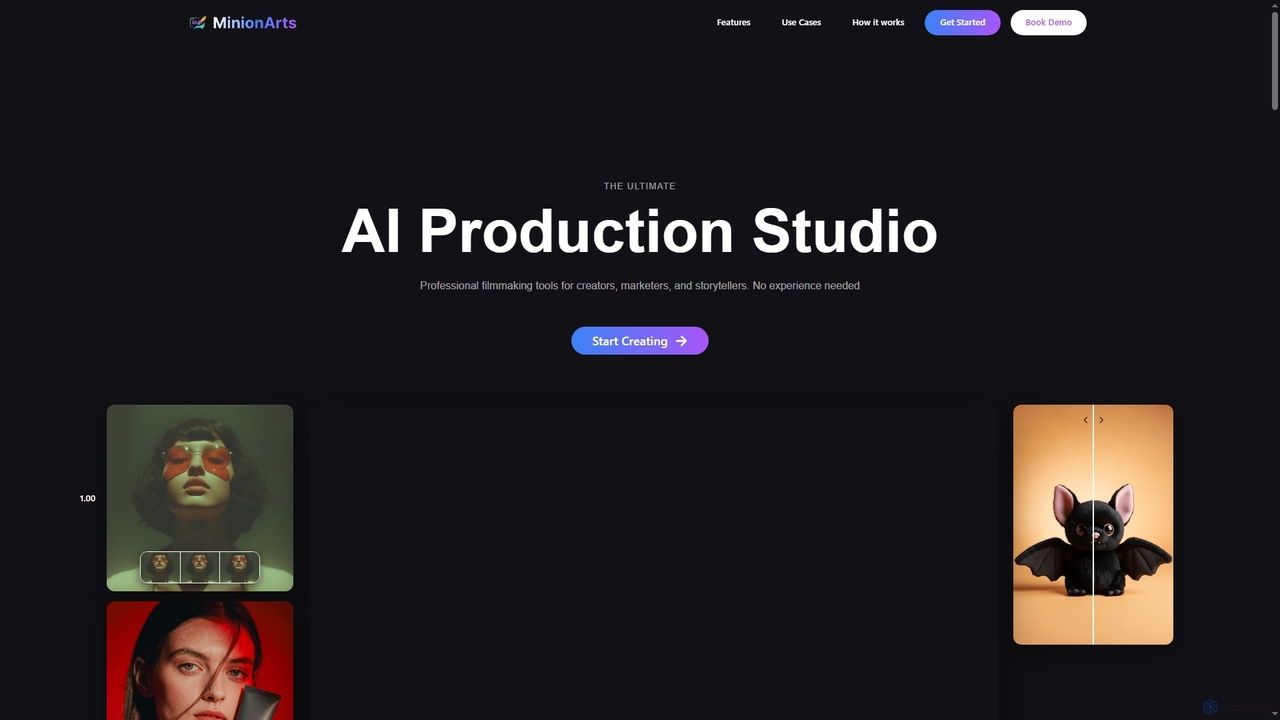
MinionArts is an AI-powered production studio that transforms scripts into professional-quality episodic video content in minutes. Designed for creators, marketers, and storytellers, it simplifies filmmaking from script to screen without requiring any prior experience. It offers advanced tools for storyboarding, scene editing, timeline assembly, and high-quality video export.
About Storytelling
AI Storytelling tools are a specialized category of creative software that uses generative artificial intelligence to construct, develop, and refine narratives. These tools leverage large language models (LLMs) to generate plot points, create complex character profiles, write dialogue, and even structure entire story arcs. They serve as powerful assistants for writers, marketers, and creators to overcome creative blocks and explore diverse narrative possibilities. Their primary value lies in automating the ideation process and providing structured frameworks for compelling stories.
Core Features
- Plot Generation: Creates structured plot outlines, story beats, and narrative arcs based on user prompts or genre conventions.
- Character Development: Generates detailed character backstories, personality traits, motivations, and relationships.
- Dialogue Writing: Produces natural-sounding conversations between characters, often adaptable to specific tones or styles.
- World-Building: Assists in creating fictional settings, histories, cultures, and rules for a story's universe.
- Narrative Restructuring: Suggests alternative plot twists, scene arrangements, and pacing improvements to enhance the story.
Use Cases
These tools are widely used by screenwriters, novelists, and game developers for brainstorming and drafting. Marketers also utilize them to craft engaging brand stories and advertising campaigns. In education, they help create interactive learning scenarios and engaging content for students.
How to Choose
When selecting an AI Storytelling tool, consider the level of creative control it offers—some provide high-level ideas while others write detailed prose. Evaluate its specialization in specific genres (e.g., fantasy, sci-fi, mystery). Also, check for export formats (e.g., Final Draft, Fountain) and integration capabilities with other writing software.

StorytellingUse Cases
Outlining a Screenplay or Novel
A novelist or screenwriter facing a blank page can use an AI Storytelling tool to jumpstart their creative process. By providing a simple premise, such as 'a detective in a futuristic city solves a murder,' the tool can generate multiple plot outlines, including inciting incidents, rising action, climax, and resolution. The writer can then select the most compelling structure, ask the AI to flesh out key characters with unique motivations, and even generate sample dialogue for pivotal scenes. This process transforms hours of brainstorming into a focused session, providing a solid narrative foundation to build upon.
Crafting Brand Narratives for Marketing
A marketing team tasked with creating a new ad campaign can use an AI Storytelling tool to develop a compelling brand story. They can input their target audience demographics, brand values, and key message. The AI then generates several narrative concepts, such as a 'hero's journey' for a customer or an 'origin story' for the company. The team can explore different tones—humorous, inspirational, or dramatic—and receive script outlines for short video ads or social media story series. This helps ensure narrative consistency across the campaign and significantly speeds up the creative development phase.
Designing Game Quests and Dialogue
An indie game developer working on a role-playing game (RPG) can leverage an AI Storytelling tool to populate their game world with rich narratives. By defining the game's lore and a central conflict, the developer can generate branching questlines, complete with objectives, key non-player characters (NPCs), and potential outcomes. The tool can also write extensive dialogue trees for these NPCs, ensuring each character has a distinct voice and personality. This allows a small team or solo developer to create a world that feels vast and alive, saving hundreds of hours of manual writing and design.
Creating Educational Scenarios
An instructional designer or teacher can use AI Storytelling tools to create engaging learning materials. For a history lesson, they could generate a short, interactive story where students make decisions as a historical figure. For corporate training, they could create branching scenarios to teach ethical decision-making or customer service skills. The AI can help structure these narratives, write dialogue for different characters, and outline the consequences of each choice, making the learning experience more immersive and memorable than traditional textbooks or presentations.
Generating Social Media Story Arcs
A social media manager planning a multi-part story for Instagram or TikTok can use an AI tool to map out a compelling narrative arc. Instead of posting disconnected content, they can input a theme, like 'a week in the life of our product,' and the AI will suggest a beginning, middle, and end. It can propose daily cliffhangers to keep the audience engaged, generate script ideas for short videos, and even suggest character personas for the brand to adopt. This strategic approach to storytelling helps build a loyal following and increases viewer retention across a series of posts.
Personalized Story Generation for Children
A parent or an ed-tech developer can use an AI Storytelling tool to create personalized bedtime stories. By inputting a child's name, their interests (e.g., dinosaurs, space exploration), and a desired moral lesson (e.g., the importance of sharing), the tool can generate a unique, age-appropriate story. The AI can create a narrative where the child is the main character, embarking on an adventure that incorporates their favorite things. This provides a highly engaging and educational experience, making story time more special and impactful, and can be used to generate endless variations so the child never hears the same story twice.