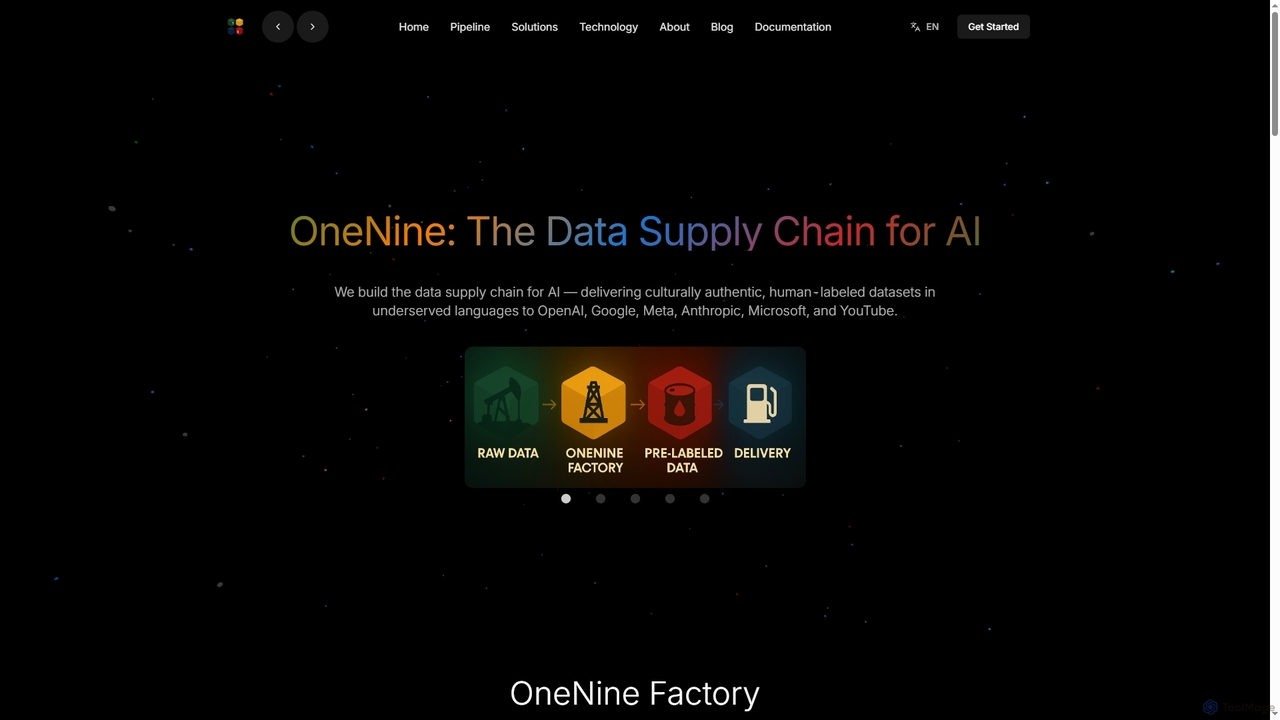
Data Labeling tools are AI-powered platforms designed to annotate raw data, such as images, text, audio, or video, with meaningful tags and attributes. These tools are crucial for creating high-quality, structured training datasets that enable machine learning models to learn patterns, make predictions, and perform specific tasks accurately. By systematically categorizing, marking, and enriching data, data labeling solutions significantly enhance the development, evaluation, and refinement of AI applications across various industries, forming the bedrock of supervised learning.
Core Features
- Image and Video Annotation: Advanced functionalities for drawing bounding boxes, polygons, keypoints, polylines, or semantic segmentation masks on images and video frames to precisely identify objects, regions, or actions. This includes capabilities for object tracking over time.
- Text Labeling and NLP Annotation: Tools to tag entities (Named Entity Recognition), sentiments, intentions, categories, or relationships within text documents, essential for training natural language processing (NLP) models for tasks like chatbots, sentiment analysis, and information extraction.
- Audio Transcription and Event Labeling: Capabilities to accurately transcribe speech, identify speakers, mark specific events, emotions, or acoustic features within audio files, vital for voice assistants, call center analytics, and sound recognition systems.
- Data Quality Assurance and Validation: Robust built-in mechanisms for review, inter-annotator agreement (IAA) calculation, consensus scoring, and automated quality checks to maintain high annotation accuracy, consistency, and reliability across large datasets.
- Workflow Management and Collaboration: Comprehensive features for managing complex labeling projects, assigning tasks to multiple annotators, tracking progress, setting up review stages, and facilitating seamless collaboration among teams, often with integrated communication tools.
Use Cases
Data Labeling tools are indispensable for organizations building or improving AI models across diverse domains. They are widely utilized by data scientists, machine learning engineers, and AI researchers to prepare diverse datasets for supervised learning. This includes training autonomous driving systems to recognize road signs and pedestrians, developing intelligent chatbots for customer service, enhancing medical image analysis for disease detection, powering recommendation engines with user preference data, and enabling computer vision for industrial inspection.
How to Choose
When selecting a Data Labeling tool, it's essential to consider the specific types of data you need to label (e.g., high-resolution images, complex legal texts, continuous audio streams) and the complexity of your annotation tasks. Evaluate the tool's annotation speed and efficiency features, its collaboration capabilities for team projects, and its integration with your existing machine learning pipelines and cloud storage solutions. Scalability for handling massive datasets, robust quality control mechanisms, and the availability of human-in-the-loop services or managed labeling teams are also critical factors. Additionally, assess the user interface's intuitiveness, security features, and the pricing model to ensure it aligns with your budget and operational needs.