

Wirestock
A marketplace connecting creative freelancers with AI companies, enabling creators to earn money by contributing high-quality images, videos, and illustrations for AI training datasets.
Training DataVisits 296.2KFavorites 31Likes 37
Popular Training Data AI tools in Ai Development include Wirestock, Sapien, and OneNine, helping you work more efficiently.
A marketplace connecting creative freelancers with AI companies, enabling creators to earn money by contributing high-quality images, videos, and illustrations for AI training datasets.
Training Data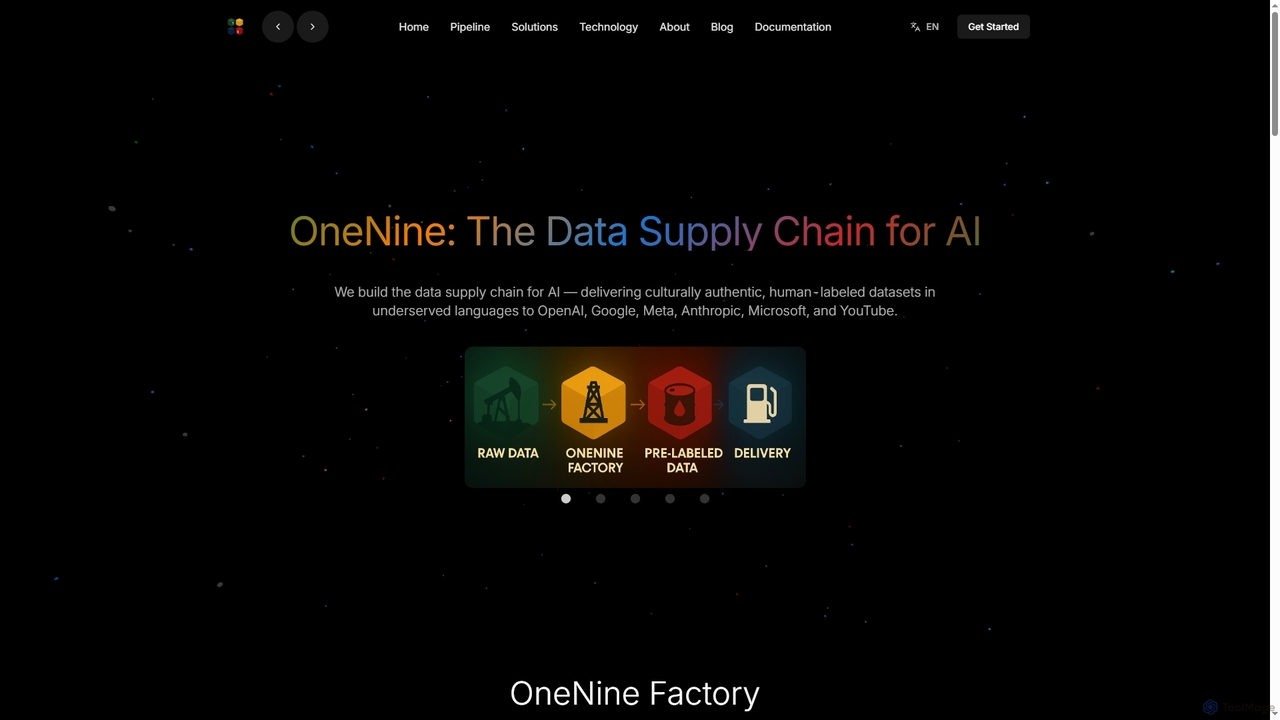
OneNine is the data supply chain for AI, specializing in delivering high-quality, culturally authentic, human-labeled datasets in underserved languages to leading AI companies. It bridges the linguistic gap, enabling more inclusive and accurate AI models globally.
Training Data
Sapien is a decentralized data foundry that provides enterprise-grade AI training data. It leverages a global network of human contributors to deliver high-quality, specialized data for complex AI systems, including 3D/4D annotation, expert reasoning, and large-scale data collection.
Training DataTraining Data tools are platforms and services designed to create, manage, and provide high-quality datasets for machine learning models. These tools streamline the critical process of data preparation, offering functionalities for data annotation, synthetic data generation, and quality assurance. Their primary value lies in accelerating the development of accurate and robust AI systems, as the performance of any model is fundamentally dependent on the quality of its training data. As a key component of the AI Development lifecycle, they form the foundation upon which effective models are built.
These tools are essential in data-intensive industries like autonomous vehicles for object detection, healthcare for medical image analysis, and retail for product categorization. Machine learning engineers, data scientists, and AI researchers use them daily to build and refine datasets for tasks ranging from natural language processing to computer vision.
When selecting a Training Data tool, consider its support for your specific data types (e.g., video, 3D point clouds). Evaluate the quality control mechanisms, such as reviewer roles and consensus scoring. Assess its scalability for large-scale projects and its ability to integrate with your existing MLOps pipeline and cloud storage. Finally, verify its security protocols and compliance with data privacy regulations like GDPR or HIPAA.
An automotive technology company developing self-driving cars needs to train its computer vision models to accurately identify pedestrians, vehicles, traffic signs, and lane markings. Using a data annotation platform, a team of labelers performs semantic segmentation and bounding box annotation on millions of images and video frames captured from road tests. The platform's quality control features, such as consensus scoring and reviewer workflows, ensure high accuracy. This meticulously labeled dataset is crucial for training perception models that can safely navigate complex urban environments.
A healthcare research institute aims to build an AI model to detect early-stage tumors in MRI scans. Due to the scarcity of expert radiologists and the high cost of manual annotation, they use a specialized medical imaging annotation tool. This tool offers features like DICOM support and semi-automated segmentation, which speeds up the process. To protect patient privacy, all data is anonymized within the platform. The resulting high-quality, labeled dataset enables the data science team to train a model that can assist radiologists by highlighting potential areas of concern, leading to earlier and more accurate diagnoses.
A financial services company wants to improve its fraud detection model but is limited by the small number of real fraud examples and strict data privacy regulations. They use a synthetic data generation tool to create a large, balanced dataset of financial transactions. The tool models the statistical properties of their real data to generate realistic but entirely artificial transaction records, including complex fraud scenarios that are rare in the real world. This allows them to train a more robust model without using sensitive customer data, improving detection rates while maintaining full compliance.
An online retail giant manages millions of products, and manually categorizing new items is slow and error-prone. They employ a data labeling service to classify a large dataset of product images and descriptions. The service uses a combination of human annotators and AI-powered pre-labeling to efficiently categorize products into a detailed taxonomy. This labeled data is then used to train a machine learning model that automatically assigns categories to new products uploaded to the site, significantly reducing manual effort, improving search relevance, and enhancing the customer shopping experience.
An AI research lab is developing a new language model and needs to run hundreds of experiments with different versions of their text corpus. To ensure their results are reproducible, they use a data management and versioning platform. This tool allows them to track every change to the dataset, link specific dataset versions to model training runs, and easily revert to previous states. It acts like 'Git for data,' providing a clear audit trail and preventing confusion. This systematic approach is vital for collaborative research and for publishing verifiable scientific findings.
A human resources technology firm is building an AI tool to help screen resumes. To prevent perpetuating historical biases, they use a data quality assurance tool to audit their training dataset. The tool analyzes the distribution of demographic data (e.g., gender, ethnicity) and identifies potential imbalances or correlations that could lead to unfair outcomes. It provides visualizations and statistical reports that help the data science team identify and mitigate bias before model training. This proactive step is essential for developing responsible and ethical AI systems that promote fair hiring practices.
Training Data tools are specialized software platforms and services used to create, manage, annotate, and improve datasets for training machine learning models. They are a fundamental part of the AI development pipeline, as the quality of a model is directly dependent on the quality of the data it learns from. Key functions include data labeling (e.g., drawing boxes around objects in images), synthetic data generation, data versioning, and quality assurance workflows to ensure accuracy and consistency.
Choosing the right platform depends on your specific needs. Consider the following factors:
Real data is collected from real-world sources, such as photos taken by a camera or text from websites. It offers authenticity but can be expensive to acquire, may contain biases, and often comes with privacy concerns. Synthetic data is artificially generated by computer algorithms to mimic the properties of real-world data. Its advantages include scalability (you can create as much as you need), perfect labels, and the ability to cover rare edge cases. However, it may not always perfectly capture the complexity and nuances of the real world, a problem known as the 'sim-to-real gap'.
Data labeling, or annotation, is the process of adding informative tags or labels to raw data (like images, text, or audio). This process is critical for supervised machine learning, the most common type of AI. The labels provide the 'ground truth' or the correct answers that the model learns from. For example, to train an AI to recognize cats, you must first show it thousands of images labeled as 'cat'. The quality and accuracy of these labels directly determine how well the model will perform on new, unseen data. Inaccurate or inconsistent labeling leads to a poorly performing model.
Training Data tools are primarily used by professionals involved in the machine learning lifecycle. Key users include: