ToolMage
Sign in

Best 1 Data Simulation AI tools for Data Management

Popular Data Simulation AI tools in Data Management include TheNoah, helping you work more efficiently.

TheNoah
Paid

TheNoah

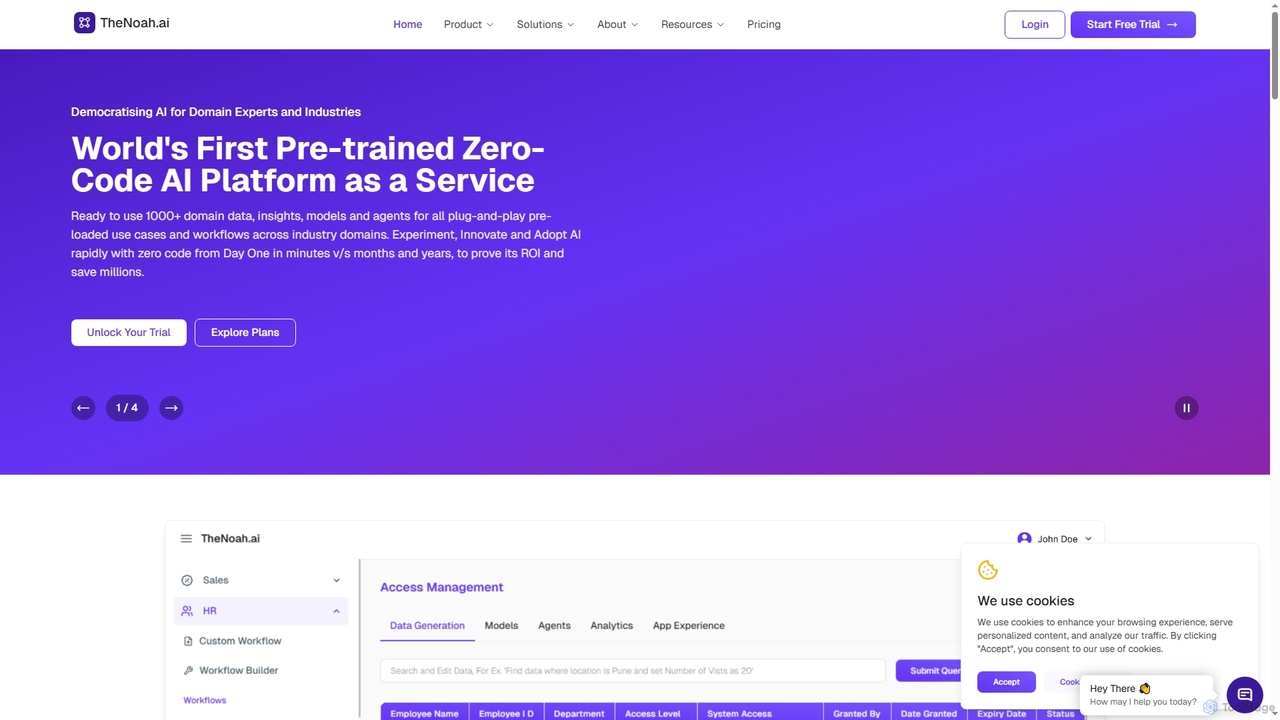
TheNoah is the world's first pre-trained, zero-code AI platform designed for enterprises and domain experts. It offers over 1000 ready-to-use domain-specific models, AI agents, and data simulation capabilities to rapidly automate workflows, generate actionable insights, and accelerate AI adoption across industries without requiring technical expertise.

Data Simulation
Visits 9.3KFavorites 152Likes 172

About Data Simulation

Data Simulation tools are AI-powered solutions designed to generate synthetic datasets that accurately mimic the statistical properties and patterns of real-world data. These tools leverage advanced algorithms, including statistical modeling and machine learning, to create realistic yet artificial data. They are invaluable for testing systems, training AI models, enhancing data privacy, and exploring complex scenarios without relying on sensitive or scarce actual data, thereby streamlining development and research processes within data management.

Core Features

  • Synthetic Data Generation: Creates artificial datasets that mirror the statistical characteristics of original data.
  • Privacy Preservation: Generates data that protects sensitive information while maintaining data utility.
  • Statistical Fidelity: Ensures the synthetic data accurately reflects the distributions, correlations, and relationships found in real data.
  • Scenario Modeling: Allows users to simulate various "what-if" scenarios for robust testing and analysis.
  • Data Augmentation: Expands existing datasets with synthetic examples to improve model training and performance.

Use Cases

Data Simulation tools are widely adopted across various sectors. They are crucial for software developers needing diverse test data, AI researchers requiring extensive training datasets, and financial analysts simulating market fluctuations for risk assessment. These tools enable organizations to innovate and test rigorously while safeguarding sensitive information and overcoming data limitations.

How to Choose

When selecting a Data Simulation tool, consider its ability to generate high-fidelity data that closely matches your real data's statistical properties. Evaluate the range of data types it supports (e.g., tabular, time-series, text) and its scalability for large datasets. Assess its privacy features, such as differential privacy, and its integration capabilities with your existing data management and analytics platforms. Finally, consider the ease of use and the level of customization offered for specific simulation needs.

Data Simulation use cases

1

Training Robust AI/ML Models

AI and machine learning engineers often face challenges with data scarcity, imbalance, or privacy concerns when developing new models. Data simulation tools enable them to generate vast, diverse, and balanced synthetic datasets. This allows for more comprehensive model training, reducing bias, improving generalization, and testing model performance against a wider range of scenarios, ultimately leading to more robust and reliable AI systems without compromising real-world data privacy.

2

Comprehensive Software Testing and Quality Assurance

Software development teams require extensive and varied test data to ensure the reliability and security of their applications. Data simulation tools allow QA engineers to create realistic, yet entirely artificial, datasets that cover numerous edge cases, error conditions, and user behaviors. This eliminates the need to use sensitive production data in testing environments, accelerates the testing cycle, and helps identify bugs and vulnerabilities early in the development process, ensuring higher software quality.

3

Secure Data Sharing for Collaboration and Research

Organizations frequently need to share data with external partners, researchers, or for public release, but privacy regulations (like GDPR, HIPAA) restrict the use of real sensitive information. Data simulation tools provide a solution by generating synthetic versions of datasets that retain the statistical properties and insights of the original data, but contain no identifiable personal information. This facilitates secure collaboration, accelerates research, and enables broader data utility while fully complying with privacy mandates.

4

Advanced Financial Risk and Scenario Modeling

Financial institutions rely heavily on accurate data to assess risk, develop trading strategies, and comply with regulations. Data simulation tools allow financial analysts and quants to model complex market fluctuations, economic downturns, and various customer behaviors that might not be present in historical data. By simulating these "what-if" scenarios, firms can stress-test their portfolios, evaluate the resilience of their strategies, and make more informed decisions to mitigate potential financial losses.

5

Accelerating Product Development and Prototyping

During the early stages of product development, real user data is often unavailable, hindering the testing and refinement of new features. Product managers and developers can use data simulation tools to generate representative datasets that mimic future user interactions or system inputs. This allows for rapid prototyping, early validation of design choices, and iterative testing of product functionalities before launch, significantly reducing time-to-market and ensuring a more polished final product.

6

Healthcare Research and Clinical Trial Simulation

Healthcare researchers and pharmaceutical companies face significant challenges in accessing sufficient, diverse, and privacy-compliant patient data for studies and drug discovery. Data simulation tools enable the creation of synthetic patient cohorts that reflect real demographic, clinical, and treatment response patterns. This facilitates the simulation of clinical trials, development of diagnostic algorithms, and exploration of disease progression, accelerating medical breakthroughs while rigorously protecting patient confidentiality and adhering to ethical guidelines.

Data Simulation FAQ

What is Data Simulation and why is it important?

Data Simulation is the process of creating artificial datasets that statistically resemble real-world data. It's crucial because it allows organizations to overcome challenges like data scarcity, privacy concerns, and the high cost of acquiring real data. By generating synthetic data, businesses can safely test new systems, train AI models, develop products, and conduct research without exposing sensitive information or being limited by insufficient real data, making it a vital component of modern data management strategies.

How do Data Simulation tools ensure data privacy?

Data Simulation tools ensure privacy by generating entirely new data points that do not correspond to any real individual, while preserving the statistical properties and relationships of the original dataset. Techniques like differential privacy, k-anonymity, and generative adversarial networks (GANs) are often employed to create synthetic data that is statistically useful but impossible to trace back to its source. This allows for data sharing and analysis without compromising the confidentiality of personal or sensitive information.

What are the key factors to consider when choosing a Data Simulation tool?

When selecting a Data Simulation tool, prioritize its ability to produce high-fidelity synthetic data that accurately reflects the statistical nuances of your real data. Consider the types of data it can simulate (e.g., tabular, time-series, image, text) and its scalability to handle large volumes. Evaluate its privacy-enhancing features, such as built-in anonymization techniques. Additionally, assess its integration capabilities with your existing data infrastructure, ease of use, and the level of customization it offers for specific simulation requirements.

How does Data Simulation differ from Data Anonymization?

While both Data Simulation and Data Anonymization aim to protect privacy, they achieve it differently. Data Anonymization modifies existing real data by removing or altering identifiable information, making it difficult to link data back to individuals. Data Simulation, on the other hand, generates entirely new, artificial datasets from scratch that mimic the statistical properties of real data, without using any actual sensitive records. Simulation creates "new" data, while anonymization "transforms" existing data, offering distinct approaches to privacy-preserving data utility.

In which industries is Data Simulation most beneficial?

Data Simulation offers significant benefits across numerous industries. In finance, it's used for risk modeling, fraud detection, and scenario analysis. Healthcare leverages it for clinical trial simulations and patient data research while protecting privacy. Software development relies on it for comprehensive testing and quality assurance. AI/Machine Learning benefits from synthetic data for model training and augmentation, especially in fields with limited real data. Additionally, research and development across various sectors use it to explore hypotheses and accelerate innovation.