Data Management Best in category 1 results Search AI Tool

Popular AI tools in the Search field of Data Management include MyScale, etc., helping you quickly improve efficiency.

MyScale

MyScale

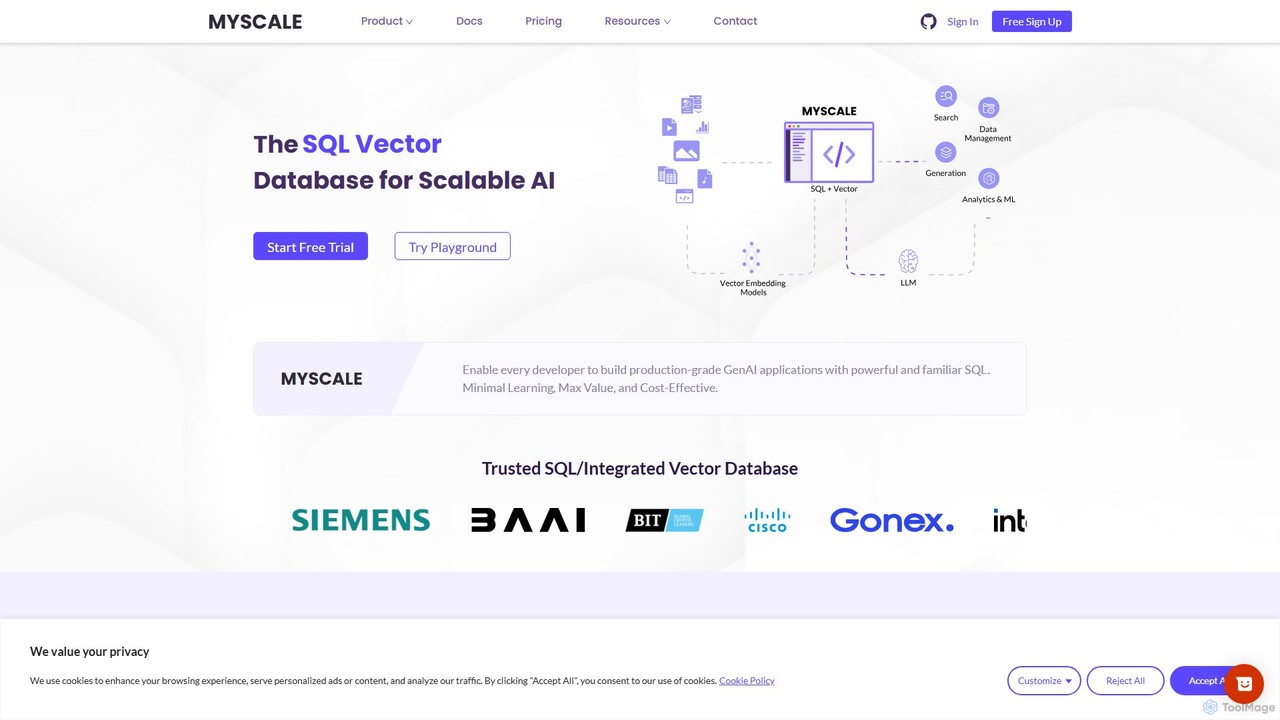
MyScale is a high-performance vector database that uniquely combines vector search with the power of SQL. It's designed …

38.4K

About Search

AI Search tools are a class of intelligent software designed to understand user intent and context, going far beyond traditional keyword matching. These tools leverage technologies like Natural Language Processing (NLP) and vector embeddings to interpret the meaning behind a query. This allows them to deliver highly relevant, accurate, and personalized results from vast datasets. By focusing on semantic understanding rather than literal terms, AI Search transforms how users find information within enterprise systems, websites, and applications.

Core Features

  • Semantic Understanding: Interprets the contextual meaning of a query, not just the keywords, to find conceptually related information.
  • Natural Language Query (NLQ): Allows users to ask questions in conversational language, as they would to a human.
  • Vector Search: Indexes data (text, images) as numerical representations (vectors) to find similar items based on meaning rather than syntax.
  • Personalization: Adapts search results based on user history, behavior, and preferences to increase relevance.
  • Faceted Search & Filtering: Provides advanced filtering options based on metadata and extracted entities to help users refine results.

Use Cases

AI Search tools are widely adopted in e-commerce for product discovery, in enterprises for building intelligent knowledge bases, and in customer support portals to power self-service. They are also crucial for developers building in-app search functionalities and for researchers navigating large archives of documents or data.

How to Choose

When selecting an AI Search tool, consider its ability to index your specific data sources (e.g., PDFs, databases, websites). Evaluate the sophistication of its NLP capabilities and support for multiple languages. Assess its API and integration options for seamless deployment into your existing stack. Finally, analyze its scalability to handle your data volume and query load, along with its pricing model.

SearchUse Cases

1

Enhancing E-commerce Product Discovery

For an online fashion retailer, improving how customers find products is critical. A customer might search for "comfortable shoes for a summer trip to Europe." A traditional search would look for these exact keywords. An AI Search tool, however, understands the concepts of 'comfort,' 'summer,' and 'travel-friendly.' It returns results like breathable walking sandals, lightweight sneakers, and stylish espadrilles, even if their descriptions don't contain the exact search phrase. This leads to a better user experience, higher conversion rates, and increased customer satisfaction by showing shoppers what they truly want.

2

Building an Intelligent Corporate Knowledge Base

A large enterprise stores its policies, procedures, and best practices across thousands of documents in various formats (PDFs, Word docs, intranet pages). An employee asking, "What's our parental leave policy for part-time staff?" would traditionally have to sift through dozens of HR documents. With an AI Search tool integrated, the system understands the specific query. It can synthesize information from multiple sources to provide a direct, concise answer, such as, "Part-time employees are eligible for 6 weeks of paid parental leave after 12 months of service," and provide links to the exact source documents. This saves hours of employee time and ensures consistent, accurate information delivery.

3

Improving Customer Support Self-Service

A SaaS company's support portal is the first line of defense for customer issues. When a user types a problem like "my invoice from last month is wrong," a basic search might return irrelevant articles about billing in general. An AI Search system understands the intent is to view and dispute a specific invoice. It can surface the most relevant troubleshooting guide, link directly to the user's billing history page, and even suggest a pre-filled support ticket form. By providing accurate, actionable answers immediately, AI Search reduces the number of support tickets, lowers operational costs, and improves overall customer satisfaction.

4

Accelerating Legal and Compliance Document Review

Legal teams often need to find specific clauses or information across thousands of contracts and regulatory documents. A query like "find all contracts with non-standard liability clauses related to GDPR" is impossible for keyword search. An AI Search tool trained on legal terminology can understand the nuances of 'non-standard liability' and 'related to GDPR'. It can instantly surface the exact documents and highlight the relevant paragraphs for review. This process, known as eDiscovery, reduces manual review time from weeks to hours, minimizes the risk of human error, and ensures thorough compliance checks.

5

Powering In-App Content Search

For a media streaming service, a powerful in-app search is essential for user retention. A user might search for "that sci-fi movie about dreams within dreams." A keyword search would fail. An AI Search tool can process this natural language query, understand the conceptual link to the movie 'Inception', and present it as the top result. It can also provide related suggestions like "movies directed by Christopher Nolan" or "mind-bending thrillers." This intelligent discovery process keeps users engaged with the platform, helps them find content they'll love, and increases overall watch time.

6

Facilitating Scientific Research and Literature Discovery

A medical researcher is investigating the link between gut microbiome and autoimmune diseases. Searching for specific keywords might miss relevant papers that use different terminology. By using an AI Search tool on a database of academic papers, the researcher can input their hypothesis as a query. The system uses vector search to find conceptually similar studies, even if they don't share exact keywords. It can identify papers discussing related biological pathways or similar patient outcomes, uncovering connections that would be nearly impossible to find manually. This accelerates the research process and can lead to novel scientific breakthroughs.

SearchFrequently Asked Questions