ToolMage
Sign in

Best 1 Deep Learning AI tools for Data Science

Popular Deep Learning AI tools in Data Science include PyTorch, helping you work more efficiently.

PyTorch
Free

PyTorch

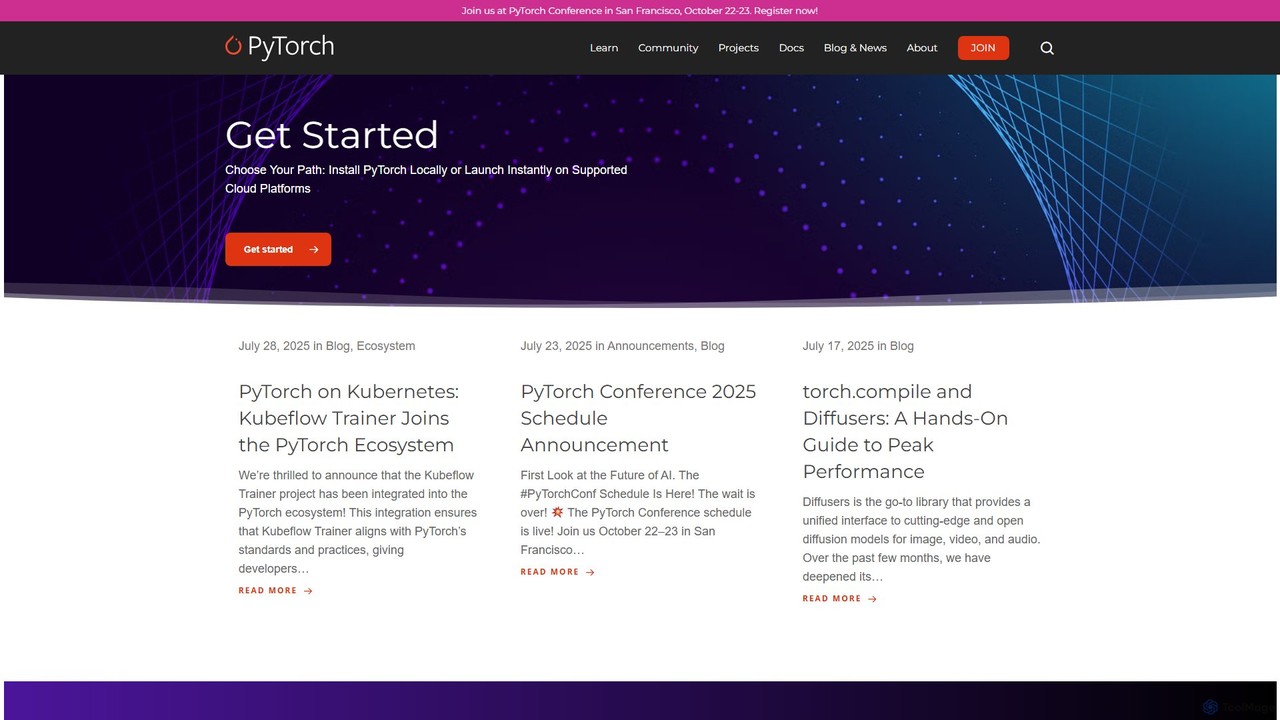
PyTorch is an open-source machine learning framework based on the Torch library, used for applications such as computer vision and natural language processing. It offers a flexible, Python-first environment that accelerates the path from research prototyping to production deployment.

Deep Learning
Visits 1.5MFavorites 160Likes 175

About Deep Learning

Deep Learning tools are a specialized category of data science software that utilize multi-layered neural networks to analyze complex patterns in large datasets. These tools mimic the human brain's structure to learn from vast amounts of data, enabling them to perform tasks like image recognition, natural language processing, and predictive modeling with high accuracy. They are essential for developing sophisticated AI applications that require nuanced understanding and decision-making. Unlike traditional machine learning, deep learning excels at automatically discovering features from raw data, reducing the need for manual feature engineering.

Core Features

  • Neural Network Architecture Design: Provides interfaces and libraries for building, configuring, and visualizing complex neural network structures like CNNs, RNNs, and Transformers.
  • Automated Feature Extraction: Automatically identifies and learns relevant features from raw data (e.g., pixels in an image, words in a text) without manual intervention.
  • Large-Scale Model Training: Supports distributed training across multiple GPUs or TPUs to accelerate the processing of massive datasets and complex models.
  • Transfer Learning Support: Allows the use of pre-trained models as a starting point for new tasks, significantly reducing training time and data requirements.
  • Model Optimization and Deployment: Includes tools for model quantization, pruning, and conversion for efficient deployment on various platforms, from cloud servers to edge devices.

Use Cases

Deep Learning tools are widely used in industries requiring advanced pattern recognition. In healthcare, they assist radiologists in medical image analysis for disease detection. The automotive industry uses them to develop perception systems for autonomous vehicles. In finance, they power sophisticated fraud detection systems by analyzing complex transaction patterns in real-time.

How to Choose

When selecting a Deep Learning tool, first consider the supported frameworks (e.g., TensorFlow, PyTorch, JAX) and their compatibility with your existing stack. Evaluate its scalability and support for distributed training if you work with large models or datasets. Assess the availability of pre-trained models and toolkits for specific domains (like NLP or computer vision) to accelerate development. Finally, consider the ease of deployment and integration with production environments.

Featured tool rankings

Deep Learning use cases

1

Medical Image Analysis for Disease Detection

A radiologist or medical researcher uses a deep learning platform to train a Convolutional Neural Network (CNN) on thousands of MRI scans. The goal is to create a model that can automatically identify and segment potential tumors with higher accuracy and speed than manual review. The tool's interface allows them to visualize network layers, adjust hyperparameters, and monitor training progress. The resulting model can serve as a diagnostic aid, flagging suspicious regions for expert review, ultimately accelerating the diagnostic workflow and potentially improving early detection rates.

2

Developing Perception Systems for Autonomous Vehicles

An automotive engineer uses a deep learning framework to build and train models for object detection and semantic segmentation. The models are fed with vast datasets of road imagery and sensor data (LiDAR, radar) to learn to identify pedestrians, vehicles, traffic signs, and lane markings in real-time. The framework's tools for data augmentation and distributed training are critical for handling the scale and diversity of the data. The final, optimized models are deployed onto the vehicle's onboard computer to power its perception system, a core component for safe navigation.

3

Advanced Natural Language Processing (NLP)

A data scientist aims to build a sophisticated sentiment analysis model that understands sarcasm and context. They use a deep learning library to fine-tune a large language model (LLM) like BERT or GPT on a custom dataset of customer reviews. The tool facilitates the complex process of tokenization, embedding, and training the Transformer-based architecture. The resulting model can classify text with much higher nuance than traditional methods, providing more accurate insights for market research, brand monitoring, or customer feedback analysis.

4

Real-Time Financial Fraud Detection

A financial institution's data science team develops a fraud detection system using a deep learning framework. They train a Recurrent Neural Network (RNN) or an autoencoder on millions of historical transaction data points. The model learns the complex, sequential patterns of normal user behavior. When deployed, it analyzes incoming transactions in real-time, calculating an anomaly score. Transactions that deviate significantly from the learned patterns are flagged for immediate review, enabling the institution to block fraudulent activities much faster and more accurately than rule-based systems.

5

Generative Art and Music Creation

A digital artist or musician uses a deep learning tool featuring Generative Adversarial Networks (GANs) or Variational Autoencoders (VAEs). They train the model on a large dataset of existing artworks or musical pieces. By manipulating the latent space of the trained model, they can generate entirely new, original creations that blend styles or explore novel concepts. The tool provides an interactive environment to guide the generation process, allowing the artist to co-create with the AI, pushing the boundaries of their creative expression and producing unique works that would be difficult to conceive manually.

6

Drug Discovery and Genomics Research

A computational biologist uses a deep learning platform to predict molecular activity and protein structures. They employ Graph Neural Networks (GNNs) to analyze complex molecular graphs and predict how a potential drug compound might interact with a target protein. This process can screen millions of compounds virtually, drastically reducing the time and cost of initial lab experiments. The platform helps manage complex biological datasets, visualize molecular structures, and accelerate the identification of promising candidates for new therapies, revolutionizing the early stages of drug discovery.

Deep Learning FAQ

What are Deep Learning tools?

Deep Learning tools are software frameworks, libraries, and platforms designed for building, training, and deploying deep neural networks. They are a specialized subset of data science tools that use models with many layers (hence "deep") to learn hierarchical patterns from large volumes of data. Key features include support for various neural network architectures (like CNNs and RNNs), GPU acceleration for fast computation, and utilities for managing the entire machine learning lifecycle, from data preparation to model deployment.

What is the difference between Deep Learning and Machine Learning?

Deep Learning is a specific subfield of Machine Learning. The main difference lies in the complexity of the models and the degree of automation in feature extraction.

  • Machine Learning (ML): Often requires developers to manually identify and engineer relevant features from the data for the model to learn from. It works well with structured, smaller datasets.
  • Deep Learning (DL): Uses deep neural networks to automatically learn features directly from raw data (like images or text). It excels with large, unstructured datasets and complex problems like image recognition or natural language understanding.
In essence, all deep learning is machine learning, but not all machine learning is deep learning. Deep learning automates a significant part of the feature engineering process, which is a major advantage for complex data types.

How to choose the right Deep Learning tool or framework?

Selecting the right tool depends on your specific needs and expertise. Consider these factors:

  • Primary Use Case: Are you focused on computer vision, NLP, or another domain? Some frameworks like PyTorch are popular in research, while TensorFlow has strong production deployment capabilities.
  • Ecosystem and Community: A large community means more tutorials, pre-trained models (like on Hugging Face for Transformers), and support.
  • Scalability: If you plan to work with massive datasets, ensure the tool supports distributed training across multiple GPUs or cloud infrastructure.
  • Ease of Use: High-level APIs like Keras (part of TensorFlow) or libraries like Fast.ai can significantly lower the barrier to entry for beginners compared to lower-level frameworks.
Start by identifying your project's core requirements and then evaluate which tool's ecosystem best aligns with them.

What are some common types of neural networks used in Deep Learning?

Different neural network architectures are designed for specific types of data and tasks. Some of the most common include:

  • Convolutional Neural Networks (CNNs): Ideal for image and video data. They use convolutional layers to detect features like edges, textures, and shapes, making them powerful for image classification and object detection.
  • Recurrent Neural Networks (RNNs): Designed for sequential data like text or time series. They have loops that allow information to persist, making them suitable for tasks like language translation and stock price prediction. LSTMs and GRUs are advanced types of RNNs.
  • Transformers: A more recent architecture that has revolutionized NLP. They use attention mechanisms to weigh the importance of different words in a sequence, enabling a more sophisticated understanding of context.

Who are the primary users of Deep Learning tools?

Deep Learning tools cater to a range of users with varying technical skills. The primary users include:

  • Data Scientists and ML Engineers: Professionals who build, train, and deploy custom deep learning models for specific business problems, such as fraud detection or recommendation systems.
  • AI Researchers: Academics and R&D professionals who use these tools to experiment with new neural network architectures and push the boundaries of AI capabilities.
  • Software Developers: Developers who integrate pre-trained deep learning models into applications via APIs for features like image recognition or text-to-speech.
  • Domain Experts (e.g., Biologists, Physicists): Specialists who apply deep learning models to analyze complex data in their respective fields, often using specialized platforms that require less coding.