Cleora
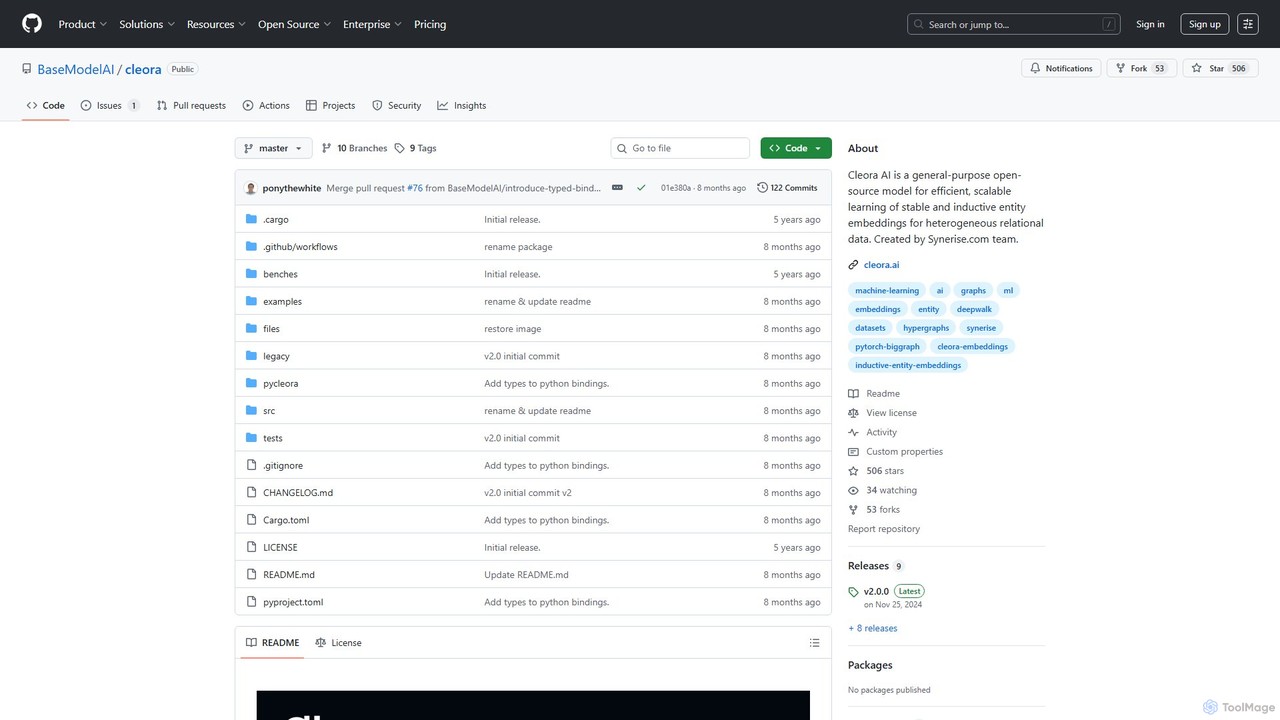
Cleora is an open-source, high-performance model for creating stable and inductive entity embeddings from large-scale, heterogeneous relational data …
Cleora is an open-source, high-performance model for creating stable and inductive entity embeddings from large-scale, heterogeneous relational data and hypergraphs. Written in Rust with a Python API, it offers unparalleled speed and scalability for tasks like recommendation systems and graph analytics.
About Graph Analytics
Graph Analytics tools are a specialized class of data science software for analyzing relationships and connections within network data. They operate on graph structures, composed of nodes (entities) and edges (relationships), to uncover complex patterns that are difficult to identify with traditional tabular analysis. This approach allows for the discovery of influential entities, critical pathways, and hidden communities within vast datasets. By modeling data as a network, these tools provide deep insights into system dynamics and interconnected behaviors.
Core Features
- Pathfinding Analysis: Calculates the shortest or most efficient path between nodes, crucial for logistics and network routing.
- Centrality Analysis: Identifies the most important or influential nodes within a network, such as key influencers or critical system components.
- Community Detection: Groups nodes into clusters based on dense internal connections, used for market segmentation or identifying fraud rings.
- Link Prediction: Forecasts the probability of a future connection forming between two nodes, enhancing recommendation engines.
- Interactive Visualization: Renders complex graphs visually, allowing analysts to explore relationships and patterns intuitively.
Use Cases
Graph Analytics is widely applied in social network analysis to understand influence, in finance for detecting sophisticated fraud networks, and in logistics for supply chain optimization. It is also essential in cybersecurity for mapping threat pathways and in bioinformatics for analyzing protein-protein interaction networks.
How to Choose
When selecting a Graph Analytics tool, consider its scalability to handle large-scale graphs with billions of nodes and edges. Evaluate the library of available graph algorithms and the quality of its visualization engine. Also, assess its integration capabilities with existing data sources (like databases and data lakes) and the learning curve of its query language or user interface.
Graph AnalyticsUse Cases
Detecting Financial Fraud Rings
A fraud analyst at a financial institution uses a graph analytics platform to investigate suspicious transaction patterns. By modeling accounts as nodes and transactions as edges, they can visualize the flow of money. Using community detection algorithms, the analyst identifies a tightly-knit cluster of accounts involved in circular transactions, a common money laundering tactic. Pathfinding analysis then reveals the origin and destination of the illicit funds, allowing the institution to block the accounts and report the activity to authorities, preventing further financial loss.
Optimizing Supply Chain Logistics
A logistics manager for a large retail company needs to optimize delivery routes from multiple warehouses to hundreds of stores. Using a graph analytics tool, they model warehouses and stores as nodes and possible delivery routes as edges with associated costs (time, distance). By running a shortest path algorithm, the manager identifies the most cost-effective routes for the entire delivery network. This analysis helps reduce fuel consumption, lower operational costs, and ensure timely delivery of goods, improving overall supply chain efficiency.
Analyzing Social Network Influence
A marketing analyst wants to identify key influencers for a new product launch campaign. They ingest social media data into a graph analytics tool, where users are nodes and interactions (likes, shares, follows) are edges. By applying centrality algorithms like PageRank or Betweenness Centrality, the analyst pinpoints individuals who are highly connected and act as bridges between different communities. This allows the marketing team to focus their outreach efforts on these true influencers, maximizing campaign reach and impact with a more targeted approach.
Enhancing E-commerce Recommendation Engines
A data scientist at an e-commerce company aims to improve product recommendations. They build a bipartite graph with users and products as the two sets of nodes, and purchase history as edges. Using link prediction algorithms, the system can forecast which products a user is likely to buy next based on the purchasing patterns of similar users. This graph-based approach provides more nuanced recommendations than traditional collaborative filtering, as it can capture complex relationships like 'users who bought X also viewed Y but ultimately purchased Z', leading to higher conversion rates.
Mapping Cybersecurity Threat Pathways
A cybersecurity analyst investigates a network breach. They use a graph analytics tool to map all network connections, with devices as nodes and data flows as edges. By visualizing the network traffic leading up to the breach, they can trace the attacker's path through the system. Pathfinding algorithms help identify the initial point of compromise and how the threat propagated laterally across different systems. This graphical representation provides a clear overview of the attack surface and helps the security team to quickly isolate affected systems and strengthen vulnerable pathways.
Analyzing Biological Networks in Research
A bioinformatician studies a specific disease by analyzing protein-protein interaction (PPI) networks. Using a graph analytics tool, they represent proteins as nodes and their interactions as edges. By applying centrality analysis, they identify 'hub' proteins that have a high number of connections. These proteins are often critical for biological processes and can be potential drug targets. Community detection can also reveal functional modules or protein complexes involved in the disease pathway, providing researchers with deeper insights into the disease's molecular mechanisms.