Data Science Best in category 1 results Model Management AI Tool

Popular AI tools in the Model Management field of Data Science include Radicalbit, etc., helping you quickly improve efficiency.

Radicalbit

Radicalbit

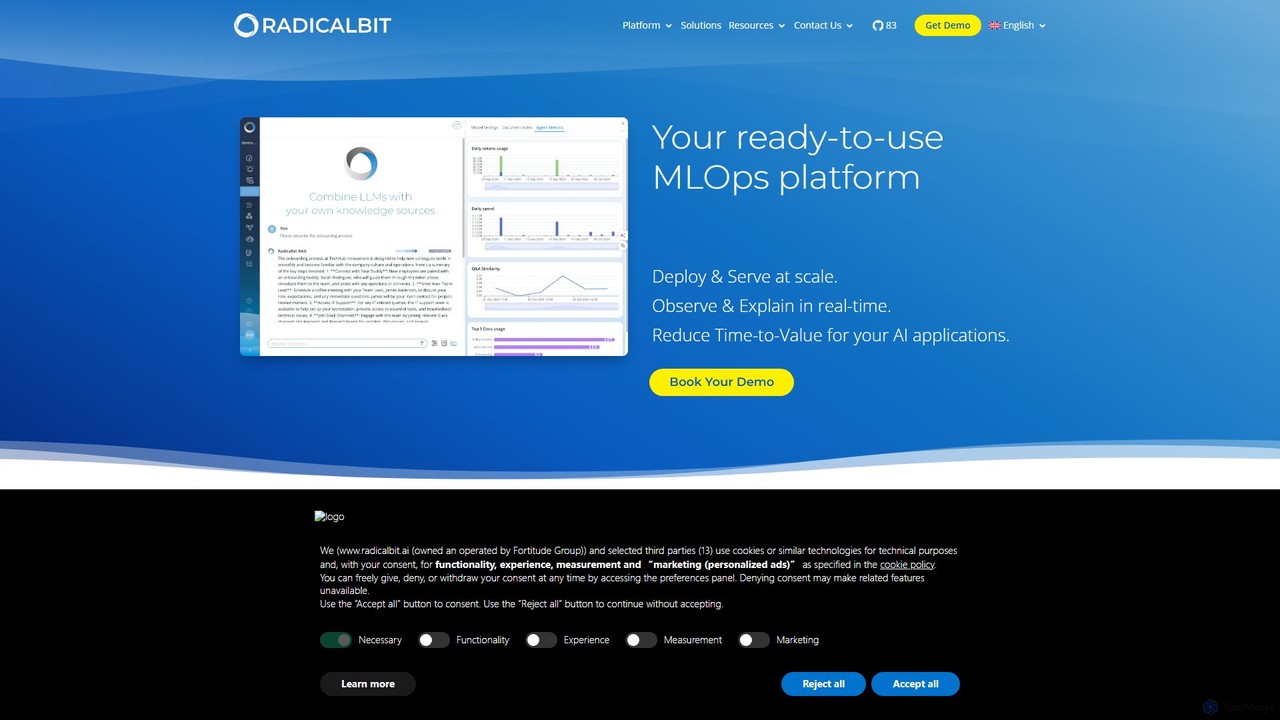
Radicalbit is an enterprise-grade MLOps platform designed to deploy, serve, and monitor AI and LLM models at scale. …

4.4K

About Model Management

Model Management tools are a specialized category within Data Science that systematize the lifecycle of machine learning models after they are trained. These platforms provide a centralized framework for versioning, deploying, monitoring, and governing models in production environments. Their primary value lies in bridging the gap between model development and real-world application, ensuring reliability, scalability, and compliance. By automating key MLOps processes, they enable organizations to efficiently manage a large portfolio of AI models and maximize their return on investment.

Core Features

  • Model Registry: A central repository for storing, versioning, and tracking all model artifacts and metadata.
  • Automated Deployment: Streamlines the process of packaging models and deploying them as scalable APIs or services.
  • Production Monitoring: Actively tracks model performance, data drift, and prediction accuracy in real-time.
  • Governance and Compliance: Manages access controls, provides audit trails, and ensures model lineage for regulatory needs.
  • A/B Testing Framework: Facilitates controlled experiments to compare different model versions in a live environment.

Use Cases

Model Management platforms are crucial for organizations with mature data science practices, particularly in regulated industries like finance, healthcare, and insurance. MLOps engineers, data science team leads, and IT administrators use these tools to create robust, repeatable deployment pipelines. They are essential for managing business-critical applications such as fraud detection systems, recommendation engines, and predictive maintenance models.

How to Choose

When selecting a Model Management tool, consider its integration with your existing ML frameworks (e.g., TensorFlow, PyTorch) and cloud infrastructure (AWS, GCP, Azure). Evaluate the scope of its monitoring capabilities, including support for detecting data and concept drift. Also, assess its governance features, scalability for handling prediction loads, and whether it offers a user-friendly interface for less technical stakeholders or is primarily API-driven for automation.

Model ManagementUse Cases

1

Automating CI/CD for Machine Learning Models

An MLOps engineer at a tech company is responsible for deploying a new version of a natural language processing (NLP) model that powers a customer support chatbot. Instead of manual deployment, which is error-prone and slow, they use a Model Management platform. The process involves:

  • Pushing the trained model to the platform's Model Registry, which automatically versions it.
  • Configuring a deployment pipeline that runs automated tests for performance and bias.
  • Using the platform's one-click deployment feature to push the model as a REST API endpoint to a Kubernetes cluster.
This automates the entire release cycle, reducing deployment time from days to hours and ensuring a consistent, reliable process.

2

Governing and Auditing Financial Models

A data science team lead at a financial institution needs to manage a portfolio of credit risk models. Regulatory compliance requires a full audit trail for each model, including who trained it, what data was used, and its performance over time. A Model Management platform provides a centralized governance hub. It automatically logs every action, from model registration to deployment requests and approvals. When auditors request information, the team lead can generate a report in minutes, showing the complete lineage and performance history of any model, ensuring compliance with regulations like SR 11-7.

3

Monitoring Model Drift in E-commerce

An e-commerce company uses a machine learning model to predict customer churn. Over time, customer behavior patterns change, causing the model's predictions to become less accurate—a phenomenon known as model drift. The data science team uses a Model Management tool to continuously monitor the model in production. The tool automatically compares the statistical distribution of incoming live data with the training data. When it detects a significant drift, it triggers an alert, notifying the team to retrain the model with fresh data. This proactive monitoring prevents a silent decline in performance and ensures the business can react quickly to changing market dynamics.

4

A/B Testing New Recommendation Engine Models

A data scientist at a streaming service develops a new 'challenger' algorithm for a movie recommendation engine, which they believe will outperform the current 'champion' model. To validate this, they use the A/B testing feature of their Model Management platform. They configure the system to route 10% of user traffic to the new challenger model while the other 90% continues to use the champion. The platform collects performance metrics for both models in real-time, such as click-through rate and watch time. After a week, the data clearly shows the challenger model increases user engagement by 15%. The data scientist can then confidently promote the challenger to become the new champion for all users.

5

Managing Model Access Control for Security

In a large enterprise, multiple teams (Data Science, App Development, QA) need to interact with machine learning models. An IT administrator uses a Model Management platform to enforce granular access control. They create roles with specific permissions:

  • Data Scientists can register new model versions but cannot deploy to production.
  • MLOps Engineers can deploy models to staging and production environments.
  • App Developers can only access production model endpoints with read-only API keys.
This role-based access control (RBAC) ensures that only authorized personnel can perform critical actions, preventing accidental deployments or unauthorized model access, thereby enhancing the overall security and stability of the ML systems.

6

Streamlining Model Handoffs Between Teams

A data science team finishes training a new fraud detection model. In the past, handing this model over to the IT operations team for deployment was a complex process involving emails, shared drives, and manual documentation. By using a Model Management platform, the process is streamlined. The data scientist registers the final model in the central registry, which includes all necessary artifacts, performance metrics, and dependencies. The MLOps engineer is automatically notified. They can then access this single source of truth to package and deploy the model without ambiguity or missing information. This creates a clear, repeatable handoff process, reducing friction between teams and accelerating time-to-market.

Model ManagementFrequently Asked Questions