deid
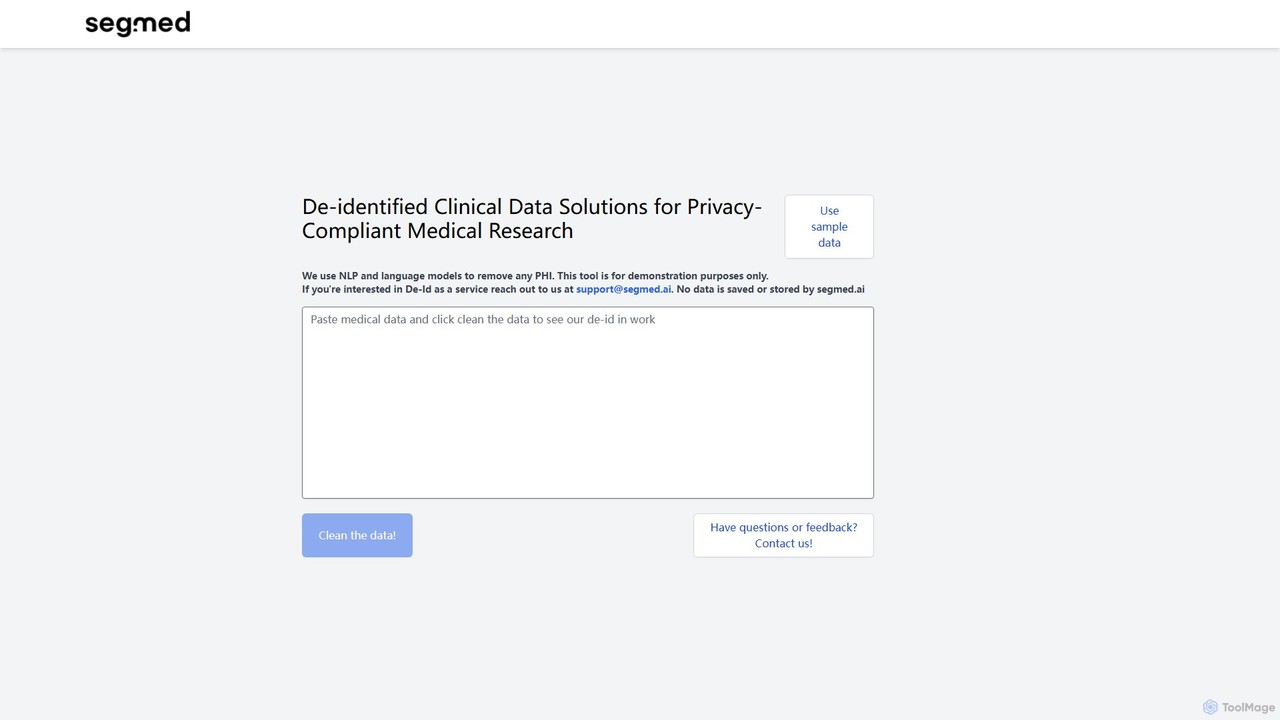
An AI-powered tool by Segmed for the de-identification of medical data. It uses NLP and language models to …
An AI-powered tool by Segmed for the de-identification of medical data. It uses NLP and language models to automatically detect and remove Protected Health Information (PHI) from clinical texts, ensuring privacy and compliance for medical research and data sharing.
About Privacy
Privacy AI tools are a specialized category of artificial intelligence solutions designed to protect sensitive information while enabling data analysis and model training. These tools leverage advanced cryptographic techniques, anonymization algorithms, and secure computation methods to ensure data confidentiality and regulatory compliance. They allow organizations to derive valuable insights from data without compromising individual privacy, addressing critical challenges in data science and ethical AI development.
Core Features
- Differential Privacy: Adds controlled noise to data or query results to prevent re-identification while preserving statistical utility.
- Homomorphic Encryption: Enables computations on encrypted data without decrypting it, ensuring data remains private throughout processing.
- Federated Learning: Trains AI models on decentralized datasets located at various sources, keeping raw data local and private.
- Secure Multi-Party Computation (SMC): Allows multiple parties to jointly compute a function over their private inputs without revealing those inputs to each other.
- Data Anonymization & Pseudonymization: Techniques to remove or mask personally identifiable information (PII) from datasets, reducing privacy risks.
Applicable Scenarios
These tools are crucial for industries handling sensitive personal or proprietary data, such as healthcare, finance, and government. They enable data scientists and compliance officers to conduct analyses, develop AI models, and share insights while adhering to strict privacy regulations like GDPR and CCPA. Typical applications include secure patient data analysis, confidential financial fraud detection, and privacy-preserving market research.
How to Choose
Selecting the right Privacy AI tool involves evaluating several factors: the specific privacy guarantees required (e.g., k-anonymity, differential privacy level), the performance overhead introduced by privacy techniques, compatibility with existing data infrastructure and AI frameworks, and the ease of integration. Consider the types of data you handle, the computational resources available, and the regulatory landscape you operate within to ensure the tool meets both security and utility needs.

PrivacyUse Cases
Secure Healthcare Data Analysis
Healthcare providers and researchers utilize Privacy AI tools to analyze vast datasets of patient records for disease patterns, treatment efficacy, and public health trends. By applying techniques like differential privacy or federated learning, they can train diagnostic AI models or conduct epidemiological studies without directly accessing or exposing individual patient identities, ensuring compliance with strict medical privacy laws like HIPAA.
Confidential Financial Fraud Detection
Financial institutions employ Privacy AI to detect fraudulent transactions and suspicious activities across large customer bases. Using homomorphic encryption or secure multi-party computation, banks can collaboratively analyze encrypted transaction data from multiple sources or process individual customer data without ever decrypting it, thereby protecting sensitive financial information from potential breaches while identifying anomalies.
Privacy-Preserving Customer Behavior Analytics
E-commerce platforms and marketing firms use Privacy AI tools to understand customer preferences and personalize experiences without infringing on individual privacy. Through advanced anonymization and pseudonymization techniques, they can analyze aggregated behavioral data to identify trends, optimize product recommendations, and tailor marketing campaigns, all while ensuring that no single customer's identifiable data is exposed or misused.
Federated AI Model Training for IoT Devices
Manufacturers of smart devices and IoT ecosystems leverage federated learning, a core Privacy AI technique, to train AI models directly on user devices (e.g., smartphones, smart home sensors). This approach allows models to learn from diverse user data without ever sending raw, sensitive information to a central server, enhancing privacy for users while improving device intelligence and personalization.
Compliant Data Sharing for Collaborative Research
Academic institutions and industry consortia engaged in collaborative research often need to share datasets containing sensitive information. Privacy AI tools facilitate this by enabling the creation of synthetic data, applying strong anonymization, or using secure multi-party computation to allow joint analysis. This ensures that researchers can pool resources and accelerate discoveries without violating data privacy agreements or exposing proprietary information.
Private AI Inference for Sensitive Queries
Users or organizations with highly sensitive input data can utilize Privacy AI tools for private inference. This allows them to query an AI model (e.g., for medical diagnosis, financial advice, or personal recommendations) without revealing their specific input data to the model provider. Techniques like homomorphic encryption or secure enclaves ensure that the query remains encrypted or protected throughout the prediction process, safeguarding user confidentiality.