
Bilberrydb
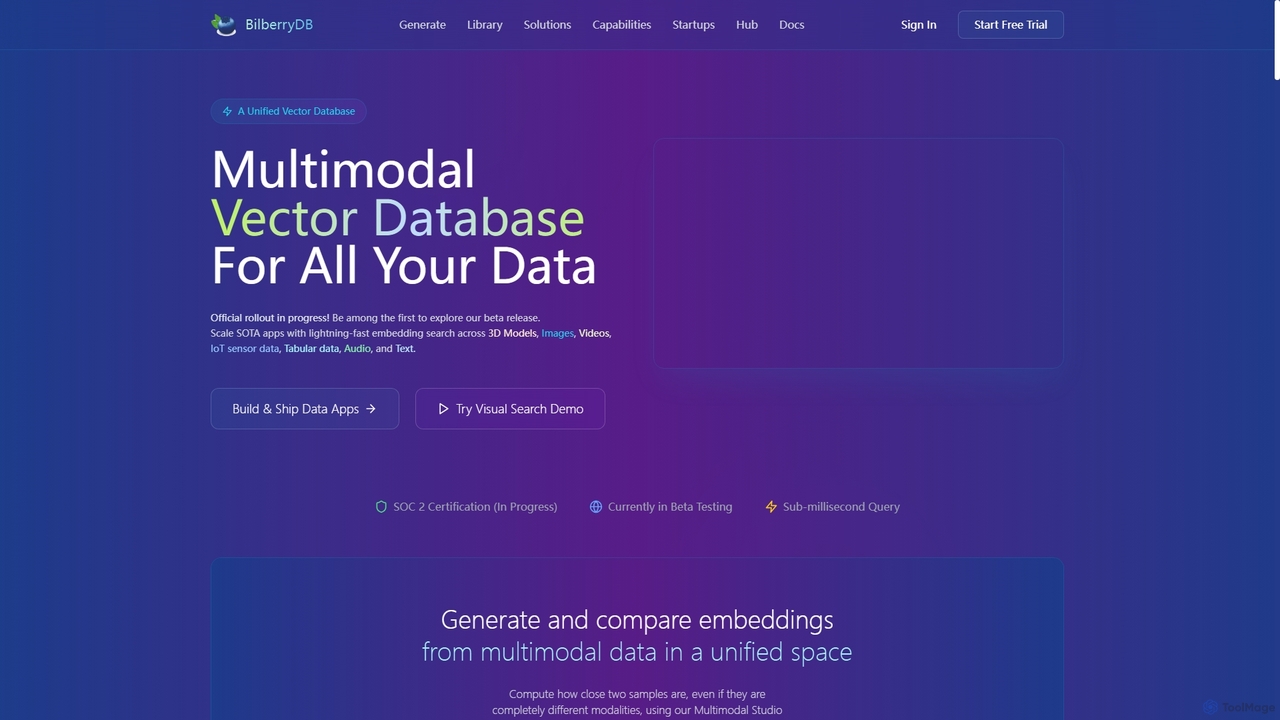
Bilberrydb is an enterprise-grade, multimodal vector database designed for building advanced AI applications. It enables lightning-fast embedding search …
Bilberrydb is an enterprise-grade, multimodal vector database designed for building advanced AI applications. It enables lightning-fast embedding search across diverse data types including 3D models, images, videos, audio, text, and tabular data on a unified platform.
About Search
AI Search tools are a class of applications that use artificial intelligence, particularly natural language processing (NLP) and machine learning, to deliver highly relevant and context-aware search results. Unlike traditional keyword-based search, these tools understand the user's intent and the semantic meaning behind a query. This enables them to retrieve information from complex and unstructured datasets with greater accuracy. As a key component of data science, AI Search transforms raw data into discoverable and actionable insights.
Core Features
- Semantic Understanding: Interprets the meaning and context of a query, not just matching keywords, to find conceptually related results.
- Natural Language Querying: Allows users to ask questions in conversational language, making search more intuitive.
- Vector Search: Indexes data (text, images) as numerical representations (vectors) to find similar items based on their conceptual meaning.
- Automated Data Indexing: Automatically processes and categorizes information from various sources like documents, databases, and websites.
- Personalized Results: Tailors search results based on individual user history, preferences, and behavior.
Use Cases
AI Search tools are widely used in enterprise environments for internal knowledge management, helping employees find documents and information quickly. They are also integral to e-commerce platforms for enhancing product discovery and in customer support portals for providing instant answers from help articles and past tickets. Data science teams use them to explore and analyze large, unstructured datasets.
How to Choose
When selecting an AI Search tool, consider its ability to handle your specific data types (e.g., text, PDF, images). Evaluate its integration capabilities via APIs, scalability to handle growing data volumes, and the level of customization available for tuning relevance. Also, assess the technical expertise required for implementation and maintenance.
SearchUse Cases
Enhancing Enterprise Knowledge Base Search
An employee at a large corporation needs to find the latest compliance policy for remote work. Instead of sifting through hundreds of documents using keyword search, they use an internal AI Search portal. They type a natural language query: 'What are the data security rules for employees working from home?'. The system understands the intent and retrieves the specific paragraphs from the official HR policy document, a related IT security guide, and a recent company-wide announcement, ranking them by relevance and saving the employee significant research time.
Intelligent Product Discovery for E-commerce
A customer on an online furniture store's website is looking for a new chair. They type 'durable and comfortable chair for long hours of gaming'. A traditional search might fail if products aren't tagged with 'gaming'. An AI Search engine, however, understands the concepts of 'durability', 'comfort', and 'long hours'. It returns ergonomic office chairs, high-back gaming chairs, and premium leather recliners, pulling information from product descriptions, specifications, and customer reviews that mention these qualities, leading to a better user experience and higher conversion rates.
Accelerating Legal eDiscovery Processes
A paralegal is tasked with finding all documents related to a 'breach of contract concerning software delivery delays' in a dataset of millions of emails and contracts. Using an AI Search tool, they can input this complex, natural language query. The system goes beyond keywords like 'breach' or 'delay'. It identifies documents discussing missed deadlines, software performance issues, and client complaints, even if they don't use the exact legal terms. This semantic search capability drastically reduces manual review time and improves the accuracy of evidence collection.
Streamlining Customer Support with Instant Answers
A customer support agent receives a ticket about a 'product making a strange noise'. Instead of manually searching a knowledge base, the agent uses an AI-powered search bar integrated into their CRM. The AI Search tool analyzes the ticket's text and instantly surfaces relevant troubleshooting guides, similar closed tickets with successful resolutions, and technical manuals. This allows the agent to provide a fast, accurate response without escalating the ticket, improving first-contact resolution rates and overall customer satisfaction.
Semantic Search for Code Repositories
A software developer is looking for a specific function in a massive codebase but can't remember its exact name. They only remember that it 'parses user authentication tokens from an HTTP request'. They type this description into an AI-powered code search tool. The tool uses vector search to find code snippets that perform a semantically similar function, even if the function names, variables, and comments are completely different. It might return functions named `handleAuth`, `decodeJWT`, or `processUserToken`, helping the developer find the right code in seconds.
Analyzing Unstructured Data for Market Research
A data scientist is analyzing thousands of customer reviews to understand sentiment about a new product. Instead of manual analysis, they use an AI Search tool to query the entire dataset. They can ask questions like 'What features do customers dislike most?' or 'Find reviews that mention competitors'. The tool can identify themes, extract key phrases, and even cluster similar feedback together. This allows the data scientist to quickly generate insights from vast amounts of unstructured text data, informing future product development and marketing strategies.