
KickRender
KickRender is an AI-powered rendering tool that transforms 3D models and sketches into stunning visualizations in seconds. It …
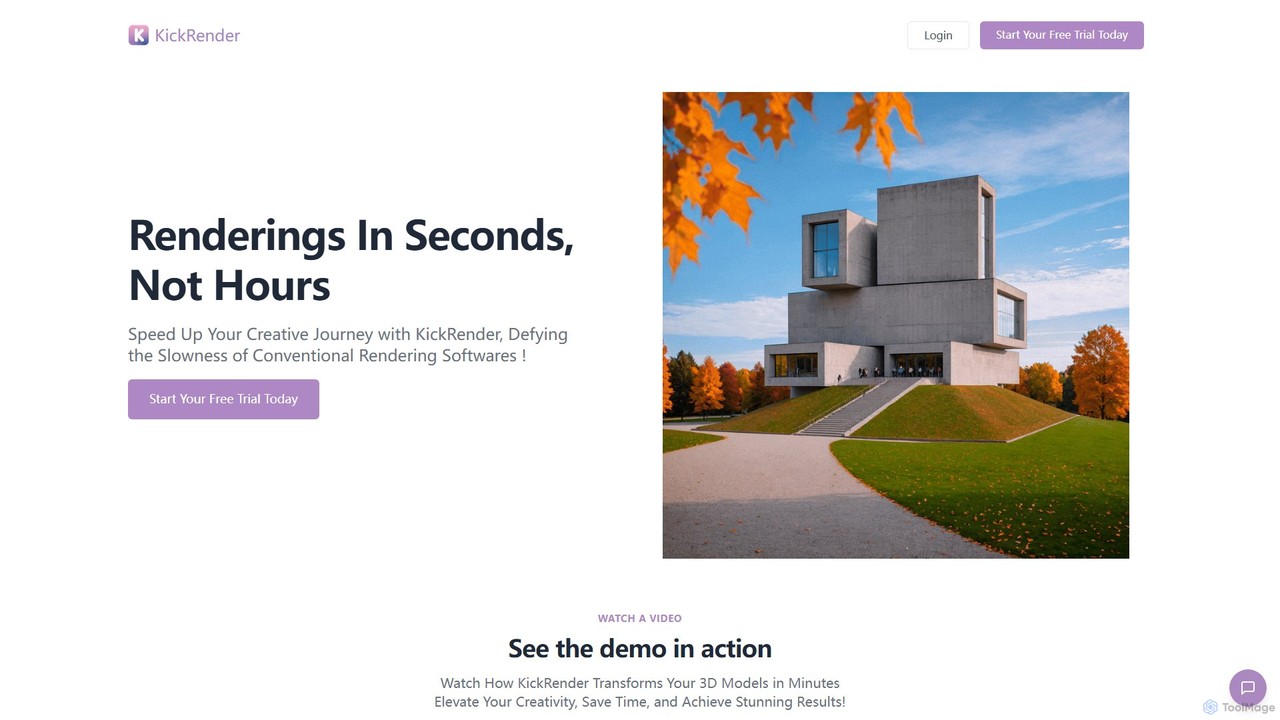
KickRender is an AI-powered rendering tool that transforms 3D models and sketches into stunning visualizations in seconds. It integrates seamlessly with Rhino and supports image uploads from Archicad, Revit, and Sketchup. By using simple text prompts, designers and architects can rapidly iterate on ideas, bypassing the slow process of traditional rendering.
About 3D Rendering
AI 3D Rendering tools are advanced software solutions that leverage artificial intelligence to generate photorealistic or stylized three-dimensional images and animations from 3D models. These tools utilize sophisticated algorithms, often incorporating machine learning and neural networks, to automate complex rendering processes like lighting, texturing, and shading. They significantly accelerate the visualization workflow for designers, architects, game developers, and artists, enabling faster iterations and higher-quality visual outputs with reduced manual effort.
Core Features
- Automated Lighting & Shadows: AI intelligently calculates and applies realistic lighting schemes and accurate shadows based on scene context.
- Material & Texture Generation: Automatically creates and applies high-fidelity textures and material properties, often from simple text prompts or reference images.
- Real-time Previews: Provides instant visual feedback during the design process, allowing for quick adjustments and creative exploration.
- Scene Optimization: AI assists in optimizing camera angles, object placement, and overall scene composition for visually appealing results.
- Style Transfer & Upscaling: Applies specific artistic styles to renders or enhances resolution and detail of existing 3D outputs.
Use Cases
These tools are indispensable across various creative and technical fields. They are widely used in architectural visualization to present building designs, in product design for creating realistic prototypes, and in game development for generating immersive environments and character assets. Marketing professionals also utilize them to produce compelling visuals for advertising campaigns without the need for physical product photography.
How to Choose
When selecting an AI 3D Rendering tool, consider its rendering speed and output quality, which directly impact project timelines and visual fidelity. Evaluate its compatibility with your existing 3D modeling software and supported file formats. Ease of use and the learning curve are crucial for efficient integration into your workflow, as are the pricing model and the availability of specific features like real-time rendering or advanced material libraries.
3D RenderingUse Cases
Architectural Project Visualization
Architects and interior designers use AI 3D rendering to quickly generate photorealistic images and walkthroughs of proposed buildings or spaces. This allows clients to visualize designs with accurate lighting, materials, and environmental context, facilitating faster feedback and design iterations, significantly reducing the time spent on manual rendering.
Product Design & Prototyping
Industrial designers and manufacturers leverage these tools to create high-fidelity visual prototypes of new products. By inputting 3D models, they can rapidly render various material finishes, lighting conditions, and product configurations, enabling efficient design validation and marketing material creation before physical production.
Game Environment & Asset Creation
Game developers utilize AI 3D rendering to accelerate the creation of immersive game worlds, characters, and props. AI can quickly generate detailed textures, optimize scene lighting, and render complex environments, drastically cutting down asset production time and allowing artists to focus on creative aspects rather than technical rendering challenges.
Film & Animation Pre-visualization
Filmmakers and animators employ AI rendering for pre-visualization (pre-vis) to plan shots, lighting, and camera movements efficiently. This allows for rapid iteration on scene compositions and visual storytelling without the lengthy render times of final production, streamlining the animation pipeline and reducing production costs.
Marketing & Advertising Visuals
Marketing teams and advertisers use AI 3D rendering to produce stunning visuals for campaigns, product launches, and digital content. They can create realistic product shots, lifestyle imagery, or abstract concepts without the expense and logistics of traditional photography or videography, offering flexibility and speed in content creation.
E-commerce Product Imagery
Online retailers and e-commerce businesses benefit from AI 3D rendering to generate high-quality product images from 3D models. This enables them to display products from multiple angles, with different color variations or in various simulated environments, enhancing the online shopping experience and reducing the need for costly photoshoots.