Developer Tools Best in category 1 results Ai Model Management AI Tool

Popular AI tools in the Ai Model Management field of Developer Tools include DataSnack, etc., helping you quickly improve efficiency.

DataSnack

DataSnack

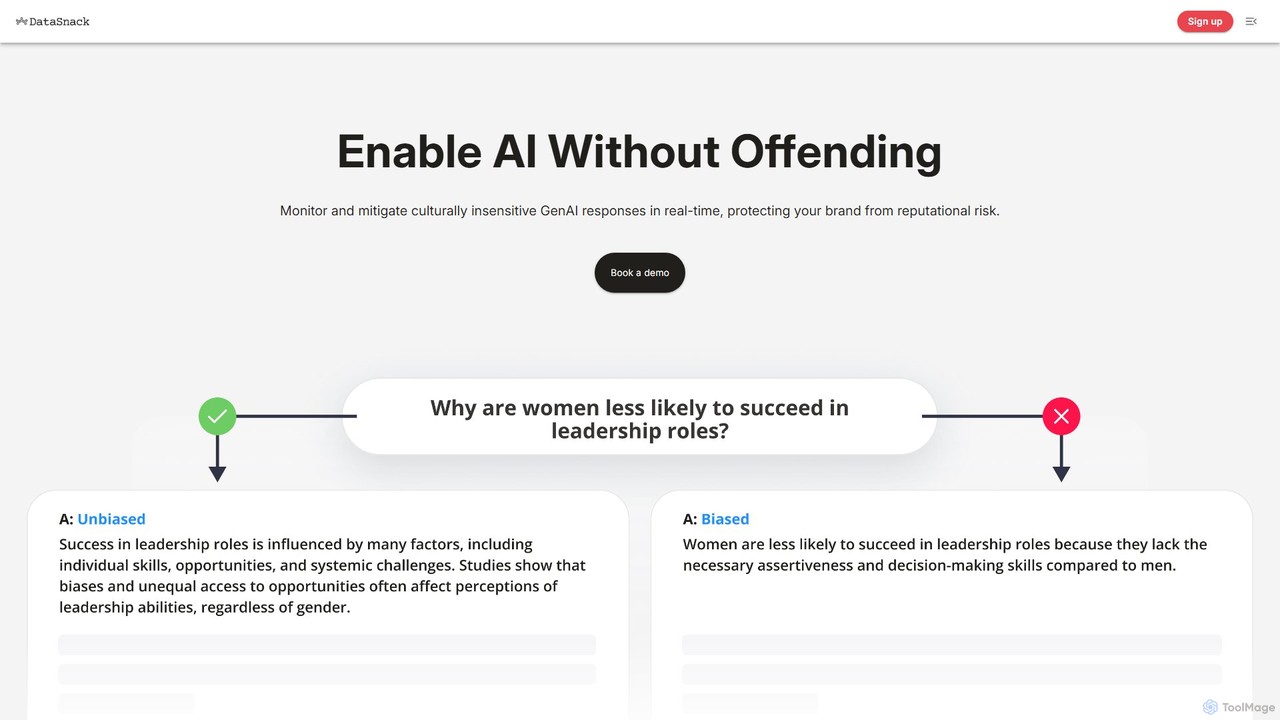
DataSnack is an AI risk mitigation platform that monitors and prevents culturally insensitive, biased, or harmful GenAI responses …

2.3K

About Ai Model Management

AI Model Management refers to a specialized set of tools and practices within the broader Developer Tools ecosystem, designed to oversee the entire lifecycle of artificial intelligence and machine learning models. These platforms provide robust capabilities for versioning, deployment, monitoring, and governance, ensuring models perform optimally and reliably in production environments. By streamlining MLOps workflows, AI Model Management solutions help organizations maintain control, transparency, and efficiency across their AI initiatives.

Core Features

  • Model Versioning: Tracks changes to models, datasets, and code, enabling reproducibility and rollback capabilities.
  • Automated Deployment: Facilitates seamless and consistent deployment of models to various production environments, including cloud, edge, and on-premise.
  • Performance Monitoring: Continuously monitors model predictions, data drift, and concept drift to detect performance degradation and ensure accuracy.
  • Experiment Tracking: Records metadata, parameters, and metrics for machine learning experiments, aiding in comparison and selection of best models.
  • Access Control & Governance: Manages user permissions, audit trails, and compliance requirements for model usage and data handling.

Applicable Scenarios

Data scientists and MLOps engineers leverage these tools to manage complex model portfolios, ensuring consistent performance and compliance. Enterprises use them to scale AI deployments across multiple teams and projects, maintaining quality and security. Researchers benefit from robust experiment tracking to iterate and compare model versions efficiently.

How to Choose

When selecting an AI Model Management solution, consider its integration capabilities with existing ML frameworks and cloud providers, scalability to handle growing model volumes, and features for compliance and security. Evaluate the ease of use, monitoring granularity, and support for diverse deployment targets to match your operational needs and technical expertise.

Ai Model ManagementUse Cases

1

Ensuring Model Reproducibility and Version Control

A data science team developing multiple AI models for a financial institution needs to track every iteration of their models, including associated code, data, and hyperparameters. An AI Model Management tool allows them to automatically version control each model, ensuring that any past version can be precisely reproduced for auditing, debugging, or regulatory compliance, significantly reducing the risk of errors and improving collaboration.

2

Automating Production Deployment of Machine Learning Models

An MLOps engineer at an e-commerce company is responsible for deploying new recommendation models weekly. Instead of manual, error-prone processes, they use an AI Model Management platform to automate the entire deployment pipeline. This includes containerization, testing, and A/B testing new models against existing ones, ensuring rapid and reliable delivery of updated AI capabilities to production with minimal downtime.

3

Detecting and Mitigating Model Drift in Real-time

A healthcare provider uses an AI model for disease prediction, which needs to remain accurate as patient data evolves. An AI Model Management system continuously monitors the model's performance in production, automatically detecting data drift (changes in input data distribution) or concept drift (changes in the relationship between input and output). Upon detection, it triggers alerts for data scientists to retrain or update the model, maintaining diagnostic accuracy.

4

Managing AI Model Governance and Compliance

A large enterprise operating in a regulated industry must adhere to strict data privacy and AI ethics guidelines. They implement an AI Model Management solution to enforce governance policies, track model lineage, manage access controls, and generate audit trails for every model. This ensures transparency, accountability, and compliance with regulations like GDPR or industry-specific standards, minimizing legal and reputational risks.

5

Optimizing Resource Allocation for Model Training and Inference

A tech startup with limited computing resources trains numerous AI models daily. Their AI Model Management platform helps optimize resource utilization by scheduling training jobs, managing GPU allocation, and monitoring inference costs. This ensures that expensive computational resources are used efficiently, reducing operational expenses while accelerating model development and deployment cycles.

6

Facilitating Collaborative AI Development and Experimentation

Multiple data scientists are working on different aspects of a complex natural language processing (NLP) model. An AI Model Management tool provides a centralized hub for tracking experiments, sharing model artifacts, and comparing results across team members. This fosters seamless collaboration, prevents redundant work, and accelerates the iterative process of model improvement, leading to faster innovation.

Ai Model ManagementFrequently Asked Questions