PromptFolder
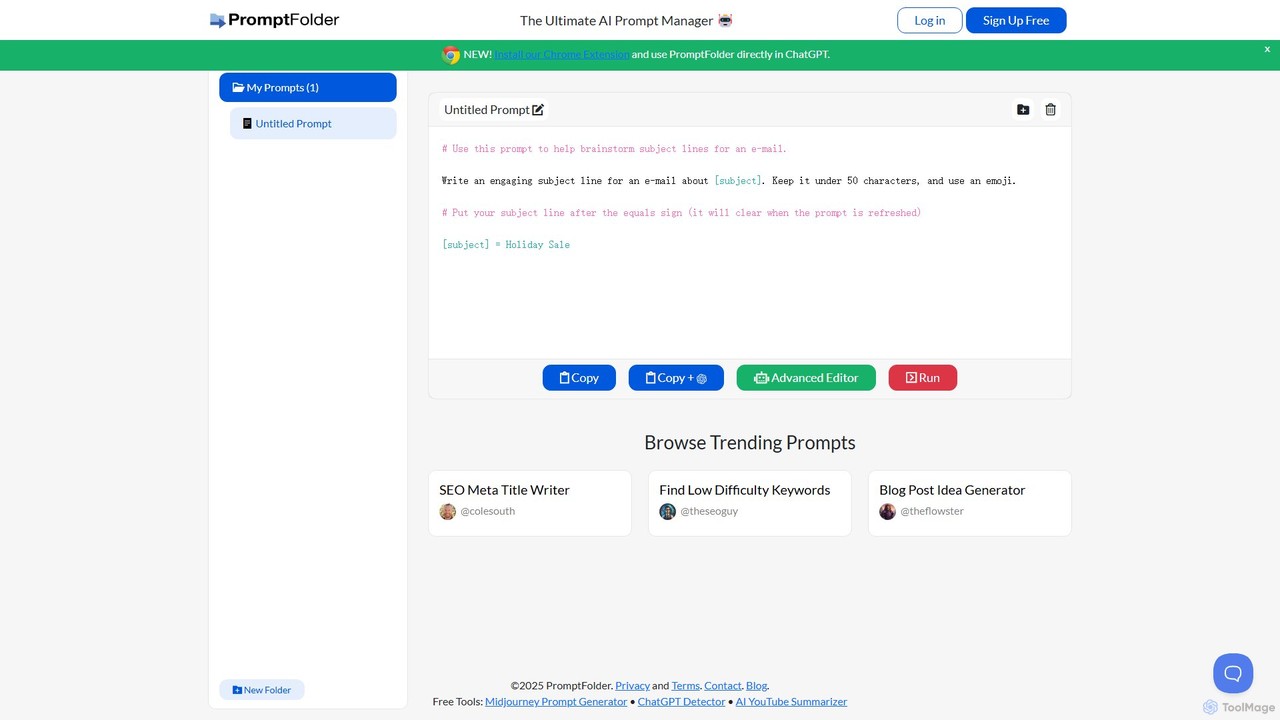
PromptFolder is a powerful AI prompt manager for ChatGPT, Midjourney, and other AI tools. It allows you to …
PromptFolder is a powerful AI prompt manager for ChatGPT, Midjourney, and other AI tools. It allows you to save, organize, and reuse your best prompts with features like folders, variables, and a dedicated Midjourney prompt builder. With its Chrome extension, you can access your entire prompt library directly within the ChatGPT interface, streamlining your workflow and boosting productivity.
About Ai Tooling
AI Tooling refers to a specialized category of software and platforms designed to assist developers in building, deploying, and managing artificial intelligence applications. These tools provide essential functionalities for every stage of the AI development lifecycle, from data preparation and model training to inference optimization and production monitoring. They empower developers to streamline complex AI workflows, accelerate innovation, and bring intelligent solutions to market more efficiently within the broader scope of developer tools.
Core Features
- Model Development & Training: Provides frameworks, libraries, and environments for building, training, and fine-tuning AI models.
- Data Management & Annotation: Offers tools for collecting, cleaning, labeling, and transforming large datasets crucial for model performance.
- Deployment & Inference: Facilitates the packaging, deployment, and scaling of AI models into production environments, often with optimized inference engines.
- Monitoring & MLOps: Enables tracking model performance, detecting drift, and managing the entire machine learning operations pipeline for continuous improvement.
- Experiment Tracking & Versioning: Helps developers manage different model versions, track experiment parameters, and reproduce results effectively.
Use Cases
AI Tooling is indispensable for data scientists, machine learning engineers, and AI researchers. They are used in scenarios like developing custom recommendation engines for e-commerce platforms, building robust computer vision systems for autonomous vehicles, or creating natural language processing models for advanced chatbots and virtual assistants.
How to Choose
When selecting AI Tooling, consider its compatibility with your existing tech stack and preferred AI frameworks. Evaluate the scalability and performance capabilities for handling large datasets and complex models. Assess the ease of integration with other development tools and cloud services. Finally, examine the community support, documentation, and pricing structure to ensure long-term viability and cost-effectiveness.
Ai ToolingUse Cases
Accelerating Custom AI Model Development
Machine learning engineers leverage AI tooling platforms to rapidly prototype, train, and validate custom AI models. By utilizing integrated development environments, automated hyperparameter tuning, and distributed training capabilities, they can significantly reduce the time spent on iterative model refinement, leading to faster deployment of specialized AI solutions for unique business challenges.
Streamlining Data Annotation for Computer Vision
Data scientists working on computer vision projects use AI tooling for efficient data annotation. These tools provide intuitive interfaces for labeling images or video frames, often incorporating AI-assisted pre-labeling features. This drastically cuts down the manual effort required to prepare high-quality, labeled datasets, which are critical for training accurate object detection or image segmentation models.
Deploying & Managing AI Models in Production
DevOps engineers and MLOps specialists utilize AI tooling to seamlessly deploy trained AI models into production environments, whether on-premise or in the cloud. These tools offer features like containerization, API endpoint creation, and auto-scaling, ensuring models are accessible, performant, and reliable for real-time inference, while simplifying version control and rollback procedures.
Optimizing Model Performance for Edge Devices
Embedded systems developers employ specialized AI tooling to optimize large AI models for deployment on resource-constrained edge devices. These tools facilitate model quantization, pruning, and compilation into highly efficient formats. This enables the execution of complex AI tasks directly on devices like IoT sensors or mobile phones, reducing latency and reliance on cloud connectivity.
Monitoring & Maintaining AI Model Health
AI operations teams use AI tooling dashboards and alerts to continuously monitor the performance and health of deployed AI models. They track metrics like prediction accuracy, data drift, and model bias over time. This proactive monitoring allows for early detection of issues, enabling timely retraining or recalibration to maintain model integrity and business value.
Experiment Tracking and Reproducibility in Research
AI researchers and data scientists rely on AI tooling for comprehensive experiment tracking and ensuring reproducibility. These platforms automatically log code versions, dataset snapshots, hyperparameter configurations, and model metrics for each experiment. This systematic approach facilitates collaboration, simplifies debugging, and ensures that research findings can be consistently replicated and built upon.