ToolMage
Sign in

Best 1 Code Conversion AI tools for Developer Tools

Popular Code Conversion AI tools in Developer Tools include js2ts, helping you work more efficiently.

Free

js2ts

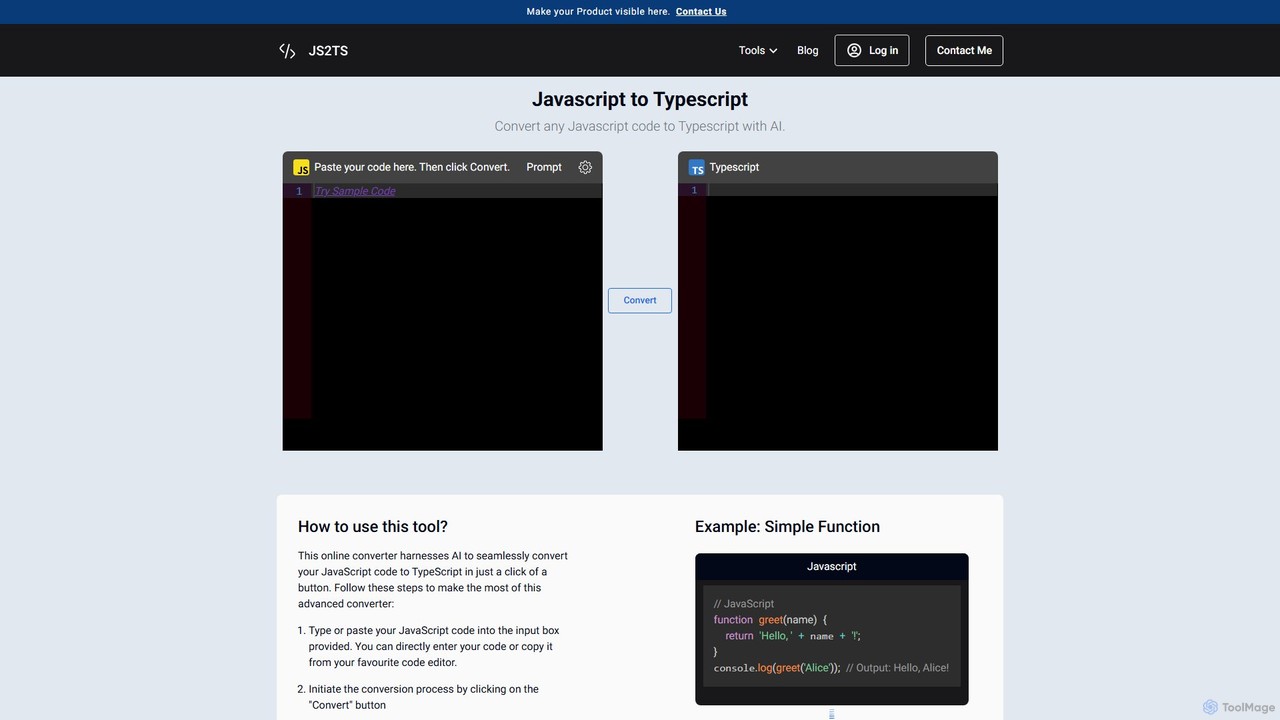
An AI-powered online tool for developers to instantly convert code between various formats, including JavaScript to TypeScript, JSON to TypeScript interfaces, CSS to JSON, and CSS to Tailwind CSS. It's free, fast, and requires no installation.

Code Conversion
Visits 12.9KFavorites 130Likes 121

About Code Conversion

Code Conversion tools are AI-powered solutions designed to automatically transform source code from one programming language or format into another. These tools leverage advanced AI models to understand code semantics, syntax, and logic, enabling seamless migration, interoperability, and modernization of software projects. They significantly reduce manual effort and potential errors in cross-language development and legacy system updates.

Core Features

  • Language Transpilation: Automatically converts code between different programming languages (e.g., Python to Java, Cto Go).
  • Syntax Adaptation: Adjusts code to match the specific syntax and conventions of the target language.
  • Semantic Preservation: Ensures the converted code maintains the original logic and functionality.
  • Framework/Library Mapping: Maps functions and structures from source frameworks to equivalent ones in the target environment.
  • Error Detection & Correction: Identifies and suggests fixes for conversion-related issues.

Use Cases

Developers and organizations utilize code conversion tools for various strategic initiatives. This includes migrating legacy applications to modern platforms, enabling cross-platform compatibility for software, and facilitating the integration of modules written in different languages. They are also valuable for learning new languages by converting familiar code snippets.

How to Choose

When selecting a code conversion tool, consider its supported languages and frameworks, the accuracy and quality of its output, and its ability to handle complex codebases. Evaluate its integration capabilities with existing development environments and its pricing model. User reviews and community support are also important indicators of reliability and effectiveness.

Featured tool rankings

Code Conversion use cases

1

Migrating Legacy Applications to Modern Stacks

An enterprise aims to modernize its outdated C++ backend to a more scalable Java microservices architecture. Code conversion tools automate the transformation of existing C++ code into Java, significantly reducing the manual refactoring effort and accelerating the migration timeline, while preserving core business logic.

2

Enabling Cross-Platform Development and Compatibility

A software team develops a core library in Python but needs to deploy it on a .NET environment. Using a code conversion tool, they can transpile the Python code to C, allowing the library to run natively within the .NET ecosystem without a complete rewrite, ensuring broader compatibility.

3

Refactoring for Performance Optimization

A developer identifies a performance bottleneck in a JavaScript module and decides to rewrite it in WebAssembly (Wasm) for faster execution. An AI code converter can assist by translating the JavaScript logic into a Wasm-compatible format, providing a strong starting point for optimization efforts.

4

Integrating Multi-Language Modules in a Project

A data science project uses R for statistical analysis, but the deployment environment is primarily Python-based. Code conversion tools can translate specific R scripts or functions into Python, enabling seamless integration of the analytical components into the larger Python application without maintaining separate execution environments.

5

Accelerating Learning of New Programming Languages

A seasoned developer familiar with Java wants to learn Go. By inputting small Java code snippets into a code conversion tool, they can see the equivalent Go syntax and structure, accelerating their understanding of the new language's paradigms and conventions through practical examples.

6

Standardizing Code Across Development Teams

A large organization has multiple development teams using different languages (e.g., Ruby, PHP) for similar functionalities. Code conversion tools can help standardize these functionalities into a single, preferred language (e.g., Python), simplifying maintenance, code reviews, and knowledge sharing across the organization.

Code Conversion FAQ

What are Code Conversion tools?

Code Conversion tools are AI-powered software solutions that automatically translate source code from one programming language or format to another. They analyze the original code's structure and semantics to generate functionally equivalent code in the target language, streamlining development workflows and facilitating system modernization.

How do AI Code Conversion tools work?

AI Code Conversion tools typically employ advanced machine learning models, often based on neural networks, trained on vast datasets of code in multiple languages. They parse the source code, build an abstract syntax tree (AST), and then generate new code in the target language while preserving the original logic and intent. This process often involves semantic analysis and pattern recognition.

What are the benefits of using Code Conversion tools?

The primary benefits include significant time and cost savings by automating tedious manual refactoring, reducing human error, and accelerating project timelines for migrations and integrations. They also improve code consistency, enable interoperability between different systems, and extend the lifespan of legacy applications by moving them to modern stacks.

How accurate are AI Code Conversion tools?

The accuracy of AI Code Conversion tools varies depending on the complexity of the source code, the specific language pair, and the sophistication of the AI model. While they can provide a highly accurate starting point, especially for common patterns, human review and refinement are almost always necessary to ensure full functional equivalence, optimal performance, and adherence to best practices in the target language.

Code Conversion vs. Code Transpilation: What's the difference?

Code conversion is a broader term encompassing any transformation of code from one form to another. Transpilation (or source-to-source compilation) is a specific type of code conversion where source code written in one language is translated into source code in another language, typically one that is at a similar level of abstraction (e.g., TypeScript to JavaScript). All transpilers are code converters, but not all code converters are transpilers (e.g., converting code to bytecode is not transpilation).