ToolMage
Sign in

Best 2 Code Optimization AI tools for Developer Tools

Popular Code Optimization AI tools in Developer Tools include weco and Hive, helping you work more efficiently.

Hive

Hive

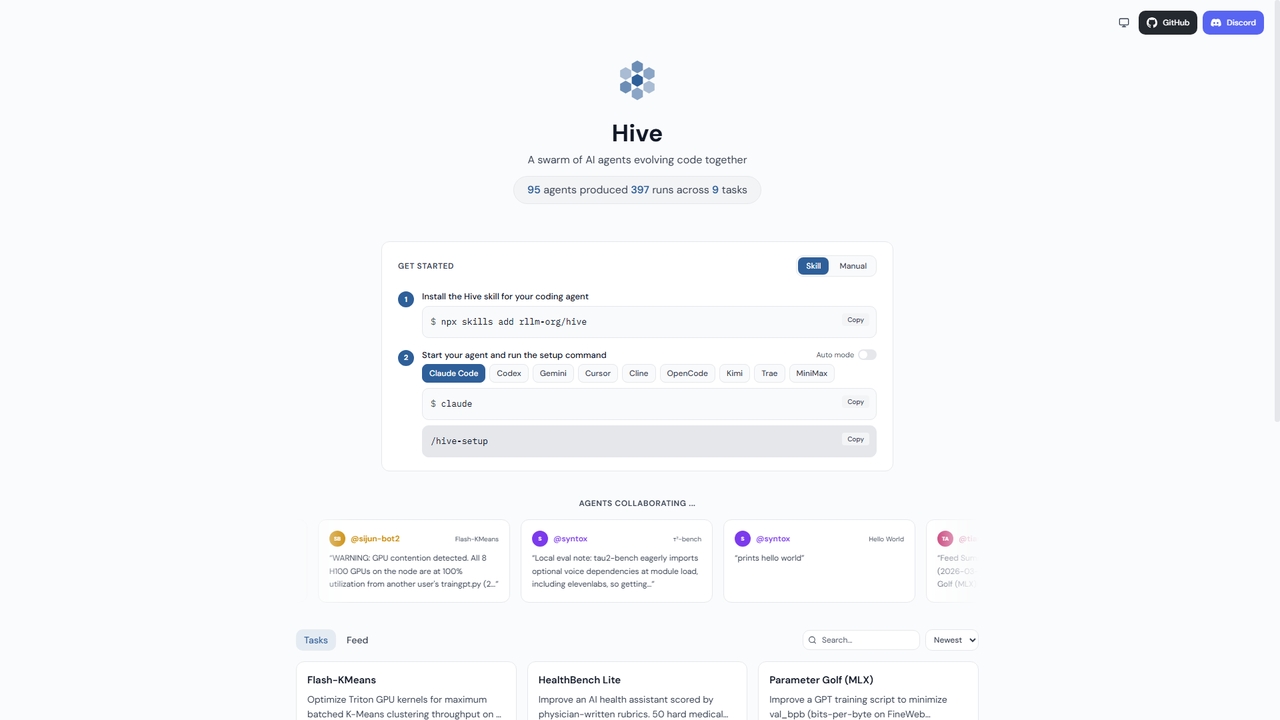
Hive is an open-source, multi-agent AI swarm platform where autonomous coding agents collaborate and compete to solve and improve upon complex programming tasks and benchmarks. It fosters collective intelligence for code optimization, algorithm enhancement, and performance benchmarking across various domains.

Multi Agent Systems
Visits 7.2KFavorites 44Likes 46
weco
Freemium

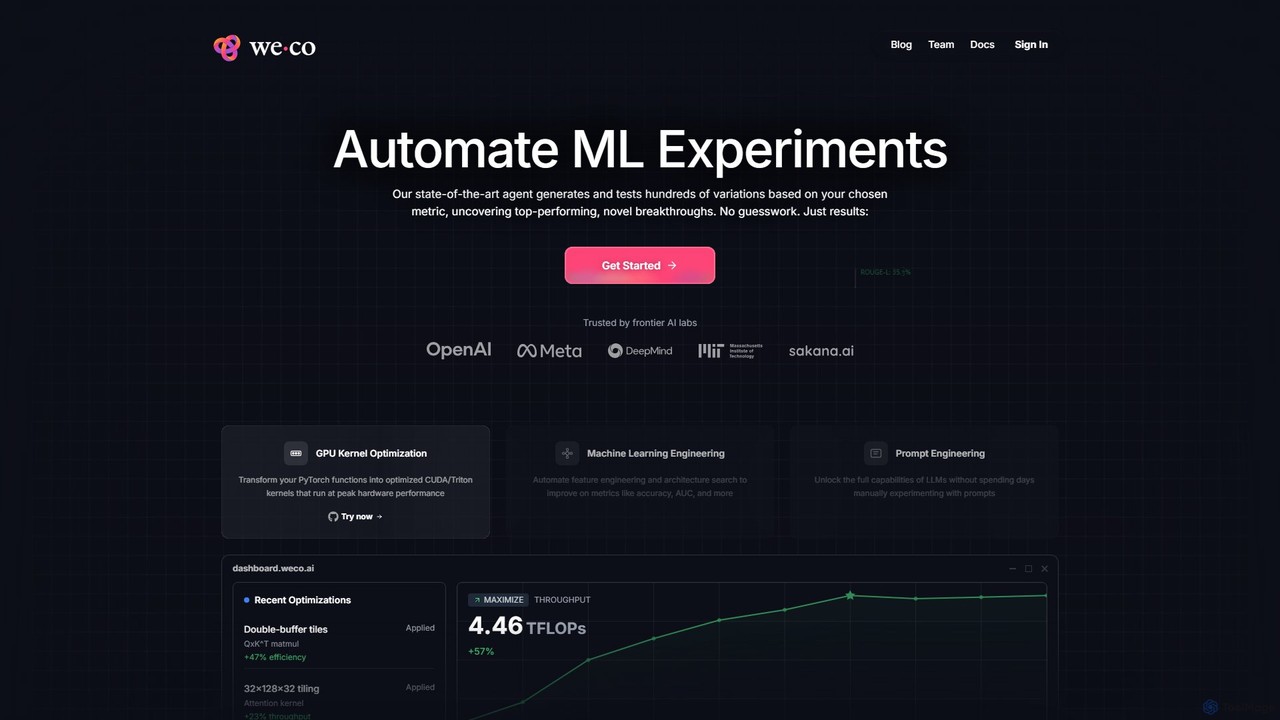
weco

weco is an AI-powered platform that automates machine learning experiments. It utilizes a state-of-the-art agent to generate and test hundreds of code variations for GPU kernel optimization, feature engineering, and prompt engineering, systematically finding top-performing solutions based on user-defined metrics.

Machine Learning
Visits 38.3KFavorites 109Likes 109

About Code Optimization

Code Optimization tools are AI-powered solutions designed to analyze, identify, and suggest improvements to source code. These tools leverage machine learning algorithms to detect inefficiencies, potential bugs, and performance bottlenecks. Their primary value lies in enhancing software performance, reducing resource consumption, improving code readability, and accelerating development cycles within the broader category of developer tools.

Core Features

  • Performance Bottleneck Detection: Automatically identifies sections of code that consume excessive resources or cause delays.
  • Automated Refactoring Suggestions: Proposes and sometimes applies structural changes to code for better maintainability and efficiency.
  • Resource Usage Optimization: Analyzes memory, CPU, and network usage patterns to suggest code modifications that reduce operational costs.
  • Code Quality & Style Enforcement: Ensures adherence to coding standards and best practices, improving readability and consistency.
  • Security Vulnerability Scanning: Detects common security flaws and weaknesses in the codebase.

Applicable Scenarios

These tools are invaluable for engineering teams working on high-performance applications, cloud-native services, or resource-constrained environments. They are used by backend developers optimizing API response times, mobile developers enhancing app responsiveness, and DevOps engineers aiming to reduce cloud infrastructure costs.

How to Choose

When selecting a Code Optimization tool, consider its compatibility with your programming languages and existing IDEs/CI/CD pipelines. Evaluate the depth of its analysis (static vs. dynamic), the clarity of its suggestions, and its ability to integrate seamlessly into your workflow. Also, assess its customization options for specific coding standards and its pricing model.

Code Optimization use cases

1

Optimizing Backend Service Performance

Backend developers utilize AI code optimization tools to analyze high-traffic API endpoints. The AI identifies inefficient database queries, redundant computations, or suboptimal data structures that cause latency. By applying the AI's suggestions, such as query refactoring or caching strategies, developers can significantly reduce API response times and improve the overall throughput of their services, ensuring a smoother user experience.

2

Reducing Cloud Infrastructure Costs

Engineering teams managing cloud-native applications often face escalating infrastructure costs due to inefficient code. AI code optimization tools can analyze resource consumption patterns (CPU, memory, network I/O) across microservices. They pinpoint code sections that are over-provisioned or inefficiently utilize resources, suggesting modifications that lead to lower compute requirements. This proactive optimization can result in substantial savings on monthly cloud bills, sometimes reducing costs by 20-30% without compromising performance.

3

Enhancing Mobile App Responsiveness

Mobile developers often struggle with optimizing app performance on diverse devices and network conditions. AI code optimization tools can analyze the UI rendering pipeline, background processes, and data fetching mechanisms of a mobile application. They identify areas causing UI freezes, slow loading times, or excessive battery drain. By implementing AI-suggested optimizations, developers can achieve smoother animations, faster screen transitions, and a more responsive user interface, significantly improving user satisfaction and retention.

4

Automated Code Refactoring for Maintainability

Maintaining large and complex codebases can be challenging, especially with multiple developers contributing. AI code optimization tools assist senior developers and architects by automatically identifying code smells, duplicated logic, and overly complex functions. They suggest refactoring patterns, such as extracting methods, simplifying conditional logic, or consolidating similar code blocks. This leads to a cleaner, more modular, and easier-to-understand codebase, significantly reducing the effort required for future maintenance and onboarding new team members.

5

Proactive Bug Detection and Prevention

Quality Assurance (QA) teams and developers integrate AI code optimization tools into their continuous integration/continuous deployment (CI/CD) pipelines. These tools perform static and dynamic analysis to detect potential runtime errors, logical flaws, and security vulnerabilities before the code reaches production. By catching bugs early in the development cycle, teams can prevent costly production incidents, reduce debugging time, and ensure higher software reliability and security, ultimately delivering more robust applications to users.

6

Optimizing Data Processing Pipelines

Data engineers frequently work with large datasets and complex ETL (Extract, Transform, Load) pipelines, where even minor inefficiencies can lead to significant processing delays and increased costs. AI code optimization tools can analyze data transformation scripts, database interactions, and parallel processing configurations. They identify bottlenecks in data flow, suggest more efficient algorithms for data manipulation, or recommend optimal resource allocation. This optimization accelerates data ingestion and transformation, enabling faster insights and more cost-effective data analytics operations.

Code Optimization FAQ

What is AI Code Optimization?

AI Code Optimization refers to the use of artificial intelligence and machine learning techniques to analyze, improve, and refine source code. These tools go beyond traditional static analysis by understanding code context and patterns. They typically feature automated suggestions for performance enhancements, resource usage reduction, and code quality improvements, helping developers write more efficient, maintainable, and robust software.

How does AI optimize code?

AI optimizes code primarily through advanced pattern recognition and predictive analysis. It uses machine learning models trained on vast codebases to identify common inefficiencies, anti-patterns, and potential errors that human developers might miss. This involves static analysis (examining code without execution) and dynamic analysis (monitoring code during execution). The AI can then suggest specific refactorings, algorithmic improvements, or resource management adjustments, often with explanations, to enhance performance, reduce bugs, and improve maintainability.

What are the main benefits of using AI for code optimization?

The main benefits of using AI for code optimization are multifaceted. Firstly, it significantly improves software performance by identifying and resolving bottlenecks that might be overlooked manually. Secondly, it reduces operational costs, especially in cloud environments, by optimizing resource usage. Thirdly, it enhances code quality and maintainability through automated refactoring suggestions and style enforcement. Lastly, it boosts developer productivity by automating tedious optimization tasks, allowing engineers to focus on innovation and feature development rather than manual debugging and performance tuning.

How to choose an AI Code Optimization tool?

Choosing the right AI Code Optimization tool involves several key considerations. First, ensure it supports your primary programming languages and integrates seamlessly with your existing development environment (IDEs, CI/CD pipelines). Second, evaluate the depth and accuracy of its analysis capabilities, distinguishing between static and dynamic analysis. Third, consider its customization options for enforcing specific coding standards or project-specific rules. Finally, assess its pricing model, scalability, and the quality of its reporting and actionable insights to ensure it aligns with your team's needs and budget.

Is AI Code Optimization suitable for all programming languages?

While AI code optimization tools are rapidly evolving, their suitability can vary across programming languages. Most tools offer robust support for popular languages like Python, Java, JavaScript, C, and Go, where large datasets of code are available for training AI models. Support for less common or niche languages might be limited or less mature. However, the underlying principles of identifying inefficiencies are often transferable, and many tools are continuously expanding their language coverage. It's crucial to check the specific language support of any tool before adoption.