Atlassian
Atlassian provides an integrated suite of collaboration, development, and issue-tracking tools for teams of all sizes. Powered by …
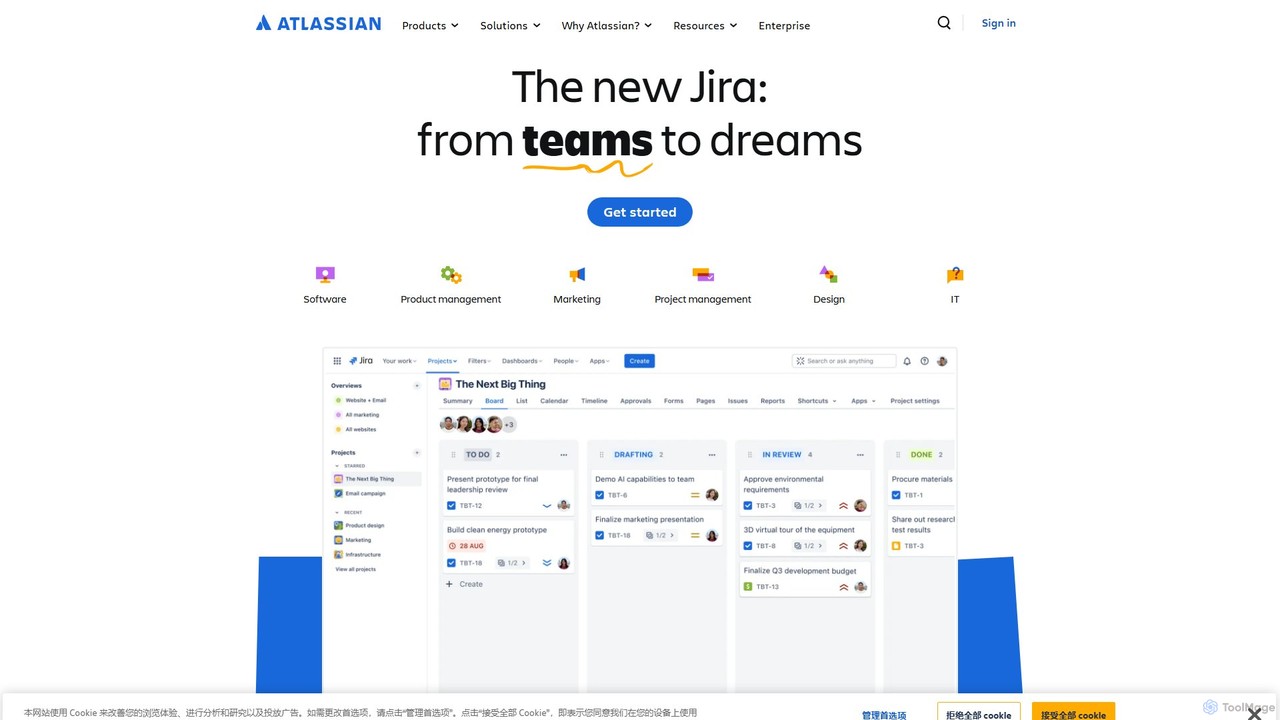
Atlassian provides an integrated suite of collaboration, development, and issue-tracking tools for teams of all sizes. Powered by Atlassian Intelligence, products like Jira, Confluence, and Trello help software, IT, and business teams plan, track, and deliver work more efficiently. It's a comprehensive platform designed to unleash the potential of every team through seamless integration and AI-driven productivity.
About Development Platforms
Development Platforms are AI-powered environments designed to streamline the entire lifecycle of AI application development, from data preparation and model training to deployment and monitoring. These platforms provide integrated tools and infrastructure, enabling developers and data scientists to build, test, and scale custom AI solutions more efficiently. As a specialized segment within Developer Tools, they empower teams to accelerate innovation and bring intelligent applications to market faster, reducing complexity and operational overhead.
Core Features
- Integrated Development Environment (IDE): Unified interface for coding, debugging, and managing AI projects.
- Model Training & Experimentation: Tools for data labeling, feature engineering, hyperparameter tuning, and tracking experiment results.
- Scalable Infrastructure: On-demand compute resources (GPUs, TPUs) for training large models and handling high inference loads.
- Model Deployment & MLOps: Capabilities for packaging, deploying, versioning, and monitoring AI models in production environments.
- API & SDK Access: Programmatic interfaces for integrating AI models and services into existing applications.
Applicable Scenarios
Development Platforms are crucial for enterprises building custom AI solutions, startups innovating with machine learning, and research institutions conducting advanced AI experiments. They support teams needing to manage complex AI workflows, ensure model governance, and rapidly iterate on intelligent products, from predictive analytics to generative AI applications.
How to Choose
When selecting an AI Development Platform, consider its support for various machine learning frameworks (e.g., TensorFlow, PyTorch), scalability options for data and compute, MLOps capabilities for production readiness, and ease of integration with existing systems. Evaluate the platform's cost model, community support, and the level of customization it offers to meet specific project requirements and team expertise.

Development PlatformsUse Cases
Accelerating Custom Predictive Model Development
Data science teams in financial institutions leverage AI Development Platforms to rapidly build and deploy custom predictive models for fraud detection or credit scoring. By utilizing integrated data pipelines, automated feature engineering, and scalable training infrastructure, they can iterate on model versions quickly, reducing development cycles from months to weeks and improving model accuracy for critical business decisions.
Streamlining MLOps for Production AI Applications
E-commerce companies use Development Platforms to implement robust MLOps practices for their recommendation engines. These platforms provide tools for continuous integration/continuous deployment (CI/CD) of models, automated monitoring of model performance drift, and A/B testing of new algorithms, ensuring that their AI-driven product recommendations remain relevant and effective for millions of users.
Building and Deploying Generative AI Solutions
Content creation agencies or marketing teams utilize AI Development Platforms to develop and deploy custom generative AI models. This includes training models on proprietary data to generate unique marketing copy, product descriptions, or even synthetic media. The platforms offer the necessary computational power and deployment pipelines to bring these creative AI applications to market efficiently.
Developing Industry-Specific AI Solutions
Healthcare technology startups employ Development Platforms to create specialized AI solutions, such as image recognition models for medical diagnostics or natural language processing tools for clinical note analysis. The platforms provide secure environments for handling sensitive data, compliance features, and the flexibility to integrate with existing healthcare systems, accelerating the development of life-saving technologies.
Enabling Collaborative AI Research and Prototyping
Research and development departments within large corporations use Development Platforms to foster collaboration among AI researchers and engineers. These platforms offer shared workspaces, version control for models and code, and reproducible experiment tracking, allowing multiple teams to work concurrently on complex AI problems, share insights, and rapidly prototype new AI capabilities.
Optimizing Resource Utilization for AI Workloads
Cloud architects and DevOps engineers utilize Development Platforms to efficiently manage and optimize the underlying infrastructure for diverse AI workloads. Features like automated resource provisioning, cost monitoring, and workload scheduling ensure that GPU clusters are used effectively for training, while inference endpoints are scaled dynamically to meet demand, significantly reducing operational costs and improving resource efficiency.