boundaryml
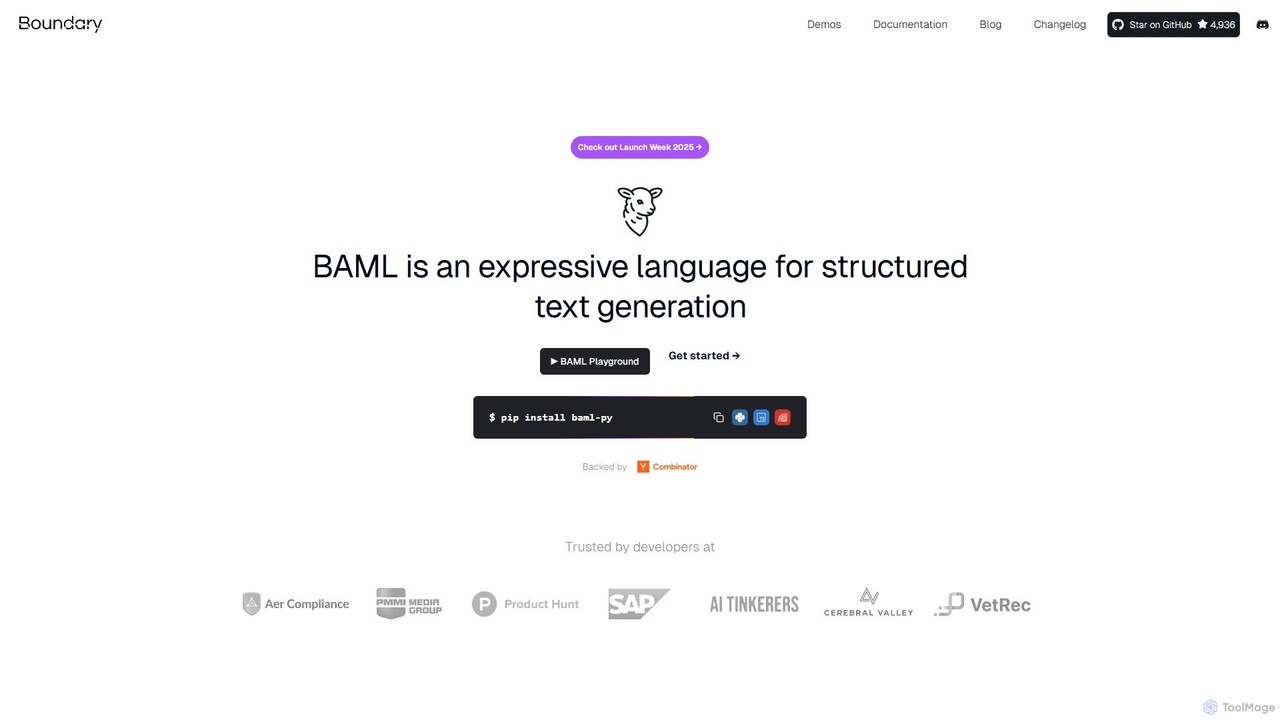
boundaryml (BAML) is a specialized programming language and toolkit for developers to reliably extract structured data from Large …
boundaryml (BAML) is a specialized programming language and toolkit for developers to reliably extract structured data from Large Language Models (LLMs). It transforms complex prompt engineering into a streamlined, code-like process, ensuring type-safe, error-corrected outputs across various LLMs and programming languages like Python and TypeScript. It's designed to enhance reliability, reduce costs, and accelerate development cycles for AI applications.
About Llm Framework
LLM Frameworks are specialized developer tools designed to simplify the creation, deployment, and management of applications powered by Large Language Models (LLMs). They provide structured interfaces, pre-built components, and best practices that abstract away the complexities of direct LLM interaction, advanced prompt engineering, and sophisticated data integration. These frameworks empower developers to build robust and scalable AI applications more efficiently, accelerating innovation in areas like intelligent agents, advanced chatbots, and complex data analysis pipelines.
Core Features
- Prompt Management: Streamline the creation, versioning, and optimization of prompts, allowing developers to experiment and refine LLM inputs effectively.
- Chain Building: Orchestrate sequences of LLM calls, external tools, and custom data processing steps to construct complex, multi-turn conversational flows or automated workflows.
- RAG (Retrieval Augmented Generation) Integration: Facilitate the seamless retrieval of external, up-to-date knowledge from databases or documents to augment LLM responses, significantly improving accuracy and reducing hallucinations.
- Agent Development: Enable the creation of autonomous AI agents that can reason, plan, and execute actions by dynamically selecting and using various tools based on user input and environmental feedback.
- Observability & Evaluation: Provide comprehensive tools for monitoring LLM application performance, debugging interactions, and systematically evaluating response quality and adherence to desired outcomes.
Use Cases
Developers leverage LLM Frameworks to rapidly prototype and deploy AI-driven solutions across various domains. For instance, they are crucial for building advanced conversational AI assistants that can handle complex, multi-step queries by integrating external knowledge bases and executing specific actions. Additionally, these frameworks are used to create intelligent data processing pipelines that can summarize lengthy documents, extract specific entities, or generate detailed reports from unstructured text, significantly reducing manual effort and improving data insights.
How to Choose
When selecting an LLM Framework, consider its compatibility with your preferred Large Language Models and existing technical infrastructure. Evaluate its capabilities for advanced prompt engineering, robust RAG implementation, and sophisticated agent orchestration, ensuring it meets your application's specific complexity and scalability requirements. Look for strong community support, comprehensive documentation, and extensibility options to adapt the framework to evolving needs, alongside considerations for performance, security, and deployment flexibility across different environments.
Llm FrameworkUse Cases
Building Advanced Conversational AI
AI developers utilize LLM Frameworks to construct sophisticated chatbots and virtual assistants capable of understanding nuanced user queries and maintaining context across extended conversations. By integrating RAG components, these frameworks allow the chatbot to access and synthesize information from proprietary knowledge bases, providing accurate and up-to-date answers beyond its initial training data. This enables enterprises to deploy highly effective customer service agents or internal knowledge assistants that can resolve complex issues.
Automating Data Extraction and Summarization
Data analysts and content managers employ LLM Frameworks to automate the processing of large volumes of unstructured text data. The frameworks facilitate the creation of 'chains' that can ingest documents, extract key entities, summarize main points, and identify sentiment. This capability is invaluable for quickly gleaning insights from research papers, legal documents, customer feedback, or news articles, significantly reducing the manual effort required for data analysis and content curation.
Developing Intelligent Agents for Task Automation
Software engineers use LLM Frameworks to develop autonomous agents that can perform multi-step tasks by interacting with various tools and APIs. These agents can plan a sequence of actions, execute them, and adapt based on feedback, such as booking travel, managing project tasks, or orchestrating complex data workflows. The framework provides the scaffolding for the LLM to 'reason' and 'act,' transforming high-level instructions into concrete operational steps, enhancing productivity in complex operational environments.
Creating Custom Search and Q&A Systems
Product teams and information architects leverage LLM Frameworks to build highly customized search and question-answering systems for specific domains. By combining LLMs with vector databases and RAG techniques, these frameworks enable users to query vast amounts of internal documentation or specialized content in natural language. The system can then retrieve relevant passages and synthesize a concise, accurate answer, offering a superior user experience compared to traditional keyword-based search engines for specialized information retrieval.
Rapid Prototyping of LLM Applications
Innovators and researchers utilize LLM Frameworks for quickly prototyping new ideas and testing hypotheses involving Large Language Models. The modular nature and pre-built components of these frameworks drastically reduce the setup time and coding effort required to integrate LLMs into experimental applications. This allows for faster iteration cycles, enabling teams to validate concepts, gather user feedback, and refine their AI-powered solutions with unprecedented speed, accelerating the development lifecycle.
Integrating LLMs into Existing Software
Enterprise developers integrate LLM Frameworks into their existing software ecosystems to add advanced AI capabilities without a complete overhaul. The frameworks provide clear APIs and connectors that allow legacy systems or modern applications to leverage LLMs for tasks like intelligent content generation, personalized recommendations, or advanced analytics. This seamless integration enhances the functionality of current platforms, extending their value and providing new avenues for automation and user interaction within established business processes.