Skin Ollama
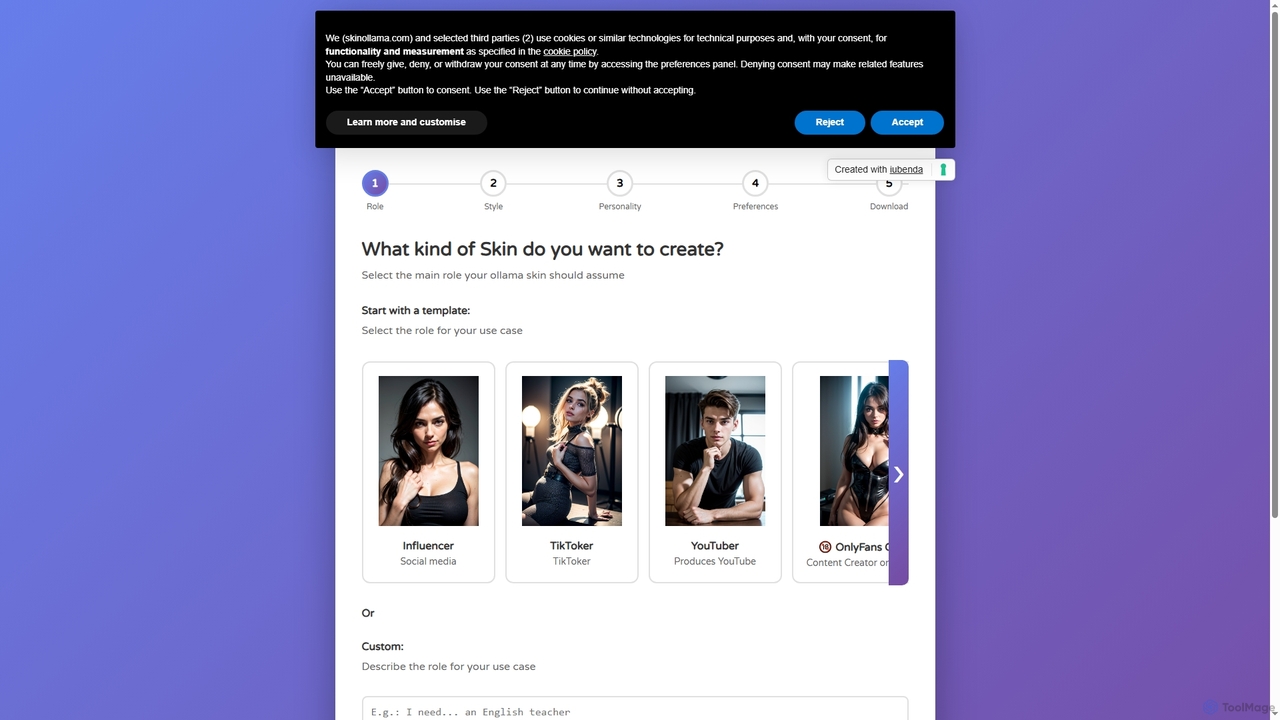
Skin Ollama is an intuitive online tool designed to customize Ollama AI models by building unique "skin files." …
Skin Ollama is an intuitive online tool designed to customize Ollama AI models by building unique "skin files." Users can define their AI's role, communication style, personality, and advanced preferences, enabling highly personalized interactions and specialized AI behaviors for various applications.
About Model Configuration
Model Configuration tools are specialized AI developer tools designed to define, adjust, and optimize the internal settings and architecture of artificial intelligence models. These tools enable developers to precisely control hyperparameters, network structures, and training parameters, which is crucial for achieving desired model performance, efficiency, and specific operational behaviors. They streamline the iterative process of model development, ensuring reproducibility and facilitating performance tuning for various AI applications.
Core Features
- Hyperparameter Tuning: Adjusting learning rates, batch sizes, optimizers, and regularization techniques to optimize model performance.
- Architecture Definition: Specifying neural network layers, activation functions, and model components for custom architectures.
- Training Pipeline Setup: Configuring data loading, preprocessing, validation splits, and early stopping criteria.
- Version Control & Reproducibility: Managing different model configurations and ensuring experiments can be replicated.
- Deployment Optimization: Setting parameters for model quantization, inference speed, and resource allocation in production environments.
Use Cases
Developers use Model Configuration tools to fine-tune pre-trained large language models for specific industry applications, ensuring domain-specific accuracy. They are also essential for configuring custom computer vision models to accurately detect unique objects in specialized datasets. Furthermore, these tools allow MLOps engineers to define and manage consistent model settings across development, staging, and production environments, ensuring seamless deployment and scalability.
How to Choose
When selecting Model Configuration tools, consider their compatibility with your existing AI frameworks (e.g., TensorFlow, PyTorch) and cloud platforms. Evaluate the granularity of control offered over various model parameters and the ease of defining complex architectures. Look for robust version control features to track changes and ensure reproducibility, alongside integration capabilities with MLOps pipelines for automated deployment and monitoring.

Model ConfigurationUse Cases
Optimizing Custom NLP Model Performance
An AI researcher uses Model Configuration tools to systematically adjust learning rates, batch sizes, and optimizer settings for a custom natural language processing model. This iterative process helps achieve higher accuracy and faster convergence on a specialized text classification dataset, significantly improving the model's ability to categorize domain-specific documents.
Fine-tuning Vision Models for Specific Objects
A computer vision engineer employs Model Configuration to adapt a pre-trained object detection model to identify rare medical anomalies in X-ray images. By configuring specific layers, adjusting regularization, and setting appropriate training schedules, the engineer enhances the model's sensitivity and precision for the unique visual patterns, leading to more reliable diagnostic support.
Configuring Generative AI for Artistic Styles
A digital artist or game developer utilizes Model Configuration to guide a generative adversarial network (GAN) or diffusion model towards producing images or textures in a particular artistic style. By tweaking architectural parameters and loss functions, they can control the output's aesthetic qualities, such as brushstroke patterns, color palettes, or thematic elements, aligning with creative visions.
Managing Model Variants for A/B Testing
An MLOps team uses Model Configuration to create and manage multiple versions of a recommendation engine, each with slightly different feature weights or inference parameters. These distinct configurations are then deployed for A/B testing in a production environment, allowing the team to evaluate which model variant performs best in terms of user engagement and conversion rates.
Reproducible Research & Experimentation
An academic researcher leverages Model Configuration tools to meticulously document and version control every parameter setting used in their AI experiments. This ensures that all research findings are fully reproducible, allowing other researchers to validate results and build upon the work with identical model setups, fostering transparency and scientific rigor.
Optimizing Edge Device Deployment
An embedded systems engineer configures a compact AI model for deployment on resource-constrained edge devices. Through Model Configuration, they apply techniques like quantization and pruning, adjusting precision levels and removing redundant connections. This process significantly reduces the model's memory footprint and computational demands, enabling efficient real-time inference on low-power hardware.