ToolMage
Sign in

Best 1 Model Hosting AI tools for Developer Tools

Popular Model Hosting AI tools in Developer Tools include Together AI, helping you work more efficiently.

Together AI
Freemium

Together AI

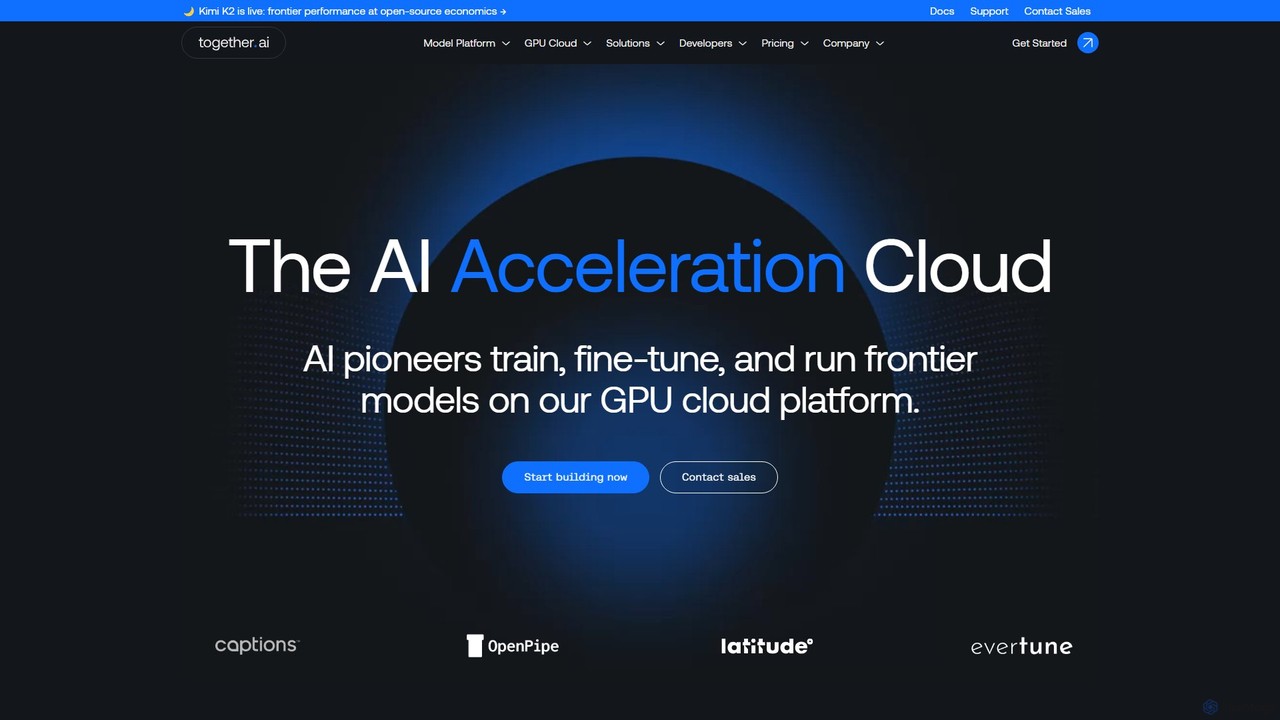
Together AI is a leading cloud platform for developers, providing fast, cost-effective infrastructure to run, fine-tune, and train open-source generative AI models. It offers an extensive library of over 200 models, serverless inference APIs, customizable fine-tuning, and dedicated GPU clusters, creating an end-to-end solution for building and scaling AI applications.

Gpu Infrastructure
Visits 760.2KFavorites 104Likes 100

About Model Hosting

Model Hosting platforms are specialized services designed to deploy, manage, and scale trained machine learning models. These platforms provide the necessary infrastructure to run models and expose them as accessible API endpoints for real-time inference. This allows developers to integrate AI capabilities into applications without managing complex server infrastructure, ensuring low latency and high availability. They often include features like auto-scaling, performance monitoring, and version management, streamlining the entire MLOps lifecycle from development to production.

Core Features

  • API Endpoint Creation: Instantly converts trained models into secure, callable REST APIs for easy application integration.
  • Auto-Scaling Infrastructure: Automatically adjusts compute resources based on real-time traffic to handle demand spikes and minimize costs.
  • Performance Monitoring: Provides dashboards to track key metrics like latency, throughput, and error rates for model optimization.
  • Model Versioning: Allows for managing and switching between different model versions seamlessly for A/B testing or rollbacks.
  • Hardware Acceleration: Offers access to specialized hardware like GPUs and TPUs for computationally intensive models.

Use Cases

Model Hosting is crucial for developers, data scientists, and businesses aiming to productionize machine learning models. Common applications include powering recommendation engines in e-commerce, running natural language processing for chatbots, providing real-time fraud detection in finance, and offering computer vision capabilities through a commercial API.

How to Choose

When selecting a Model Hosting service, consider its compatibility with your model's framework (e.g., TensorFlow, PyTorch, ONNX). Evaluate its scalability options and latency performance based on your expected traffic. Compare pricing models, such as pay-as-you-go versus subscription plans. Finally, assess the ease of use, including the deployment workflow and the quality of documentation and support.

Featured tool rankings

Model Hosting use cases

1

Powering a Real-Time Recommendation Engine

An e-commerce developer needs to integrate a personalized product recommendation model into their online store. They upload their trained model to a hosting platform, which automatically generates a scalable API endpoint. The e-commerce website's frontend calls this API with a user's browsing history. The model processes this data in milliseconds and returns a list of relevant product IDs. This allows the store to display dynamic, personalized recommendations, improving user engagement and increasing average order value without the overhead of managing and scaling GPU servers.

2

Deploying a Customer Support Chatbot

An AI engineer at a SaaS company needs to deploy a natural language understanding (NLU) model to power their support chatbot. Using a model hosting service, they deploy the model as a highly available API. The chatbot application sends user queries to this API and receives structured data like intent and entities in return. The platform's auto-scaling feature ensures the chatbot remains responsive even during peak support hours, handling thousands of concurrent conversations. The engineer can also monitor the API's latency and error rates to ensure a smooth user experience.

3

Offering a Commercial AI API Service

A startup has developed a proprietary image background removal model and wants to offer it as a paid service. They use a model hosting platform to deploy their model and create a public API. The platform handles user authentication with API keys, rate limiting to prevent abuse, and provides usage metrics that can be integrated with a billing system. This allows the startup to launch a scalable, reliable commercial product quickly, focusing on their core model technology instead of building and maintaining complex API infrastructure from the ground up.

4

Operationalizing an Internal Fraud Detection System

A data scientist in a FinTech company has built a model to detect fraudulent transactions. To put it into production, they deploy it on a secure, private model hosting environment. The company's transaction processing system makes a real-time API call to the model for every transaction. The model returns a risk score, and if the score exceeds a certain threshold, the transaction is flagged for manual review. This setup allows the company to reduce financial losses by blocking fraud in real-time with minimal latency, ensuring the core payment system remains fast and reliable.

5

A/B Testing New Language Models

A machine learning engineer wants to compare the performance of two different versions of a text summarization model. Using the model hosting platform's versioning feature, they deploy both models simultaneously under the same API endpoint. They configure traffic splitting to route 50% of user requests to the old model and 50% to the new one. Over a week, they use the platform's monitoring dashboard to compare key metrics like average latency and error rates for each version. This data-driven approach allows them to confidently decide which model version to promote to 100% of traffic.

6

Accelerating Scientific Research with GPU Inference

A computational biologist needs to run a complex protein folding prediction model that requires significant GPU power for inference. Instead of purchasing and maintaining expensive local hardware, they use a model hosting platform that offers GPU-accelerated instances. They deploy their model to a GPU-powered endpoint. Researchers in their lab can then submit protein sequences to this API from their analysis scripts, offloading the heavy computation to the cloud. This provides on-demand access to powerful hardware, significantly speeding up research cycles and enabling analyses that would be infeasible on standard CPUs.

Model Hosting FAQ

What is Model Hosting?

Model Hosting is a specialized cloud service for deploying, managing, and serving machine learning models as scalable API endpoints. Instead of just providing raw computing power, these platforms offer a managed environment specifically for ML inference. Key features include one-click deployment, automatic scaling to handle traffic fluctuations, performance monitoring, and model versioning. This allows developers and data scientists to focus on building models and applications rather than managing complex server infrastructure.

How is Model Hosting different from general cloud computing (like AWS EC2)?

General cloud computing (IaaS) like AWS EC2 provides raw virtual machines, requiring you to manually set up the environment, web server, scaling logic, and monitoring. Model Hosting platforms (PaaS/SaaS) are purpose-built for ML and abstract away this complexity. They offer a streamlined workflow: you upload a trained model, and the platform handles everything else, including creating a secure API, auto-scaling based on traffic, and providing ML-specific monitoring dashboards. This significantly reduces MLOps overhead and time to market.

What are the key factors for choosing a Model Hosting service?

When selecting a service, consider these four key factors:

  • Framework & Hardware Support: Ensure the platform supports your model's framework (e.g., TensorFlow, PyTorch, ONNX) and offers the necessary hardware (CPU, GPU, TPU) for your performance needs.
  • Scalability & Performance: Evaluate its auto-scaling capabilities. Can it handle sudden traffic spikes? Check its latency guarantees and server locations to ensure a fast response for your users.
  • Cost Structure: Compare pricing models. Some offer pay-per-use which is ideal for variable traffic, while others have fixed monthly costs. Understand the total cost of ownership, including data transfer and storage fees.
  • Developer Experience: Assess the ease of deployment. Does it have a user-friendly interface, a powerful CLI, or a client library? Good documentation and community support are also crucial.
Who typically uses Model Hosting platforms?

Model Hosting platforms are used by a wide range of roles and organizations. Key users include:

  • Machine Learning Engineers & Data Scientists: They use these platforms to quickly move their trained models from a research environment into a production-ready state.
  • Software Developers: They integrate the model APIs into web and mobile applications to add AI-powered features without needing deep ML expertise.
  • Startups & Small Businesses: They leverage these services to launch AI products quickly and cost-effectively, without large upfront investments in infrastructure.
  • Large Enterprises: They use them to manage and scale a large number of models for various internal systems, such as fraud detection, supply chain optimization, and customer service automation.
What is 'serverless' model hosting?

Serverless model hosting is an approach where the platform automatically manages all underlying infrastructure, scaling resources up from zero for each request and back down when idle. You don't need to provision or manage any servers. The key benefit is cost-efficiency; you only pay for the exact compute time used for inference, not for idle server time. This model is particularly well-suited for applications with intermittent or unpredictable traffic patterns, as it eliminates the cost of keeping a server running 24/7 for infrequent requests.