ToolMage
Sign in

Best 1 Model Testing AI tools for Developer Tools

Popular Model Testing AI tools in Developer Tools include DGAF, helping you work more efficiently.

DGAF
Freemium

DGAF

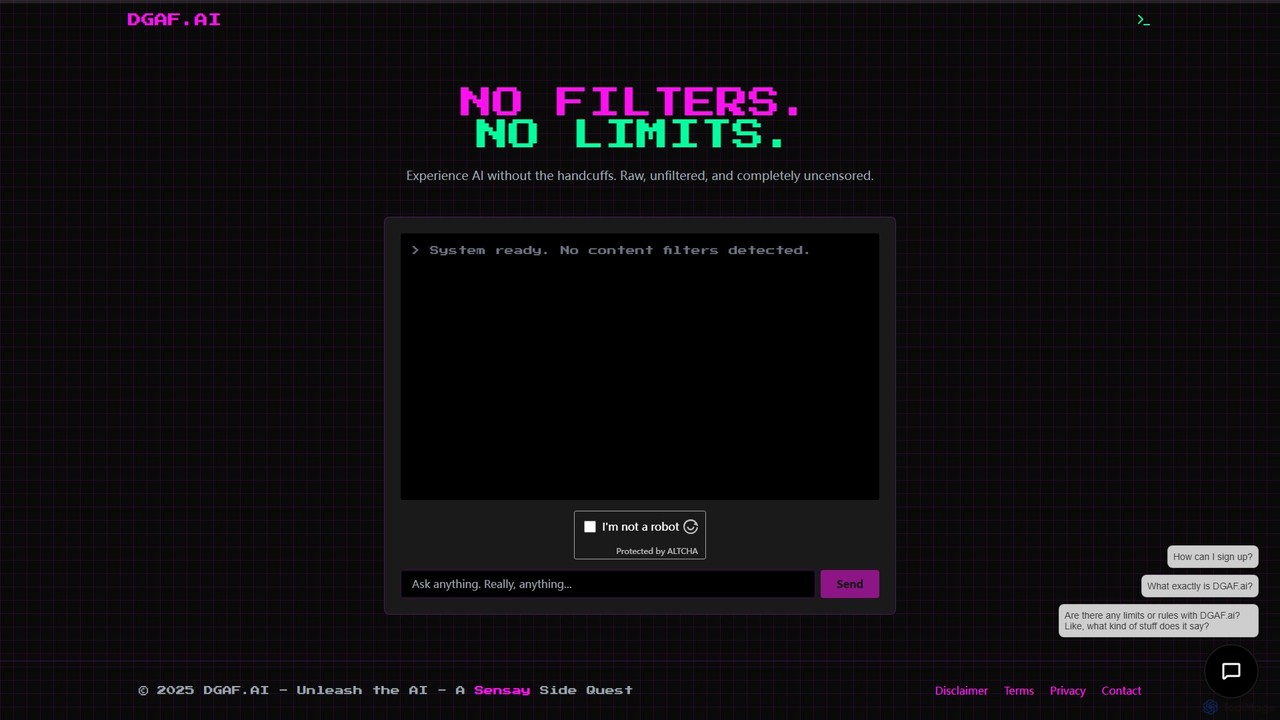
DGAF is an unfiltered and uncensored AI chat platform designed for users seeking absolute conversational freedom. It removes the typical restrictions and ethical filters found in mainstream AI, providing raw, direct, and limitless interactions for creative, exploratory, or entertainment purposes.

Uncensored Chat
Visits 7.3KFavorites 122Likes 122

About Model Testing

Model Testing tools are specialized AI-powered platforms designed to rigorously evaluate the performance, robustness, fairness, and reliability of machine learning models. These tools employ a range of techniques, from statistical analysis to adversarial attacks, to identify potential weaknesses, biases, and vulnerabilities before and after deployment. By providing comprehensive insights into model behavior, they enable developers and MLOps teams to build more trustworthy and effective AI systems, ensuring models perform as expected in real-world scenarios and meet regulatory standards.

Core Features

  • Performance Metrics & Evaluation: Comprehensive calculation and visualization of accuracy, precision, recall, F1-score, AUC, and custom metrics.
  • Bias Detection & Mitigation: Automated identification of unfair outcomes across different demographic groups and tools to suggest mitigation strategies.
  • Robustness & Adversarial Testing: Assessing model stability against noisy, perturbed, or maliciously crafted input data to prevent failures.
  • Explainability (XAI): Generating insights into how models make decisions, helping to understand feature importance and model logic.
  • Data Drift & Anomaly Detection: Monitoring changes in input data distribution over time that could degrade model performance.

Applicable Scenarios

Model Testing tools are essential for organizations deploying critical AI systems where reliability, fairness, and compliance are paramount. They are used by data scientists to validate new models, by MLOps engineers for continuous integration and deployment, and by compliance officers to ensure regulatory adherence. These tools are particularly vital in sectors like finance, healthcare, and autonomous driving, where model errors can have significant consequences.

How to Choose

When selecting a Model Testing tool, consider its compatibility with your existing ML frameworks (e.g., TensorFlow, PyTorch) and MLOps pipeline. Evaluate the range of tests offered, including bias detection, adversarial robustness, and explainability features. Look for comprehensive reporting and visualization capabilities, scalability to handle large datasets, and ease of integration into your development workflow. Finally, assess the community support and documentation for long-term maintainability.

Model Testing use cases

1

Ensuring Fair Lending Decisions with AI

Financial institutions use model testing tools to rigorously evaluate AI-powered credit scoring models. Data scientists apply bias detection tests to ensure that loan approval decisions are fair across various demographic groups, preventing discriminatory outcomes and complying with financial regulations. This proactive testing helps maintain public trust and avoid costly legal repercussions.

2

Validating Autonomous Vehicle Perception Models

Automotive engineers leverage model testing platforms to assess the robustness of AI perception models used in self-driving cars. They simulate diverse environmental conditions, edge cases, and adversarial attacks to ensure the models accurately identify objects, pedestrians, and road signs under challenging circumstances, significantly enhancing vehicle safety and reliability.

3

Continuous Monitoring for Healthcare AI Diagnostics

Healthcare providers deploy model testing tools to continuously monitor AI diagnostic models for performance degradation and data drift. MLOps teams receive alerts if a model's accuracy drops due to changes in patient data or medical imaging, allowing for timely retraining or intervention to maintain high diagnostic precision and patient safety.

4

Achieving Regulatory Compliance for AI in Pharma

Pharmaceutical companies utilize model testing to demonstrate the explainability and reliability of AI models used in drug discovery or clinical trial analysis. These tools generate audit trails and detailed explanations of model predictions, satisfying stringent regulatory requirements and accelerating the approval process for new treatments.

5

Optimizing Recommendation Engine Performance

E-commerce platforms employ model testing to compare and optimize different versions of AI recommendation engines. Product managers and data scientists conduct A/B tests within the testing environment, evaluating metrics like click-through rates and conversion lift, to identify the most effective model before rolling it out to millions of users, thereby maximizing revenue.

6

Detecting Data Quality Issues in Manufacturing AI

Manufacturing firms use model testing tools to identify and diagnose data quality issues that impact predictive maintenance AI models. Engineers can pinpoint anomalies or inconsistencies in sensor data that lead to inaccurate predictions of equipment failure, ensuring machines operate efficiently and reducing unexpected downtime.

Model Testing FAQ

What are AI Model Testing tools?

AI Model Testing tools are software solutions designed to systematically evaluate the performance, reliability, and ethical aspects of machine learning models. They help identify issues like bias, robustness vulnerabilities, and performance degradation, ensuring models are fit for purpose before and after deployment. These tools are crucial for building trustworthy and high-performing AI systems.

How do I choose the right Model Testing tool for my project?

When selecting a Model Testing tool, consider its compatibility with your existing ML stack (frameworks, cloud platforms), the types of tests it offers (e.g., bias, adversarial, explainability), and its integration capabilities with MLOps pipelines. Also, evaluate its scalability, reporting features, and the level of technical expertise required to operate it. Choose a tool that aligns with your specific model types and regulatory needs.

Why is Model Testing crucial in AI development?

Model Testing is crucial because it ensures the reliability, fairness, and safety of AI systems. Without rigorous testing, models can exhibit biases, be vulnerable to attacks, or perform poorly in real-world conditions, leading to financial losses, reputational damage, or even harm. It helps validate model integrity, meet regulatory compliance, and build user trust, ultimately leading to more successful AI deployments.

What types of tests can Model Testing tools perform?

Model Testing tools can perform various tests, including performance evaluation (accuracy, precision), bias detection (fairness metrics across groups), robustness testing (sensitivity to input perturbations), adversarial attack simulation, explainability analysis (LIME, SHAP), and data drift monitoring. Some advanced tools also offer causality analysis and anomaly detection to provide a holistic view of model health.

How do Model Testing tools integrate with MLOps pipelines?

Model Testing tools integrate with MLOps pipelines by automating the testing phase within the CI/CD process for machine learning. They can be triggered automatically upon model updates or data changes, providing continuous validation. This integration ensures that only thoroughly tested and validated models are deployed, and that deployed models are continuously monitored for performance and drift, enabling rapid iteration and reliable operations.