Developer Tools Best in category 1 results Observability & Monitoring AI Tool

Popular AI tools in the Observability & Monitoring field of Developer Tools include Langtrace, etc., helping you quickly improve efficiency.

Langtrace

Langtrace

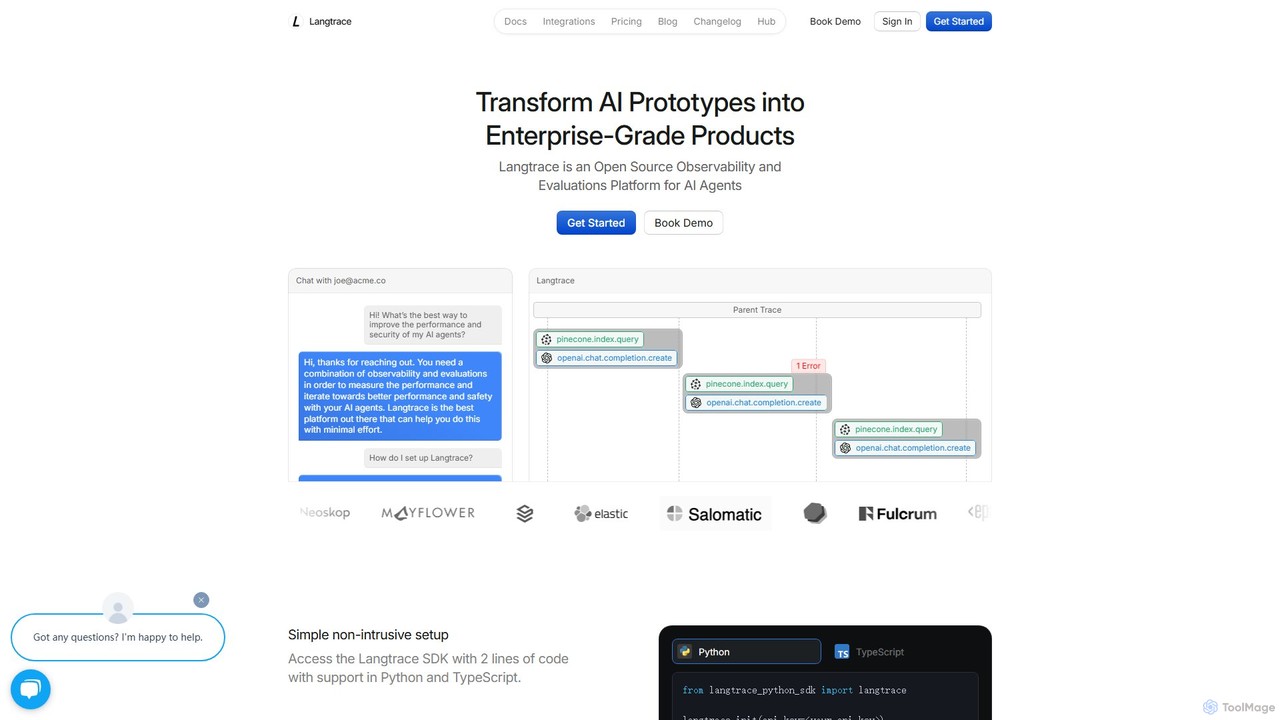
Langtrace is an open-source observability and evaluation platform for AI agents and LLM applications. It helps developers monitor, …

9.9K

About Observability & Monitoring

Observability & Monitoring tools are AI-powered solutions designed to provide deep insights into the internal states of complex systems, from applications to infrastructure. These tools leverage artificial intelligence and machine learning to collect, analyze, and visualize vast amounts of telemetry data—logs, metrics, and traces—enabling proactive identification of issues, performance bottlenecks, and security threats. They are crucial for maintaining system health, ensuring reliability, and optimizing resource utilization in modern, distributed environments.

Core Features

  • Real-time Data Ingestion: Collects and processes high-volume, high-velocity data streams from diverse sources instantly.
  • AI-driven Anomaly Detection: Automatically identifies unusual patterns and deviations from normal system behavior, often before human operators notice.
  • Predictive Analytics: Forecasts potential system failures or performance degradation based on historical data and trends.
  • Distributed Tracing: Provides end-to-end visibility into requests as they flow through complex microservices architectures.
  • Root Cause Analysis: Helps pinpoint the exact source of issues by correlating events across different system components.

Applicable Scenarios

These tools are indispensable for DevOps teams, Site Reliability Engineers (SREs), and IT operations personnel managing cloud-native applications, microservices, and complex distributed systems. They are used in scenarios ranging from ensuring application uptime and performance in e-commerce platforms to managing large-scale data processing pipelines and securing critical enterprise infrastructure.

How to Choose

When selecting an Observability & Monitoring tool, consider its compatibility with your existing technology stack and data sources, the depth and breadth of its AI/ML capabilities for anomaly detection and prediction, and its scalability to handle your data volume. Evaluate its integration with incident management systems, alert customization options, and the clarity of its dashboards and reporting features to ensure it meets your operational needs and budget.

Observability & MonitoringUse Cases

1

Proactive Anomaly Detection in Cloud Infrastructure

For cloud architects and SREs managing dynamic cloud environments, AI Observability & Monitoring tools continuously analyze metrics and logs from virtual machines, containers, and serverless functions. They automatically detect subtle anomalies, such as unusual CPU spikes or network latency, that might indicate an impending outage or performance degradation. This allows teams to investigate and resolve issues proactively, preventing service disruptions and maintaining high availability for critical applications.

2

Real-time Performance Monitoring for Microservices

Development and operations teams deploying microservices architectures rely on these tools to gain real-time visibility into service performance. By collecting distributed traces and metrics across hundreds of microservices, the tools can identify bottlenecks, latency issues, and error rates within specific service calls. This enables engineers to quickly pinpoint which service is causing a slowdown or failure, optimizing resource allocation and improving the overall responsiveness of complex applications.

3

Automated Root Cause Analysis for Incident Response

During critical incidents, IT operations and incident response teams use AI Observability & Monitoring tools to accelerate problem resolution. When an alert is triggered, the tools automatically correlate related logs, metrics, and traces across different systems, providing a consolidated view of the incident. This AI-driven correlation helps identify the root cause much faster than manual investigation, significantly reducing Mean Time To Resolution (MTTR) and minimizing business impact.

4

Capacity Planning and Resource Optimization

Infrastructure managers and financial operations (FinOps) teams utilize these tools for intelligent capacity planning and cost optimization. By analyzing historical usage patterns and predicting future resource needs, AI Observability & Monitoring solutions help determine optimal resource allocation for cloud and on-premise infrastructure. This prevents over-provisioning, reduces unnecessary cloud spend, and ensures that sufficient resources are available to handle peak loads without performance degradation.

5

Security Event Monitoring and Threat Detection

Security operations centers (SOCs) and cybersecurity analysts leverage these tools to enhance their threat detection capabilities. AI Observability & Monitoring platforms can ingest security logs, network traffic data, and user activity logs, applying machine learning to identify suspicious behaviors, unauthorized access attempts, or potential data breaches. This enables rapid detection and response to security incidents, strengthening an organization's overall security posture.

6

User Experience Monitoring (UEM) for Web Applications

Product managers and front-end developers use these tools to understand the real-world performance experienced by end-users of web applications. By monitoring browser performance metrics, page load times, and user interaction flows, AI Observability & Monitoring tools provide insights into user experience bottlenecks. This data helps prioritize development efforts, optimize front-end code, and ensure a smooth, responsive experience for all application users, directly impacting customer satisfaction.

Observability & MonitoringFrequently Asked Questions