ToolMage
Sign in

Best 1 On Premise Deployment AI tools for Developer Tools

Popular On Premise Deployment AI tools in Developer Tools include Bourdain Onsite AI, helping you work more efficiently.

Bourdain Onsite AI
Paid

Bourdain Onsite AI

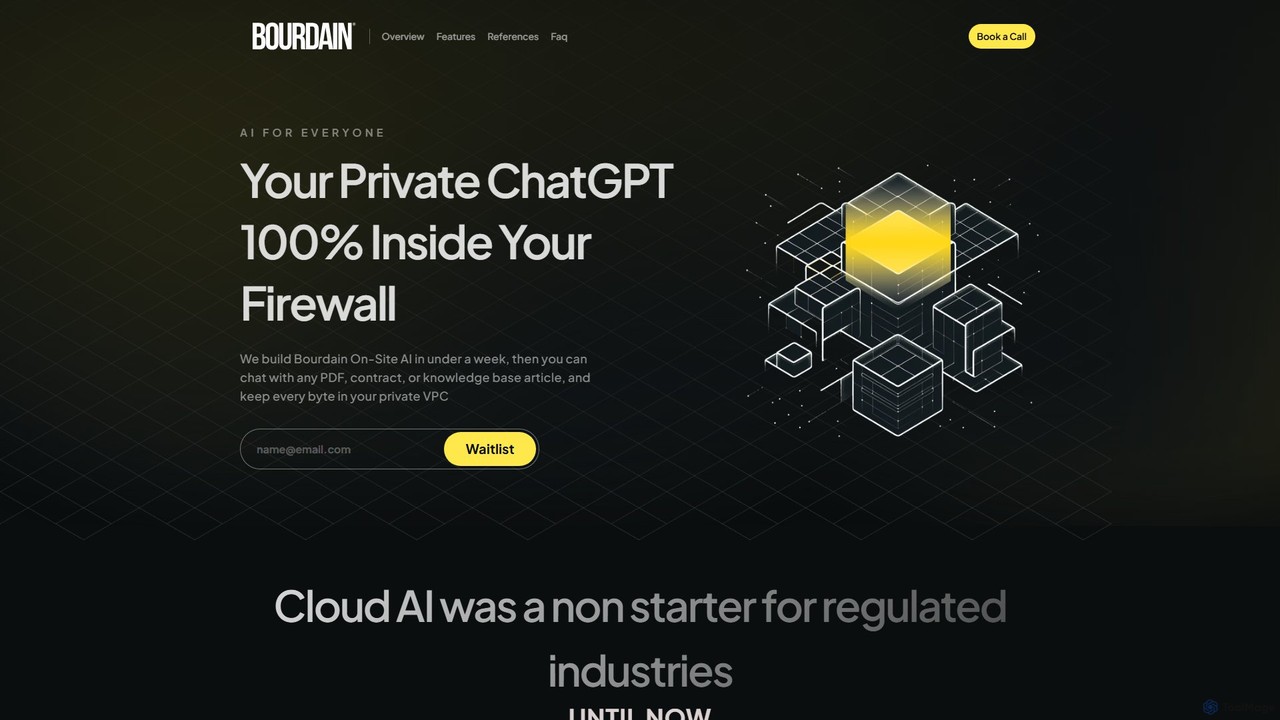
Bourdain Onsite AI is a private, on-premise AI chat solution designed for enterprises, especially in regulated industries. It functions like a private ChatGPT, operating 100% within your firewall to ensure complete data residency and security. Chat with any PDF, contract, or knowledge base article securely.

Enterprise Solutions
Visits 5.8KFavorites 104Likes 100

About On Premise Deployment

On-Premise Deployment AI tools are a class of software designed to be installed and operated entirely within an organization's private infrastructure. Unlike cloud-based SaaS solutions, these tools run on your own servers, giving you complete control over data, security, and system configurations. This approach is critical for industries with stringent data privacy regulations or those handling highly sensitive intellectual property. By keeping all processing and data in-house, organizations can ensure compliance and customize the environment to meet specific performance and integration needs.

Core Features

  • Data Sovereignty & Security: All data is processed and stored within your own network, eliminating third-party data access risks and ensuring compliance with regulations like GDPR and HIPAA.
  • Full Customization & Control: Gain the ability to modify the software, manage update schedules, and integrate deeply with existing proprietary systems without vendor limitations.
  • Offline Operation: These tools can function without an internet connection, making them ideal for secure, air-gapped environments or locations with unreliable connectivity.
  • Performance Optimization: Resources can be dedicated and hardware can be fine-tuned specifically for the AI application, potentially reducing latency and improving processing speed.

Applicable Scenarios

On-Premise Deployment is essential for organizations in sectors like finance, healthcare, government, and defense, where data security and regulatory compliance are non-negotiable. It is also the preferred choice for research and development teams training proprietary models on sensitive datasets, or for manufacturing facilities that require real-time, offline AI processing for quality control on the factory floor.

Selection Criteria

When choosing an on-premise AI tool, evaluate the total cost of ownership (TCO), including hardware, licensing, and maintenance personnel. Assess the tool's system requirements and compatibility with your existing infrastructure. Consider the vendor's support model for updates and troubleshooting. Finally, analyze the tool's scalability to ensure it can grow with your organization's data volume and processing demands.

On Premise Deployment use cases

1

Secure Financial Data Analysis for Fraud Detection

A financial institution's compliance team needs to analyze millions of transaction records for fraudulent patterns without exposing sensitive customer data to external services. They deploy an on-premise machine learning platform on their secure internal servers. This allows their data scientists to build and train fraud detection models using proprietary data, ensuring full compliance with PCI DSS and other financial regulations. The system operates entirely within their firewall, providing maximum security and control over critical financial information.

2

AI-Powered Medical Imaging Analysis in a Hospital

A hospital's radiology department wants to use an AI tool to assist in analyzing patient scans (MRIs, CT scans) for early disease detection. Due to strict HIPAA regulations, patient data cannot leave the hospital's network. They install an on-premise AI medical imaging software on a dedicated server within the hospital's data center. Radiologists can upload scans directly to this secure system, which analyzes the images and highlights potential anomalies. This enhances diagnostic accuracy while ensuring patient confidentiality is maintained at all times.

3

Internal Knowledge Management for a Law Firm

A law firm manages a vast repository of confidential case files, legal precedents, and client communications. They need an intelligent search tool to quickly find relevant information without uploading sensitive documents to a third-party cloud. By implementing an on-premise enterprise search solution powered by an LLM, lawyers and paralegals can perform natural language queries across their entire document database. The system runs on a server in their office, ensuring attorney-client privilege is protected and all data remains securely in-house.

4

Quality Control in an Air-Gapped Manufacturing Facility

A high-tech manufacturing plant operates in an air-gapped environment for security reasons, with no connection to the external internet. They need to implement an AI-powered visual inspection system on their assembly line. An on-premise computer vision tool is installed on edge devices directly connected to the line's cameras. The AI model, running locally, analyzes product images in real-time to detect defects. This setup allows for immediate quality control without compromising the facility's network security, ensuring both product quality and operational integrity.

5

Classified Document Analysis for Government Agencies

A government intelligence agency needs to process and analyze large volumes of classified documents. Due to the extreme sensitivity of the information, using any cloud-based service is prohibited. The agency deploys an on-premise Natural Language Processing (NLP) suite within its secure, accredited data center. Analysts use the tool to perform entity recognition, sentiment analysis, and topic modeling on classified reports. This allows them to extract critical intelligence efficiently while adhering to the strictest national security protocols, ensuring sensitive state secrets are never exposed.

6

Custom AI Model Training to Protect Intellectual Property

A technology company's R&D team is developing a next-generation AI model trained on its proprietary source code and internal user data. To protect this invaluable intellectual property, they set up an on-premise training environment using their own GPU clusters. By using an on-premise AI development platform, they can iterate on model architectures and training processes without ever sending their code or data to an external cloud. This ensures complete confidentiality and ownership over their innovative AI models, providing a critical competitive advantage.

On Premise Deployment FAQ

What are On-Premise Deployment AI tools?

On-Premise Deployment AI tools are software applications that you install and run on your own servers and infrastructure, rather than accessing them over the internet from a third-party provider. The key characteristic is that all data and processing happen within your organization's private network. This model provides maximum control over security, data privacy, and customization, making it ideal for enterprises with strict compliance requirements or highly sensitive data.

How do On-Premise tools differ from Cloud-based (SaaS) AI tools?

The primary difference lies in where the software runs and who manages it. On-Premise tools run on your local servers, giving you full control but also responsibility for maintenance, security, and updates. Cloud-based (SaaS) tools are hosted by a vendor and accessed via the internet, where the vendor handles all maintenance and updates, but your data is stored on their servers. Key differences include:

  • Data Location: In-house vs. third-party servers.
  • Cost Model: Higher upfront capital expense (CAPEX) for on-premise vs. ongoing operational expense (OPEX) for SaaS.
  • Control: Full control and customization for on-premise vs. limited control for SaaS.
  • Maintenance: Managed by your IT team vs. managed by the vendor.

Who should use On-Premise Deployment AI tools?

On-Premise Deployment is best suited for organizations that prioritize data security, control, and regulatory compliance above all else. This typically includes:

  • Regulated Industries: Companies in finance, healthcare, and legal sectors that must comply with strict data privacy laws like GDPR, HIPAA, or PCI DSS.
  • Government & Defense: Agencies handling classified or sensitive national security information.
  • Large Enterprises: Corporations with significant intellectual property or proprietary data they cannot risk exposing to third-party environments.
  • Organizations with Offline Needs: Facilities like manufacturing plants or remote research stations that require AI to function without a stable internet connection.

What are the key factors when choosing an On-Premise AI tool?

When selecting an on-premise AI tool, consider the following factors:

  • System Requirements: Ensure your hardware (servers, GPUs, storage) and software environment (OS, dependencies) meet the tool's specifications.
  • Total Cost of Ownership (TCO): Look beyond the initial license fee. Factor in costs for hardware acquisition, maintenance, energy consumption, and the salaries of the IT staff required to manage it.
  • Scalability: Assess how the tool scales. Can you easily add more server nodes to handle increased workloads, and what is the associated cost?
  • Vendor Support & Updates: Understand the vendor's support policy. How are updates and security patches delivered and applied? Is professional support available when you encounter issues?

What are the main challenges of using On-Premise AI tools?

While offering significant benefits, on-premise deployment comes with its own set of challenges. The primary challenge is the higher initial cost, as it requires investment in powerful server hardware and infrastructure. Another key challenge is the need for in-house technical expertise; your IT team must be capable of installing, configuring, maintaining, and troubleshooting the software. Finally, your organization assumes full responsibility for security, data backups, and system uptime, which can be resource-intensive compared to a SaaS model where the vendor handles these tasks.