Skcript
Skcript is an enterprise AI software company that develops a suite of intelligent products to streamline business operations. …
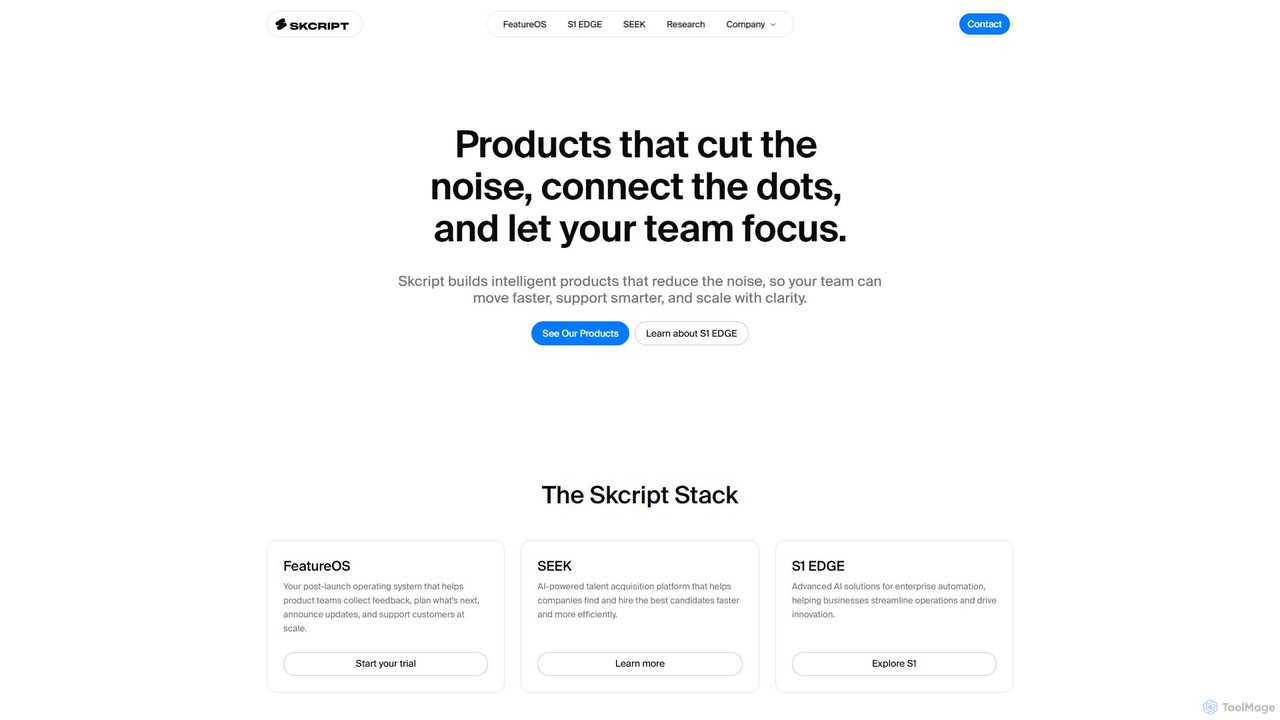
Skcript is an enterprise AI software company that develops a suite of intelligent products to streamline business operations. Its offerings include FeatureOS for product management, SEEK for AI-powered talent acquisition, and S1 EDGE for advanced enterprise automation, helping teams focus, innovate, and scale efficiently.
About Product Management
Product Management AI tools are specialized software solutions that leverage artificial intelligence to streamline and enhance various stages of the product lifecycle. These tools utilize machine learning, natural language processing, and data analytics to provide product managers with intelligent insights, automate routine tasks, and support data-driven decision-making. They empower teams to better understand market needs, prioritize features, optimize roadmaps, and ultimately build more successful products. By integrating AI, these tools significantly boost efficiency and accuracy in complex product development processes, making them a vital part of modern developer toolkits.
Core Features
- Market Insight & Trend Analysis: Automatically gathers and analyzes market data, user feedback, and competitor intelligence to identify emerging trends and unmet user needs.
- Requirements Management & Prioritization: Assists in organizing and analyzing user stories and feature requests, using algorithms to evaluate value and complexity for intelligent prioritization recommendations.
- Roadmap Planning & Optimization: Intelligently generates or optimizes product roadmaps based on data predictions and resource allocation, identifying potential risks and dependencies.
- User Behavior Analysis & Insights: Analyzes user interaction data to identify usage patterns, pain points, and growth opportunities, informing product iterations.
- Documentation Generation & Communication Aid: Automates the creation of product requirement documents (PRDs), user stories, or meeting summaries, enhancing team communication efficiency.
Applicable Scenarios
AI product management tools are invaluable for product managers in various settings. Startups can rapidly validate product ideas and optimize their Minimum Viable Product (MVP) feature sets. Large enterprise product teams benefit from managing complex product portfolios, coordinating cross-departmental requirements, and optimizing resource allocation. Furthermore, data-driven product development teams can leverage these tools for in-depth user data analysis to guide product iterations and feature optimization.
How to Choose
When selecting an AI product management tool, consider its feature coverage, ensuring it spans from market research to post-launch analytics. Evaluate its data integration capabilities with existing project management, CRM, and analytics platforms. Assess the transparency and explainability of its AI models, allowing product managers to understand and adjust recommendations. Finally, prioritize user experience and ease of use, looking for intuitive interfaces and robust team collaboration features.

Product ManagementUse Cases
Intelligent Market Demand Analysis and Insights
Product managers and market researchers can leverage AI tools to rapidly identify market gaps, user pain points, and competitive advantages. The AI tool automatically scrapes vast amounts of data from social media, reviews, and industry reports, performing sentiment analysis and topic extraction to generate visual reports. This helps product managers uncover unmet needs and potential opportunities, significantly shortening market research cycles and increasing the success rate of product innovation.
Automated User Story and Requirement Organization
Product owners and business analysts often struggle to transform raw requirements from various channels (user interviews, customer service feedback, sales records) into structured user stories and feature lists. AI tools, utilizing Natural Language Processing (NLP), automatically identify, classify, and deduplicate user feedback. They generate compliant user story drafts and link them to Epics or Features, significantly reducing manual organization time and ensuring the completeness and consistency of requirements.
Intelligent Roadmap Optimization and Risk Prediction
Product directors and senior product managers are responsible for developing and adjusting product roadmaps, balancing business value, development costs, and market timing, while also anticipating potential risks. AI tools analyze historical project data, team capabilities, market trends, and resource constraints to simulate different roadmap scenarios. They predict release cycles and success rates, and identify critical dependencies and bottlenecks, thereby enhancing the scientific validity and feasibility of the roadmap and reducing project delays and failure risks.
In-depth A/B Test Result Analysis and Recommendations
Product managers and growth hackers need to quickly extract valuable insights from complex A/B test data and receive clear product improvement recommendations. AI tools not only calculate the statistical significance of test results but also deeply analyze user behavior paths and conversion funnels. They identify preference differences across various user groups and generate specific UI/UX or feature optimization suggestions based on these findings, accelerating product iteration cycles and ensuring data-backed changes that enhance user experience and business metrics.
Automated Product Documentation Generation and Updates
Product managers and technical writers often spend considerable time creating and maintaining product requirement documents (PRDs), feature specifications, and user manuals. AI tools can automatically generate structured document drafts based on brief descriptions, meeting minutes, or existing functional modules. They can also automatically identify and suggest revision points for documentation as products are updated, significantly reducing documentation writing time, improving document quality and consistency, and ensuring information synchronization across the team.
Competitor Analysis and Market Positioning Assistance
Product strategy managers and market analysts need a comprehensive understanding of competitors' product strategies, functional advantages, and market performance to aid in their own product positioning. AI tools continuously monitor competitor websites, news, user reviews, and patent information, automatically extracting key features, pricing strategies, and user feedback. They generate SWOT analysis reports, helping product teams discover differentiated opportunities for their own products, providing real-time, comprehensive competitive intelligence to support more precise market positioning and product strategy adjustments.