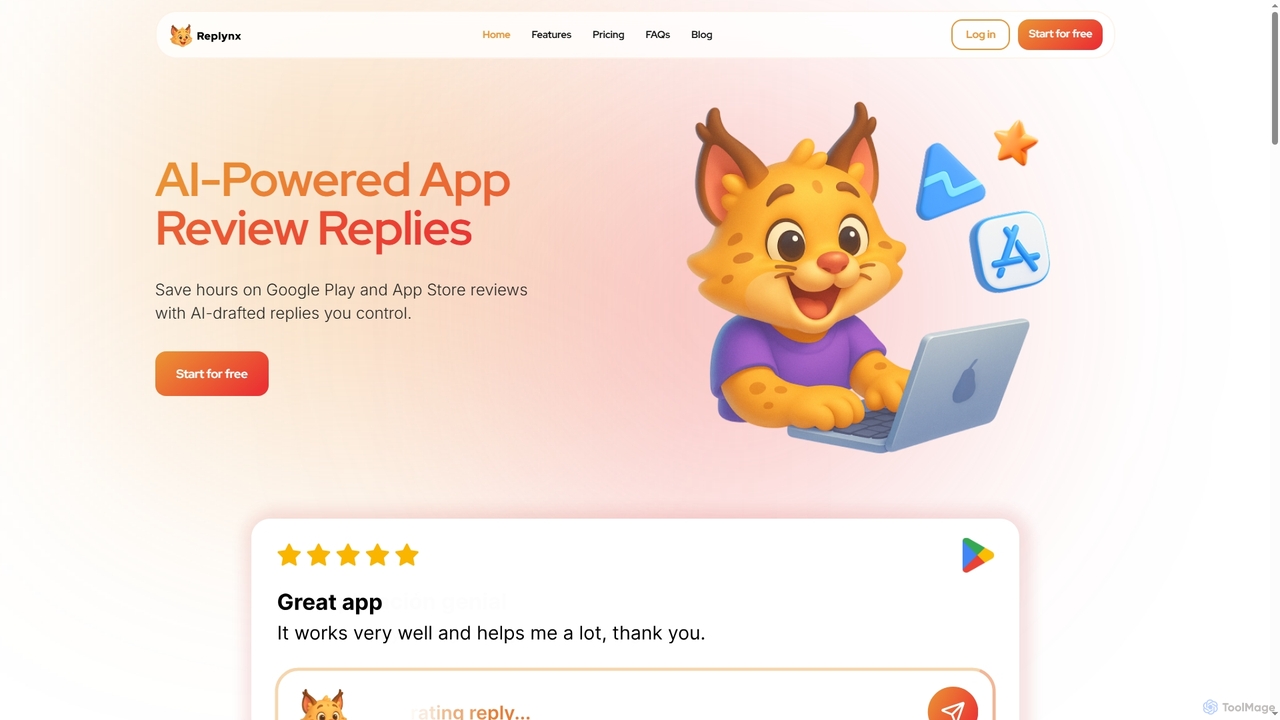
Replynx
Replynx is an AI-powered tool designed for app developers to streamline and enhance app review management on Google …
Replynx is an AI-powered tool designed for app developers to streamline and enhance app review management on Google Play and App Store. It automates reply drafting, offers multilingual translation, and centralizes all reviews, saving significant time while maintaining brand voice and tone.
About App Management
AI App Management tools are a class of solutions that use artificial intelligence to monitor, analyze, and optimize the performance, reliability, and security of live applications. These tools leverage machine learning algorithms to process vast amounts of operational data, such as logs, metrics, and traces, to identify anomalies and predict potential issues before they impact users. Their primary value lies in automating complex operational tasks, reducing incident resolution time, and providing deep insights into application health within DevOps and SRE workflows. This proactive approach helps teams maintain high levels of service availability and deliver a superior user experience.
Core Features
- AI-Powered Anomaly Detection: Automatically identifies unusual patterns in performance metrics and logs without manual thresholds.
- Predictive Performance Analysis: Forecasts potential issues like resource bottlenecks or latency spikes based on historical trends.
- Automated Root Cause Analysis (RCA): Pinpoints the source of errors or performance degradation across complex distributed systems.
- Intelligent Security Monitoring: Uses behavioral analysis to detect and flag sophisticated security threats in real-time.
- Cloud Cost Optimization: Analyzes resource usage patterns to provide recommendations for right-sizing and cost reduction.
Applicable Scenarios
These tools are essential for DevOps engineers, Site Reliability Engineers (SREs), and IT operations teams managing complex, cloud-native applications. They are widely used in industries like e-commerce, SaaS, and finance, where application uptime and performance are critical. For instance, an e-commerce platform can use them to prevent outages during peak traffic, while a SaaS provider can ensure consistent service quality for its customers.
Selection Criteria
When choosing an AI App Management tool, consider its integration capabilities with your existing tech stack (e.g., cloud providers, CI/CD pipelines). Evaluate its ability to ingest and correlate diverse data types (logs, metrics, traces). Assess the level of automation it offers for root cause analysis and remediation. Finally, consider its scalability to handle your application's data volume and its pricing model.

App ManagementUse Cases
Proactive Issue Prevention for E-commerce Platforms
An SRE team for a major online retailer uses an AI App Management tool to prepare for a holiday sales event. The tool analyzes historical performance data and predicts a potential database overload due to a 300% traffic spike. Based on this prediction, the team proactively scales database resources and optimizes critical queries identified by the AI. As a result, the platform handles the peak traffic smoothly without any performance degradation or downtime, protecting revenue and customer trust.
Accelerating Bug Triage and Resolution
A DevOps team at a SaaS company notices a sudden increase in API error rates after a new deployment. Instead of manually sifting through gigabytes of logs, their AI App Management tool automatically correlates the error spike with a specific code change in the deployment. The tool's root cause analysis points to a faulty third-party library update. This allows developers to immediately roll back the change and fix the bug, reducing the Mean Time to Resolution (MTTR) from hours to minutes.
Optimizing Mobile App User Experience
A product manager for a popular gaming app uses an AI App Management tool to understand user behavior. The tool automatically identifies user segments that experience frequent crashes or slow loading times on specific levels. It also visualizes user journeys, highlighting points where players drop off. Armed with this data, the development team prioritizes fixing the stability issues and redesigns the problematic levels, leading to a 15% increase in user retention and higher app store ratings.
Automated Security Incident Response
A SecOps analyst at a fintech company receives an AI-generated alert about anomalous API usage from a specific IP address, indicating a potential credential stuffing attack. The App Management tool automatically correlates this activity with a series of failed login attempts across multiple accounts. Based on a pre-configured policy, the system automatically blocks the malicious IP address and flags the potentially compromised accounts for a mandatory password reset, neutralizing the threat in seconds without manual intervention.
Managing Microservices Complexity
An engineering team manages a SaaS platform built on hundreds of microservices. When users report slowness in one feature, it's difficult to pinpoint the source. Their AI App Management tool provides a real-time service map, visualizing dependencies and latency between services. The AI highlights a specific downstream service as the bottleneck. By drilling down, the team discovers a misconfiguration in that service's cache. They fix the issue, and the end-to-end transaction time for the feature improves by 70%.
Intelligent Cloud Cost Optimization
An IT operations team for a fast-growing startup is struggling with rising cloud costs. They deploy an AI App Management tool that analyzes resource utilization across their entire cloud infrastructure. The AI identifies several over-provisioned database instances and idle virtual machines that are running 24/7. It provides specific recommendations to right-size the instances and implement auto-scaling policies. By following these suggestions, the team reduces their monthly cloud bill by 25% without impacting application performance.