Development Best in category 1 results Backend As A Service (Baas) AI Tool

Popular AI tools in the Backend As A Service (Baas) field of Development include Back4app, etc., helping you quickly improve efficiency.

Back4app

Back4app

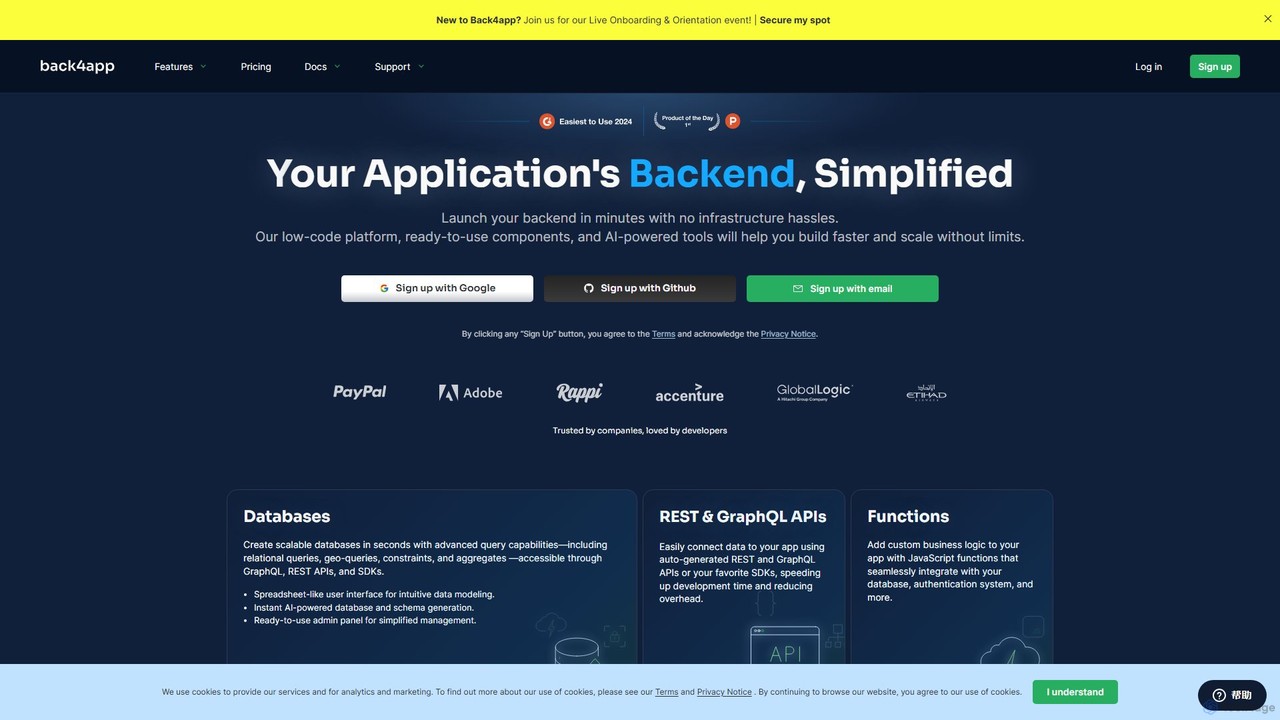
Back4app is an AI-powered, low-code Backend-as-a-Service (BaaS) platform that simplifies application development. It enables developers to launch scalable …

595.4K

About Backend As A Service (Baas)

Backend as a Service (BaaS) platforms provide developers with pre-built, cloud-hosted backend functionalities, eliminating the need to build and maintain server-side infrastructure. These services offer ready-to-use components like databases, user authentication, and cloud storage, accelerating application development within the broader 'Development' category. By abstracting complex backend operations, BaaS allows developers to focus solely on frontend and business logic, significantly reducing time-to-market and operational overhead.

Core Features

  • User Authentication: Manages user sign-up, login, and session management securely across various platforms.
  • Database Management: Provides scalable NoSQL or SQL databases with real-time synchronization and data storage capabilities.
  • Cloud Storage: Offers secure and scalable storage solutions for user-generated content, media files, and application assets.
  • Push Notifications: Enables sending targeted notifications to users across mobile and web applications.
  • Serverless Functions: Allows developers to execute custom backend logic without managing servers, often triggered by events.

Applicable Scenarios

BaaS is ideal for mobile and web application developers, startups, and small to medium-sized businesses looking to rapidly prototype and deploy applications. It's particularly useful for projects requiring quick iteration, scalable backend infrastructure, and reduced operational complexity, such as social media apps, e-commerce platforms, or IoT solutions.

How to Choose

When selecting a BaaS provider, consider its scalability to handle future growth, the range of pre-built features aligning with your application's needs, and its security measures for data protection. Evaluate the pricing model for cost-effectiveness, the ease of integration with your chosen frontend technologies, and the vendor's support for various platforms to avoid lock-in.

Backend As A Service (Baas)Use Cases

1

Rapid Mobile App Prototyping

Mobile app developers can leverage BaaS to quickly set up essential backend services like user authentication, data storage, and push notifications for new app ideas. This allows them to focus on designing the user interface and core features, enabling faster iteration, gathering early user feedback, and significantly accelerating the prototyping phase without extensive backend coding.

2

Building Scalable Real-time Applications

Developers creating real-time applications, such as chat platforms or collaborative tools, can utilize BaaS for its real-time database and messaging capabilities. This allows them to handle concurrent connections, synchronize data across multiple clients instantly, and manage user presence efficiently, ensuring a smooth and responsive user experience without managing complex server infrastructure.

3

Backend for IoT Devices and Smart Solutions

Companies developing IoT devices or smart home solutions can use BaaS to manage device data, user authentication for device control, and push notifications for alerts. BaaS provides a scalable and secure backend to collect sensor data, store device states, and enable remote control functionalities, simplifying the complex infrastructure requirements of connected devices.

4

Developing Serverless APIs and Microservices

Developers can use BaaS platforms to quickly deploy and manage serverless functions, creating custom APIs or microservices without provisioning or managing servers. This is ideal for event-driven architectures, backend logic for webhooks, or processing data from various sources, offering high scalability and cost-efficiency by paying only for execution time.

5

Backend for E-commerce and Retail Applications

E-commerce businesses can utilize BaaS to power their online stores, managing product catalogs, user accounts, shopping carts, and order processing. BaaS provides a robust and scalable backend that can handle fluctuating traffic, secure payment integrations, and personalized user experiences, allowing retailers to focus on sales and marketing rather than infrastructure management.

6

Backend for Content Management Systems (CMS)

Developers building custom CMS platforms or content-driven applications can use BaaS for robust data storage, user management for content creators, and media asset management. BaaS simplifies the backend complexities of handling large volumes of content, user roles, and permissions, allowing for faster development and deployment of flexible content solutions.

Backend As A Service (Baas)Frequently Asked Questions