ToolMage
Sign in

Best 1 Blockchain AI tools for Development

Popular Blockchain AI tools in Development include CryptoDo, helping you work more efficiently.

CryptoDo
Freemium

CryptoDo

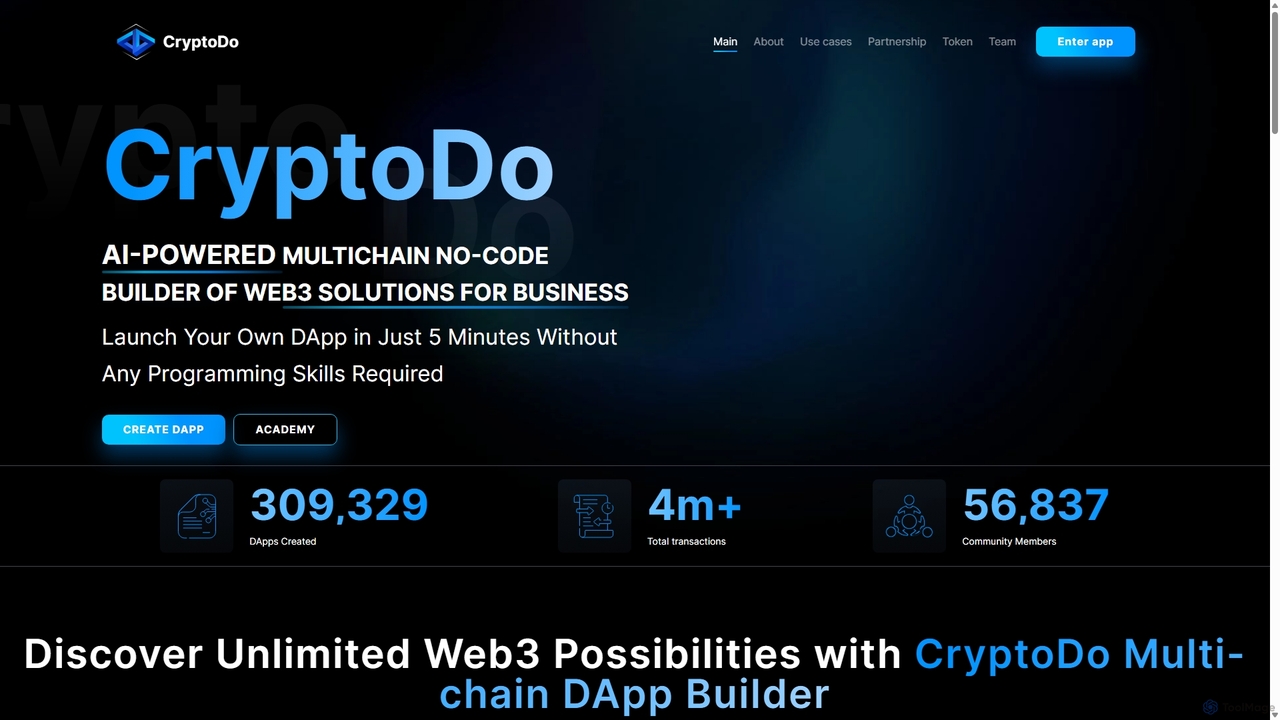
CryptoDo is an AI-powered, multi-chain, no-code platform for building Web3 solutions. It enables users to create and deploy secure DApps and smart contracts, such as ERC-20 tokens, NFTs, and DAOs, in just minutes without any programming skills. The platform features a visual builder, pre-audited templates, and an AI module for advanced customization, making blockchain development accessible, fast, and cost-effective for businesses and individuals.

Blockchain
Visits 6.3KFavorites 134Likes 129

About Blockchain

AI Blockchain tools are a specialized class of software that uses artificial intelligence to accelerate the development, auditing, and analysis of decentralized applications (dApps) and smart contracts. These tools employ machine learning models to detect vulnerabilities, generate code, and interpret complex on-chain data. They empower developers to build more secure and efficient Web3 products, reduce manual errors, and gain deeper insights from blockchain activity. This AI-driven approach significantly enhances the security and reliability of blockchain ecosystems.

Core Features

  • AI-Powered Smart Contract Auditing: Automatically scans smart contract code to identify security vulnerabilities, logical errors, and gas inefficiencies before deployment.
  • Code Generation & Completion: Generates boilerplate code for smart contracts and dApps from natural language prompts or high-level specifications.
  • On-Chain Data Analysis: Utilizes AI to analyze transaction patterns, detect anomalies, and provide predictive insights into network activity or token behavior.
  • Test Case Generation: Automatically creates comprehensive test suites to ensure the robustness and correctness of smart contract logic under various conditions.
  • Development Environment Integration: Seamlessly integrates with popular Integrated Development Environments (IDEs) to provide real-time assistance and analysis.

Use Cases

These tools are primarily used by blockchain developers, security auditors, DeFi protocol teams, and data analysts. They are crucial for building secure financial instruments, developing complex NFT projects, monitoring on-chain governance, and conducting forensic analysis of blockchain transactions to identify fraudulent activities.

How to Choose

When selecting an AI Blockchain tool, consider the specific blockchains it supports (e.g., Ethereum, Solana, Polygon). Evaluate the depth and accuracy of its security auditing capabilities. Assess its integration with your existing development workflow and IDEs, and check its ability to analyze and visualize complex on-chain data effectively.

Blockchain use cases

1

Automated Smart Contract Security Auditing

A DeFi development team preparing to launch a new lending protocol uses an AI auditing tool to perform a pre-deployment security check. The tool automatically scans thousands of lines of Solidity code, identifying a critical reentrancy vulnerability and several gas optimization issues that were missed during manual review. This process prevents a potential multi-million dollar exploit and saves the team weeks of manual auditing effort, allowing for a faster and more secure launch.

2

AI-Powered On-Chain Fraud Detection

A cryptocurrency exchange integrates an AI blockchain analysis tool to monitor real-time transactions. The AI model, trained on vast datasets of historical transactions, identifies a complex wash trading scheme involving multiple wallets designed to artificially inflate an asset's trading volume. The system automatically flags the suspicious wallets and alerts the compliance team, protecting other users from market manipulation and enhancing the platform's integrity.

3

Generating dApp Code from Natural Language

A developer with a great idea for an NFT minting dApp but limited experience in Solidity uses an AI code generation tool. They describe the desired functionality in plain English: 'Create a smart contract for an NFT collection of 1000 items, with a mint price of 0.1 ETH, and a limit of 5 mints per wallet.' The tool generates a well-structured, secure, and gas-optimized Solidity contract, along with a basic front-end script. This significantly lowers the barrier to entry and accelerates the prototype development from weeks to just a few hours.

4

Predictive Analytics for DeFi Yield Farming

A data analyst at a crypto investment fund uses an AI tool to analyze on-chain data from various DeFi protocols. The tool predicts which liquidity pools are likely to offer the highest Annual Percentage Yields (APYs) over the next week by modeling factors like transaction volume, token price volatility, and upcoming governance proposals. Based on these AI-driven insights, the fund reallocates its capital to optimize returns and mitigate risks associated with impermanent loss, outperforming manual strategies.

5

Automated Test Case Generation for Smart Contracts

A quality assurance engineer working on a complex decentralized exchange (DEX) protocol uses an AI tool to generate a comprehensive test suite. Instead of manually writing hundreds of test cases for edge scenarios, the engineer provides the smart contract source code to the tool. The AI analyzes the code paths and logic to automatically generate tests covering various conditions, including high network congestion, flash loan attacks, and invalid inputs. This ensures 99% code coverage and significantly improves the protocol's resilience against unforeseen issues.

6

Optimizing Gas Fees with AI Suggestions

A developer building a gas-intensive dApp on Ethereum uses an AI-powered IDE plugin. As they write code, the plugin provides real-time suggestions to optimize for gas consumption. It might suggest replacing a certain loop structure with a more efficient one or using a different data type to save storage costs. The tool also analyzes historical network data to recommend optimal times for deploying contracts or sending transactions. This proactive optimization helps reduce the transaction costs for the dApp's end-users by up to 30%.

Blockchain FAQ

What are AI Blockchain tools?

AI Blockchain tools are specialized software that integrate artificial intelligence into the blockchain development lifecycle. They assist developers and security auditors by automating complex tasks such as code generation, security vulnerability detection, and on-chain data analysis. Unlike standard development tools, they use machine learning models to provide predictive insights, identify sophisticated threats, and accelerate the creation of secure and efficient decentralized applications (dApps).

How do AI tools improve smart contract security?

AI tools enhance smart contract security primarily through automated auditing and formal verification. They use machine learning models trained on vast codebases of known vulnerabilities to scan new contracts for similar patterns, such as reentrancy, integer overflows, and access control issues. Some advanced tools can also generate mathematical proofs to verify that a contract's logic behaves exactly as intended under all possible conditions, providing a much higher level of assurance than manual testing alone.

How to choose the right AI Blockchain tool?

Choosing the right tool depends on your specific needs. Consider the following factors:

  • Supported Blockchains: Ensure the tool supports the specific blockchain protocol you are developing for (e.g., EVM-compatible, Solana, Cosmos).
  • Core Functionality: Determine if you need a tool primarily for security auditing, code generation, data analysis, or a combination.
  • Integration: Check if it integrates with your preferred IDE (like VS Code) and development frameworks (like Hardhat or Foundry).
  • Accuracy and Reliability: Look for reviews or case studies that validate the tool's effectiveness in finding real-world vulnerabilities or providing accurate data insights.
What is the difference between a standard IDE and an AI-powered blockchain development tool?

A standard IDE (Integrated Development Environment) provides essential tools like a code editor, debugger, and compiler. An AI-powered blockchain development tool enhances this experience by adding intelligent features. These include real-time security vulnerability detection as you type, AI-driven code completion tailored for smart contract languages, automated generation of complex functions from natural language, and predictive gas fee optimization. In essence, the AI tool acts as an expert assistant within the IDE, proactively improving code quality and security.

Who can benefit from using AI Blockchain tools?

A wide range of professionals in the Web3 space can benefit:

  • Blockchain Developers: To write more secure code faster, optimize gas usage, and automate testing.
  • Security Auditors: To augment their manual review process, catch common vulnerabilities quickly, and focus on more complex logic flaws.
  • DeFi Analysts & Traders: To gain predictive insights from on-chain data, identify trends, and detect market manipulation.
  • Project Managers & Founders: To accelerate development cycles and ensure a higher standard of security for their products before launch.