ToolMage
Sign in

Best 1 Cloud Computing AI tools for Development

Popular Cloud Computing AI tools in Development include Devtron, helping you work more efficiently.

Devtron
Freemium

Devtron

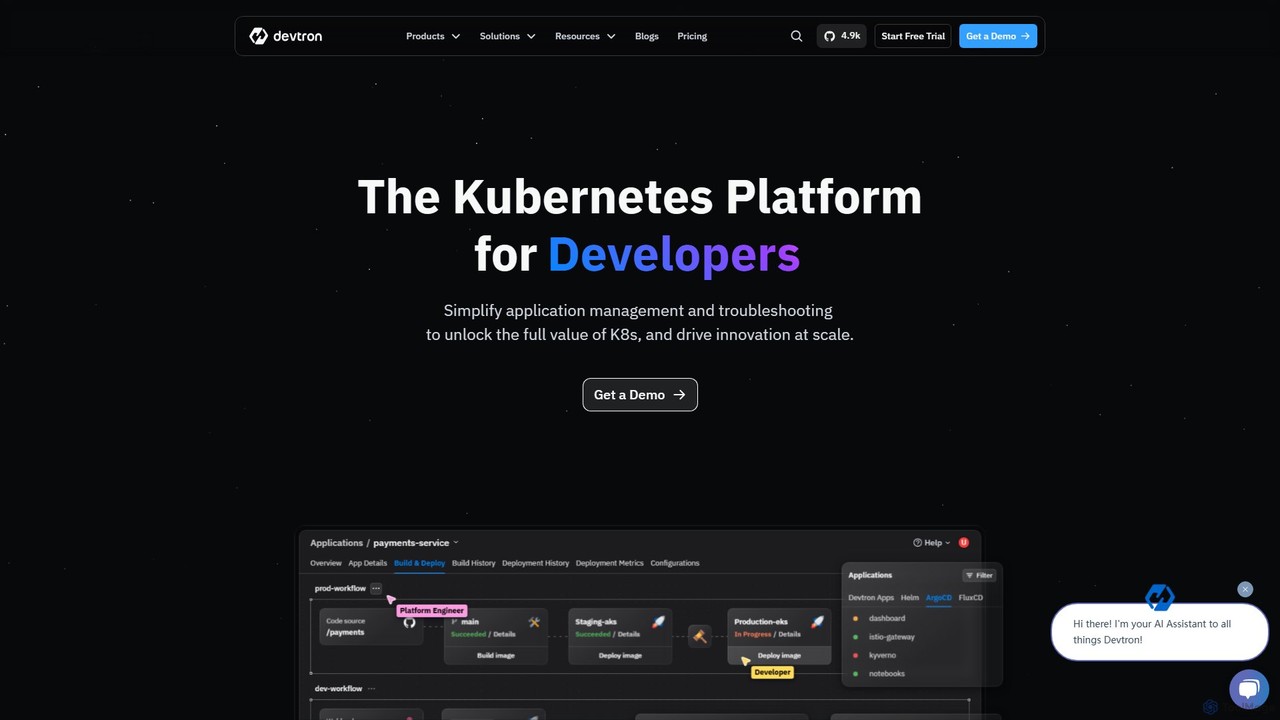
Devtron is an open-source, Kubernetes-native software delivery platform that simplifies application management. It integrates CI/CD, GitOps, security, and observability into a unified dashboard, empowering developers and DevOps teams to manage complex Kubernetes environments with ease, accelerate release cycles, and improve productivity without a steep learning curve.

Cloud Computing
Visits 56.2KFavorites 105Likes 114

About Cloud Computing

AI Cloud Computing tools provide on-demand access to scalable computing resources, specialized hardware, and managed services tailored for the entire AI development lifecycle. These platforms abstract the complexity of managing physical infrastructure, offering pre-configured environments with GPUs and TPUs for intensive tasks. This enables developers and data scientists to efficiently train large-scale models, deploy AI applications globally, and manage machine learning workflows without significant upfront hardware investment. Many of these tools are central to MLOps, automating processes from data preparation to model monitoring.

Core Features

  • Scalable Compute Instances: On-demand access to various CPU, GPU, and TPU configurations to match specific model training and inference needs.
  • Managed AI Services: Pre-trained models and APIs for tasks like computer vision, natural language processing, and speech recognition, accelerating development.
  • MLOps Toolchains: Integrated tools for automating, managing, and monitoring the entire machine learning lifecycle, from experimentation to production.
  • Optimized Data Storage: High-performance storage solutions designed for large datasets, such as object storage, and data lakes for AI workloads.
  • Pre-configured Environments: Ready-to-use development environments like Jupyter notebooks and containers with pre-installed AI frameworks (e.g., TensorFlow, PyTorch).

Use Cases

AI Cloud Computing platforms are essential for data scientists, machine learning engineers, and AI-focused startups. They are widely used for training complex deep learning models, such as large language models (LLMs) or medical image analysis algorithms. Enterprises leverage these tools to deploy scalable AI services, like real-time recommendation engines or fraud detection systems, that serve millions of users.

How to Choose

When selecting an AI Cloud Computing tool, evaluate the availability of specific hardware like the latest GPUs. Consider the breadth of the managed AI service ecosystem and its MLOps capabilities. Analyze the pricing model, including costs for compute, storage, and data transfer. Finally, assess its integration with your existing tools and its support for multi-cloud or hybrid strategies to avoid vendor lock-in.

Cloud Computing use cases

1

Training a Large Language Model (LLM)

A research team at a university needs to train a new generative AI model with over 50 billion parameters. Using an AI cloud computing platform, they provision a cluster of hundreds of high-performance GPUs on-demand. This allows them to complete the training process in weeks instead of years, which would be impossible with their local hardware. The platform's pre-configured environments with optimized deep learning libraries save them significant setup time, enabling them to focus purely on model architecture and experimentation.

2

Deploying a Real-time Recommendation Engine

An e-commerce company wants to provide personalized product recommendations to its users. They use a cloud platform's managed machine learning service to deploy their trained model as a scalable API endpoint. The platform automatically handles server provisioning, load balancing, and auto-scaling. When traffic spikes during a holiday sale, the service seamlessly scales up to handle millions of requests per minute without manual intervention, ensuring a smooth user experience and maximizing sales opportunities.

3

Automating Medical Image Analysis

A healthcare tech startup is developing an AI to detect early signs of diseases from MRI scans. They use a cloud provider's specialized healthcare AI services, which are compliant with data privacy regulations like HIPAA. The platform provides tools for securely uploading and annotating medical images, as well as powerful GPU instances for training their computer vision model. This accelerates their research and development, allowing them to bring a potentially life-saving tool to market faster while ensuring patient data is secure.

4

Building a Serverless Customer Service Chatbot

A retail company wants to offer 24/7 customer support without hiring a large team. They use a cloud platform's managed NLP services and serverless functions to build an intelligent chatbot. The NLP service understands user queries, and the serverless functions execute business logic, like checking an order status by calling an internal API. Because the entire architecture is serverless, the company pays only for the compute time used when a customer interacts with the bot, making it a highly cost-effective solution that scales automatically with demand.

5

Big Data Processing for Predictive Analytics

A financial services firm needs to analyze terabytes of historical market data to build a fraud detection model. They leverage a cloud platform's managed big data service, like Apache Spark, to process and transform the massive dataset in a distributed manner. The processed data is then used to train a machine learning model on the same platform. This integrated environment allows them to move from raw data to a trained model efficiently, significantly reducing the time and infrastructure complexity compared to an on-premise solution.

6

Establishing an MLOps Pipeline for Continuous Delivery

A software company integrates AI features into its main product and needs to update its models frequently. Using an AI cloud platform, their ML engineers build an automated MLOps pipeline. This pipeline automatically triggers model retraining when new data is available, runs automated tests for performance and bias, and deploys the new model to production with zero downtime. This CI/CD approach for machine learning ensures their AI features are always improving and reliable, without requiring manual, error-prone deployment processes.

Cloud Computing FAQ

What are AI Cloud Computing tools?

AI Cloud Computing tools are platforms that provide on-demand access to specialized resources for building, training, and deploying AI models. They offer scalable computing power (like GPUs and TPUs), managed AI services (like vision and language APIs), and MLOps toolchains. The primary purpose is to eliminate the need for developers to purchase and manage expensive physical hardware, allowing them to scale resources up or down based on project needs.

How do I choose the right AI Cloud Computing platform?

To choose the right platform, consider these factors:

  • Hardware Needs: Ensure the platform offers the specific types of GPUs or TPUs your models require for optimal performance.
  • Service Ecosystem: Evaluate the range of managed AI services and MLOps tools. A rich ecosystem can significantly speed up development.
  • Cost Structure: Analyze the pricing for compute instances, data storage, and network traffic. Look for flexible options like pay-as-you-go and reserved instances.
  • Integration and Portability: Check how well it integrates with your existing development tools and whether it supports open standards to avoid vendor lock-in.
Why use the cloud for AI development instead of local hardware?

Using the cloud for AI development offers several key advantages over local hardware. The most significant is scalability; you can access vast amounts of computing power, like hundreds of GPUs, for a short period, which is financially impractical to own. Cloud platforms also offer a pay-as-you-go model, reducing upfront costs. Furthermore, they provide managed services and pre-configured environments that simplify infrastructure management and accelerate the development cycle, allowing teams to focus on building models rather than maintaining hardware.

What is the difference between IaaS, PaaS, and SaaS in AI Cloud Computing?

These are three service models with different levels of management:

  • IaaS (Infrastructure as a Service): Provides raw computing resources like virtual machines with GPUs. You have full control but are responsible for installing and managing the entire software stack.
  • PaaS (Platform as a Service): Offers a managed platform for development, like an ML platform with built-in tools for training and deployment. It abstracts away the underlying infrastructure.
  • SaaS (Software as a Service): Delivers a ready-to-use AI application, typically via an API (e.g., a pre-trained translation or image recognition service). You don't manage any part of the infrastructure or model.
What is MLOps and how does it relate to AI Cloud Computing?

MLOps (Machine Learning Operations) is a set of practices that aims to deploy and maintain machine learning models in production reliably and efficiently. It combines machine learning, data engineering, and DevOps principles. AI Cloud Computing platforms are the primary enablers of MLOps. They provide the essential tools for automation, such as CI/CD pipelines for models, version control for data and models, and monitoring services to track model performance in production, all integrated into a single environment.