Vercel
Vercel is a frontend cloud platform providing developers with the tools and infrastructure to build, scale, and secure …
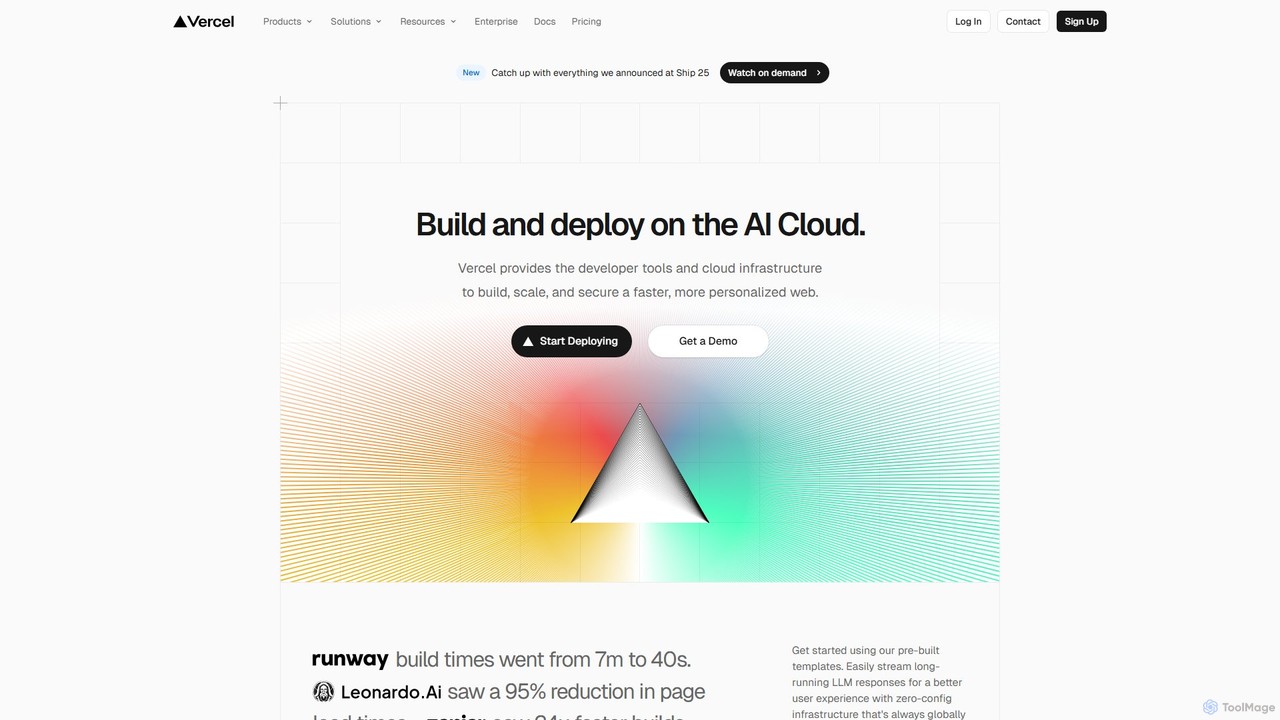
Vercel is a frontend cloud platform providing developers with the tools and infrastructure to build, scale, and secure faster, more personalized web experiences. It offers zero-config deployments, a global edge network, and serverless functions. With its new AI Cloud, Vercel simplifies the development and deployment of high-performance AI-powered applications, enabling features like streaming LLM responses with ease.
About Cloud Platform
Cloud Platforms are comprehensive, internet-based computing environments that deliver scalable infrastructure and services on demand. They provide the foundational resources—from virtual machines and storage to specialized AI/ML services—essential for developing, deploying, and managing modern AI applications. These platforms enable developers and businesses to build, train, and run AI models efficiently, abstracting away the complexities of underlying hardware management.
Core Features
- Scalable Compute Resources: Offers virtual machines, containers, and serverless functions, including GPU/TPU instances optimized for AI model training and inference.
- Managed AI/ML Services: Provides pre-built AI APIs (e.g., vision, speech, NLP) and managed machine learning platforms for model development, deployment, and monitoring.
- Data Storage & Analytics: Includes robust data lakes, databases, and analytics tools to store, process, and analyze vast datasets required for AI.
- Networking & Security: Ensures secure, high-performance connectivity and robust security features to protect data and applications.
- Developer Tools & APIs: Offers SDKs, APIs, and integrated development environments for seamless AI application creation and integration.
Applicable Scenarios
Cloud Platforms are indispensable for organizations building and scaling AI solutions. They are used by AI startups for rapid prototyping and deployment, by enterprises for integrating AI into existing workflows, and by researchers for large-scale model training. Specific scenarios include deploying custom machine learning models, running big data analytics for AI insights, and hosting AI-powered web services.
How to Choose
When selecting a Cloud Platform for AI, consider the availability of specialized AI/ML services, the range of compute options (especially GPU/TPU), data storage and processing capabilities, and the ease of integration with existing tools. Evaluate pricing models, security features, and the platform's ecosystem for developer support and community resources.

Cloud PlatformUse Cases
Deploying Custom Machine Learning Models
Data scientists and MLOps engineers leverage cloud platforms to deploy their custom-trained machine learning models as scalable APIs or services. This allows applications to access real-time predictions without managing complex server infrastructure, ensuring high availability and performance for AI-driven features in products.
Training Large-Scale Deep Learning Models
AI researchers and deep learning engineers utilize cloud platforms to access powerful GPU/TPU instances for training computationally intensive deep learning models. They can provision resources on demand, scale up or down as needed, and leverage distributed training frameworks to significantly reduce training times for complex neural networks.
Building AI-Powered Chatbots and Virtual Assistants
Developers create intelligent chatbots and virtual assistants by integrating natural language processing (NLP) and speech-to-text services offered by cloud platforms. These platforms provide the necessary APIs and infrastructure to process user queries, understand intent, and generate relevant responses, enabling seamless conversational AI experiences.
Developing Serverless AI Inference Functions
Software engineers use serverless computing services on cloud platforms to run AI inference tasks efficiently and cost-effectively. For sporadic or event-driven AI predictions (e.g., image classification on upload), serverless functions execute code only when triggered, eliminating idle server costs and simplifying deployment.
Managing Big Data for AI Analytics
Data engineers and analysts employ cloud data lakes and managed database services to store, process, and prepare massive datasets for AI model training and evaluation. Cloud platforms offer scalable storage, ETL tools, and analytics engines that streamline the data pipeline, ensuring high-quality data availability for AI initiatives.
Hosting AI-Driven Web Applications
Web developers and solution architects host AI-powered web applications on cloud platforms, utilizing services like managed Kubernetes, virtual machines, or app services. This provides a robust, scalable, and secure environment for applications that integrate AI models for features like personalized recommendations, content generation, or intelligent search.