Bench
Bench is an AI-powered platform that automates engineering workflows. It integrates with your existing CAD, CAE, and PLM …
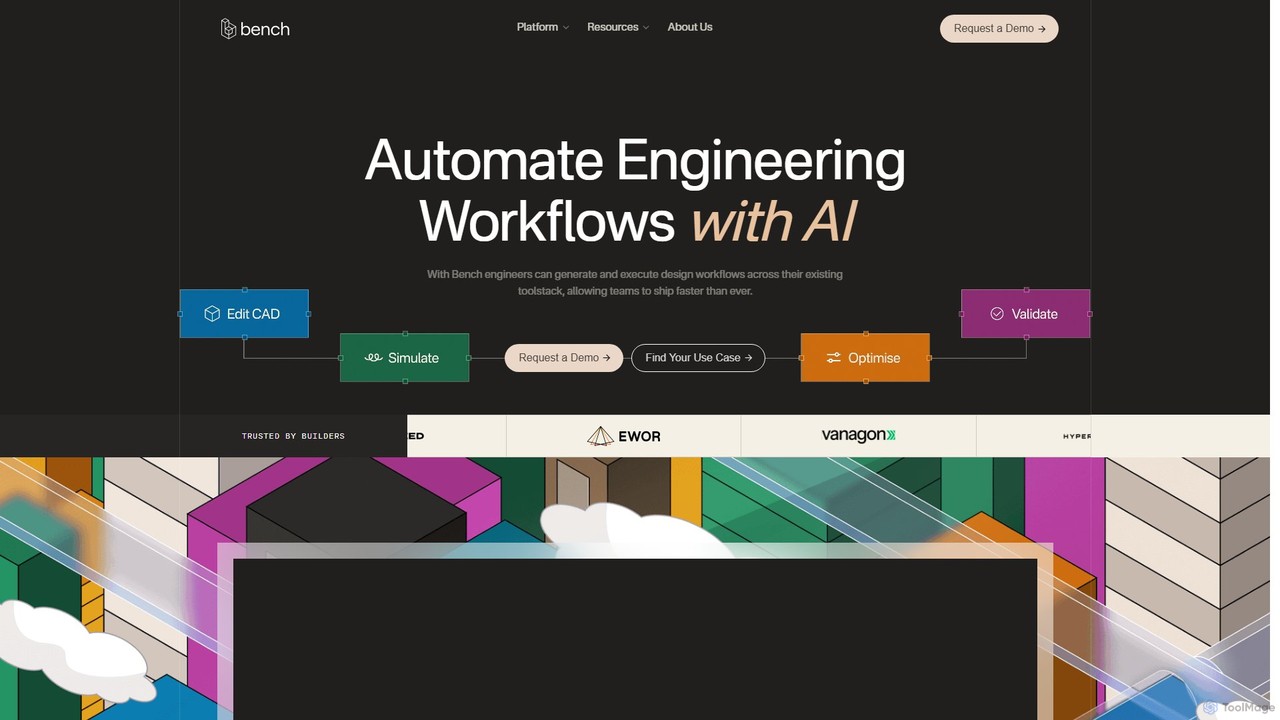
Bench is an AI-powered platform that automates engineering workflows. It integrates with your existing CAD, CAE, and PLM toolstack, enabling engineers to generate and execute complex design workflows, run parallel simulations, and automate revisions, ultimately accelerating product development and time-to-market.
About Engineering
AI Engineering tools are specialized AI-powered applications designed to solve complex problems across various engineering disciplines. These tools leverage advanced machine learning, optimization, and simulation algorithms to enhance every stage of the engineering lifecycle. They enable engineers to accelerate innovation, improve efficiency, reduce costs, and achieve superior performance in design, analysis, manufacturing, and operational processes. Within the broader AI development landscape, AI Engineering tools represent a crucial subset, applying cutting-edge AI to specific, real-world engineering challenges.
Core Features
- Generative Design: Automatically creates optimized designs based on specified parameters and constraints, exploring thousands of possibilities.
- Predictive Analytics: Forecasts equipment failures, material properties, or system performance by analyzing historical and real-time data.
- Simulation & Optimization: Runs complex simulations to model physical phenomena and optimizes parameters for maximum efficiency or desired outcomes.
- Automated Quality Control: Utilizes AI vision and data analysis for rapid, accurate inspection and defect detection in manufacturing processes.
- Materials Informatics: Accelerates the discovery, design, and characterization of new materials by predicting properties and guiding experimentation.
Applicable Scenarios
AI Engineering tools are vital for industries like automotive, aerospace, construction, electronics, and manufacturing. They assist mechanical engineers in optimizing component designs, civil engineers in structural analysis, and production managers in predictive maintenance strategies. These tools transform traditional workflows by providing data-driven insights and automation.
How to Choose
When selecting an AI Engineering tool, consider its compatibility with your specific engineering domain (e.g., mechanical, electrical, civil), integration capabilities with existing CAD/CAE/PLM software, and scalability for handling complex models and large datasets. Evaluate the accuracy and reliability of its AI models, the user interface's ease of use for engineers, and the availability of technical support and training resources.

EngineeringUse Cases
Generative Design for Lightweight Components
Mechanical engineers use AI to automatically generate and optimize thousands of design iterations for aircraft or automotive parts, achieving significant weight reduction while maintaining structural integrity. This process drastically cuts down design cycle times, allowing for rapid prototyping and testing of innovative solutions.
Predictive Maintenance of Industrial Machinery
Factory operations teams deploy AI to analyze real-time sensor data from production line equipment, accurately predicting potential failures days or weeks in advance. This enables proactive maintenance, minimizing costly unplanned downtime and extending asset lifespan, leading to significant operational cost savings.
Accelerated Materials Discovery
Research scientists in materials science leverage AI algorithms to screen vast databases of chemical compositions and predict the properties of novel materials. This accelerates the discovery of new alloys, polymers, or composites with specific desired characteristics for advanced applications, significantly reducing R&D timelines.
Automated Quality Inspection in Electronics Manufacturing
Quality control engineers implement AI-powered vision systems to rapidly inspect printed circuit boards (PCBs) for microscopic defects, solder joint issues, or component misplacements. The AI identifies anomalies with high precision, ensuring product reliability and reducing manual inspection errors, thereby improving overall production yield.
Optimizing Building Structural Performance
Civil engineers utilize AI to analyze complex structural models of buildings or bridges, optimizing material usage and design configurations to withstand various environmental loads (e.g., seismic activity, wind). This ensures safety and cost-efficiency in large-scale construction projects, reducing risks and resource consumption.
AI-Assisted Circuit Board Layout
Electrical engineers employ AI tools to assist in the complex task of designing and routing traces on integrated circuit boards. The AI can suggest optimal layouts, identify potential electromagnetic interference issues, and ensure efficient power distribution, significantly speeding up the design process and improving board performance.