Agenta
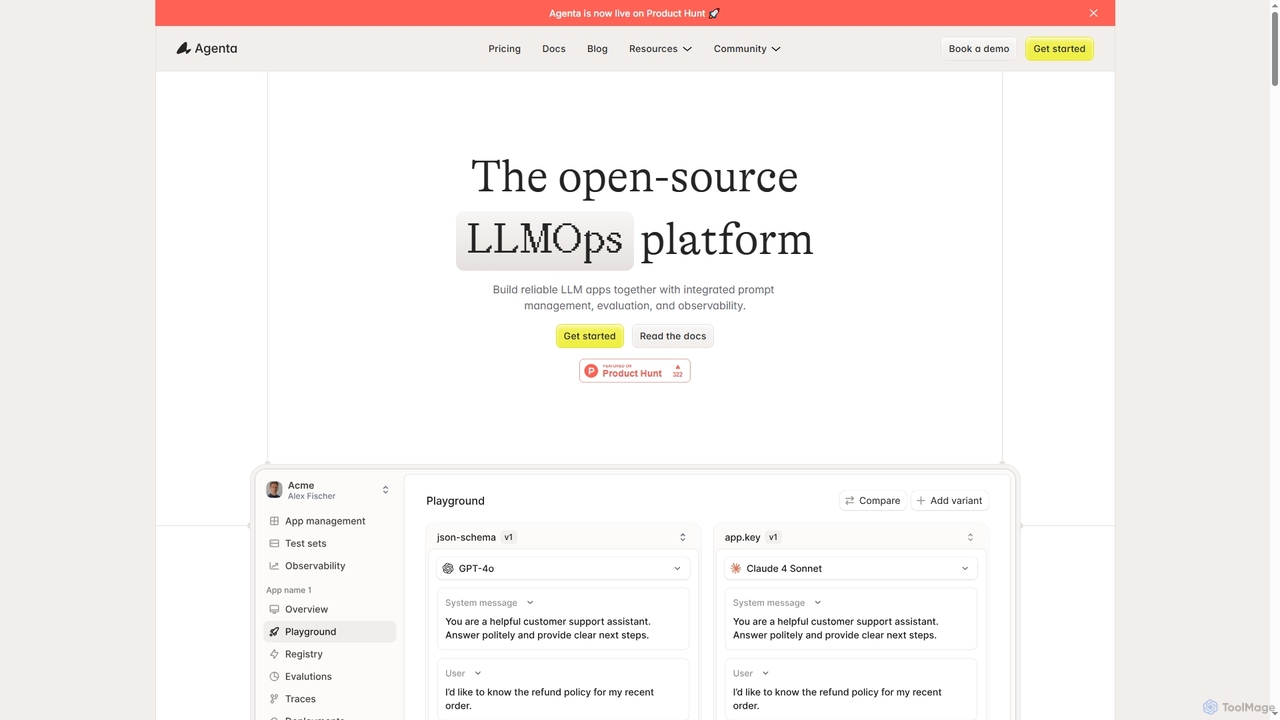
Agenta is an open-source LLMOps platform designed for teams to build reliable LLM applications. It integrates prompt management, …
Agenta is an open-source LLMOps platform designed for teams to build reliable LLM applications. It integrates prompt management, systematic evaluation, and observability into a single, collaborative workflow, helping developers, product managers, and domain experts move from scattered processes to structured development.
Portkey
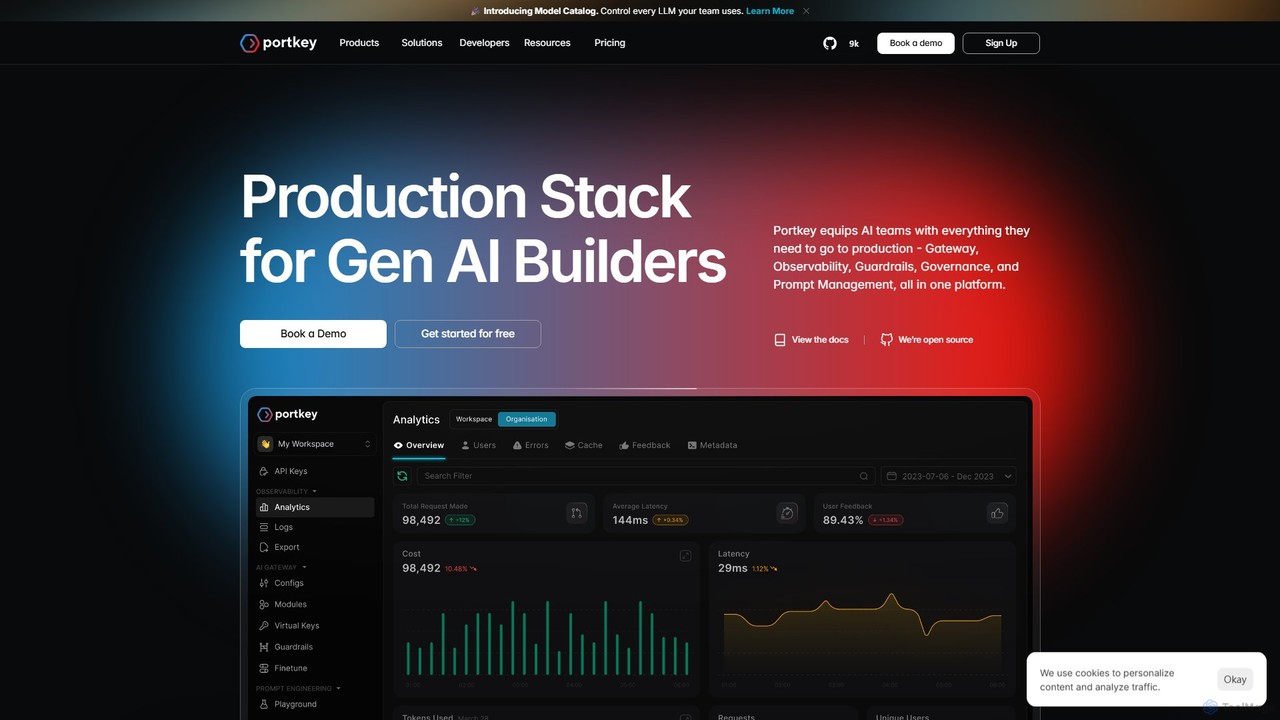
Portkey is a comprehensive LLMOps platform for GenAI developers. It provides a unified AI Gateway to access over …
Portkey is a comprehensive LLMOps platform for GenAI developers. It provides a unified AI Gateway to access over 1600 models, along with tools for observability, prompt management, cost control, and security. Streamline your AI application development from prototype to production with enhanced reliability, scalability, and governance, all in one place.
About Llmops
LLMOps (Large Language Model Operations) are specialized tools and practices designed to manage the entire lifecycle of large language models (LLMs) in production. As a critical component within AI development, these solutions streamline the development, deployment, monitoring, and governance of LLMs, addressing their unique complexities. By integrating MLOps principles with LLM-specific challenges, LLMOps ensures efficient, reliable, and scalable AI application delivery.
Core Features
- Data & Prompt Management: Tools for curating, versioning, and managing datasets for fine-tuning, along with prompt templates and engineering strategies.
- Model Fine-tuning & Experiment Tracking: Capabilities to manage various LLM versions, fine-tuning experiments, hyperparameter configurations, and performance metrics.
- Deployment & Inference Optimization: Features for efficient LLM deployment, including containerization, API management, and optimizing inference speed and cost.
- Performance & Safety Monitoring: Real-time tracking of LLM outputs for accuracy, bias, toxicity, and drift, ensuring responsible AI usage.
- Evaluation & Feedback Loops: Systems for automated and human-in-the-loop evaluation, facilitating continuous improvement and model refinement.
Applicable Scenarios
LLMOps tools are crucial for AI teams developing conversational agents, content generation platforms, or intelligent search systems. They enable MLOps engineers to manage complex LLM pipelines, data scientists to iterate on fine-tuning, and product managers to ensure model quality and compliance in production environments.
How to Choose
When selecting an LLMOps platform, consider its integration capabilities with existing MLOps stacks, support for various LLM architectures (e.g., open-source, proprietary), scalability for inference workloads, and robust monitoring features for performance, bias, and security. Evaluate the ease of prompt management and fine-tuning workflows.

LlmopsUse Cases
Managing LLM Fine-tuning Experiments
A data science team is fine-tuning a base LLM for a specific industry domain, requiring numerous experiments with different datasets, hyperparameters, and prompt strategies. An LLMOps platform allows them to track each experiment, version datasets and models, compare performance metrics, and reproduce successful configurations, significantly accelerating the iteration cycle and ensuring traceability.
Deploying and Scaling Conversational AI
An enterprise needs to deploy a custom-trained LLM to power its customer service chatbot, handling millions of queries daily. LLMOps tools facilitate the efficient deployment of the LLM as an API endpoint, manage traffic scaling, optimize inference latency, and ensure high availability, allowing the chatbot to respond quickly and reliably to a large user base.
Monitoring LLM Performance and Safety in Production
A content generation platform uses an LLM to draft marketing copy. It's critical to monitor the generated content for quality, factual accuracy, brand consistency, and potential toxicity or bias. LLMOps solutions provide real-time dashboards and alerts for these metrics, enabling immediate intervention if the model's output deviates from desired standards or exhibits harmful behavior.
Version Control for Prompts and Model Configurations
A development team is building an application that relies heavily on specific prompt engineering techniques for an LLM. An LLMOps system allows them to version control different prompt templates, track which prompts perform best with which model versions, and manage configuration changes across various deployment stages, ensuring consistency and reproducibility.
Cost Optimization for LLM Inference
A startup is running several LLM-powered features, incurring significant API costs from external providers or GPU usage for self-hosted models. LLMOps platforms offer tools for optimizing inference requests, caching common responses, selecting the most cost-effective model for a given task, and providing detailed cost analytics, helping to manage and reduce operational expenses.
Ensuring LLM Governance and Compliance
A financial institution uses LLMs for internal data analysis and reporting, requiring strict adherence to regulatory compliance and data privacy standards. LLMOps provides capabilities for auditing model decisions, tracking data lineage, implementing access controls, and documenting model behavior, ensuring that LLM usage meets legal and ethical requirements.