ToolMage
Sign in

Best 1 Security AI tools for Development

Popular Security AI tools in Development include DevOps Security, helping you work more efficiently.

DevOps Security
Paid

DevOps Security

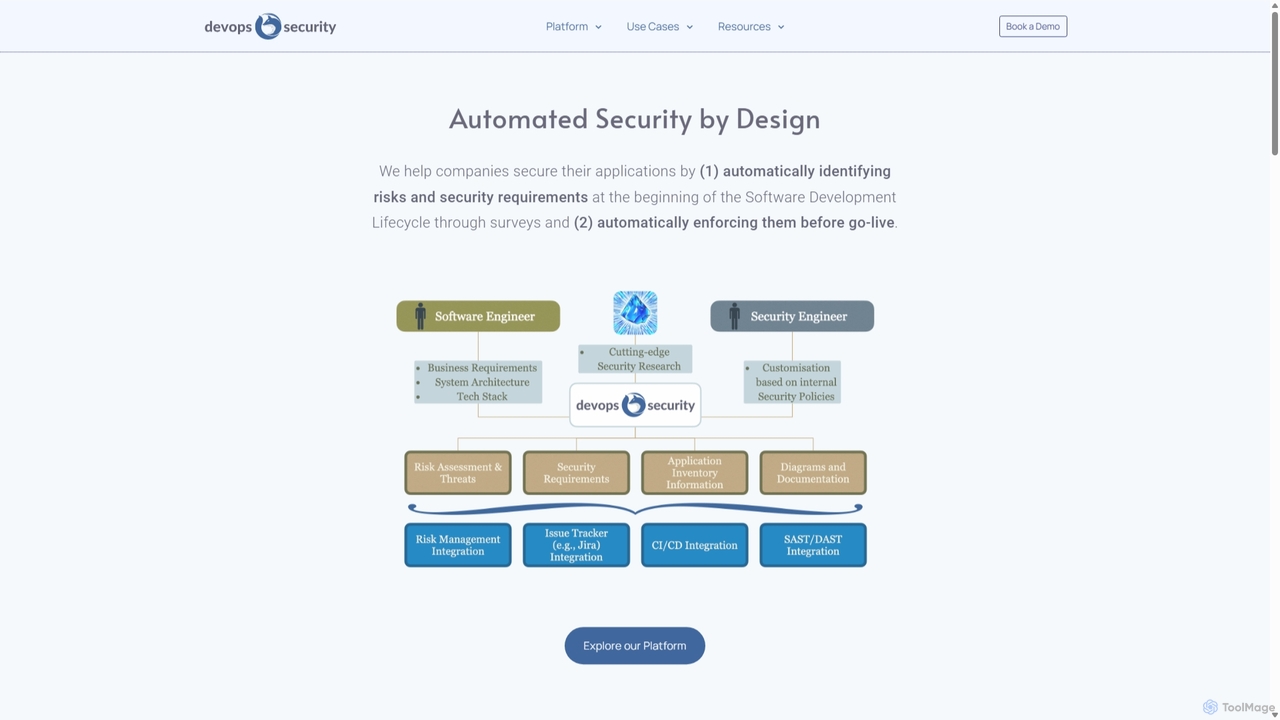
An AI-native platform that automates application security by integrating risk assessment and requirement enforcement directly into the Software Development Lifecycle (SDLC). It helps companies shift security left, empowering developers and streamlining security processes from design to deployment.

Security
Visits 3.5KFavorites 122Likes 114

About Security

AI Security tools are advanced solutions that leverage artificial intelligence and machine learning to enhance the protection of digital assets, systems, and data. Within the broader context of development, these tools automate the identification of vulnerabilities, detect sophisticated threats, and streamline incident response processes. By continuously analyzing vast amounts of data, they provide proactive defense mechanisms crucial for modern software development and operational environments, helping to embed security from the ground up.

Core Features

  • Threat Detection & Prevention: Proactively identify and block malware, phishing attempts, and zero-day exploits.
  • Vulnerability Management: Automatically scan code, applications, and infrastructure for security weaknesses.
  • Automated Incident Response: Rapidly analyze security alerts and initiate automated remediation actions.
  • Behavioral Analytics: Detect anomalous user or system behavior indicative of insider threats or compromised accounts.
  • Security Orchestration, Automation, and Response (SOAR): Integrate security tools and automate workflows for efficient security operations.

Use Cases

Organizations across various sectors utilize AI Security tools to fortify their digital defenses. From financial institutions safeguarding sensitive customer data to technology companies protecting proprietary code, these tools are indispensable. They are employed in DevSecOps pipelines to ensure code security, in cloud environments for continuous monitoring, and in enterprise networks for real-time threat intelligence.

How to Choose

Selecting the right AI Security tool requires evaluating several factors. Consider the specific security challenges you face, such as application security, network security, or data protection. Assess the tool's integration capabilities with existing development and security infrastructure, its scalability to handle growing data volumes, and the accuracy of its AI models in minimizing false positives. Finally, evaluate the vendor's support, compliance certifications, and pricing structure.

Featured tool rankings

Security use cases

1

Automated Code Vulnerability Scanning

Developers and security teams integrate AI Security tools into their CI/CD pipelines to automatically scan source code, dependencies, and containers for known vulnerabilities and misconfigurations. This proactive approach identifies security flaws early in the development lifecycle, reducing remediation costs and preventing insecure code from reaching production. The AI learns from past vulnerabilities, improving its detection accuracy over time.

2

Real-time Threat Detection in Cloud Environments

Cloud security engineers deploy AI-powered security solutions to continuously monitor cloud infrastructure, applications, and data for suspicious activities. The AI analyzes logs, network traffic, and user behavior patterns to detect anomalies indicative of unauthorized access, data exfiltration, or advanced persistent threats, providing instant alerts and often initiating automated containment measures.

3

Predictive Phishing and Malware Prevention

Enterprise security operations centers (SOCs) utilize AI Security tools to analyze incoming emails, web traffic, and file downloads for sophisticated phishing attempts and emerging malware strains. The AI identifies subtle indicators of compromise that might bypass traditional filters, such as polymorphic code or social engineering tactics, proactively blocking threats before they can impact users or systems.

4

Insider Threat Detection and Anomaly Analysis

Security analysts leverage AI to monitor user activity, access patterns, and data movements within an organization's network. By establishing baselines of normal behavior, the AI can flag unusual activities—like an employee accessing sensitive files outside working hours or attempting to exfiltrate large datasets—indicating potential insider threats or compromised accounts, enabling rapid investigation.

5

Automated Security Incident Response

Security teams implement AI-driven SOAR platforms to automate the response to common security incidents. When an alert is triggered (e.g., from an intrusion detection system), the AI can automatically enrich the alert with context, execute predefined playbooks (like isolating an infected host or blocking a malicious IP), and notify relevant personnel, significantly reducing response times and analyst workload.

6

Supply Chain Security and Open-Source Component Analysis

Development and procurement teams use AI Security tools to assess the security posture of third-party software components and open-source libraries used in their projects. The AI scans these components for known vulnerabilities (CVEs), license compliance issues, and potential malicious code, providing a comprehensive risk assessment to ensure the integrity and security of the entire software supply chain.

Security FAQ

What are AI Security tools?

AI Security tools are software solutions that apply artificial intelligence, particularly machine learning, to various aspects of cybersecurity. They are designed to automate and enhance threat detection, vulnerability management, incident response, and security analytics by identifying patterns, anomalies, and sophisticated attacks more effectively than traditional rule-based systems.

How do AI Security tools differ from traditional security solutions?

Traditional security solutions often rely on predefined rules, signatures, and known threat databases. AI Security tools, however, use machine learning algorithms to learn from data, adapt to new threats, and detect unknown or zero-day attacks by identifying deviations from normal behavior. This allows for more proactive and adaptive defense against evolving cyber threats, reducing reliance on manual updates.

What are the main benefits of using AI in cybersecurity?

The primary benefits include enhanced threat detection capabilities, especially against novel and sophisticated attacks; automation of repetitive security tasks, freeing up human analysts; faster incident response times; improved vulnerability management through continuous analysis; and better predictive capabilities for identifying potential risks before they materialize.

Who primarily uses AI Security tools?

AI Security tools are used by a wide range of professionals and organizations. This includes security operations center (SOC) analysts, cybersecurity engineers, developers (especially in DevSecOps roles), cloud architects, and IT administrators. Enterprises of all sizes, government agencies, and critical infrastructure providers leverage these tools to protect their digital assets.

What should I consider when choosing an AI Security tool?

When selecting an AI Security tool, evaluate its specific capabilities (e.g., endpoint protection, network security, application security), its integration with your existing security ecosystem, the accuracy of its AI models (to minimize false positives), its scalability, compliance certifications, and the vendor's reputation and support. Also, consider the ease of deployment and management.