AIInterviewMasters
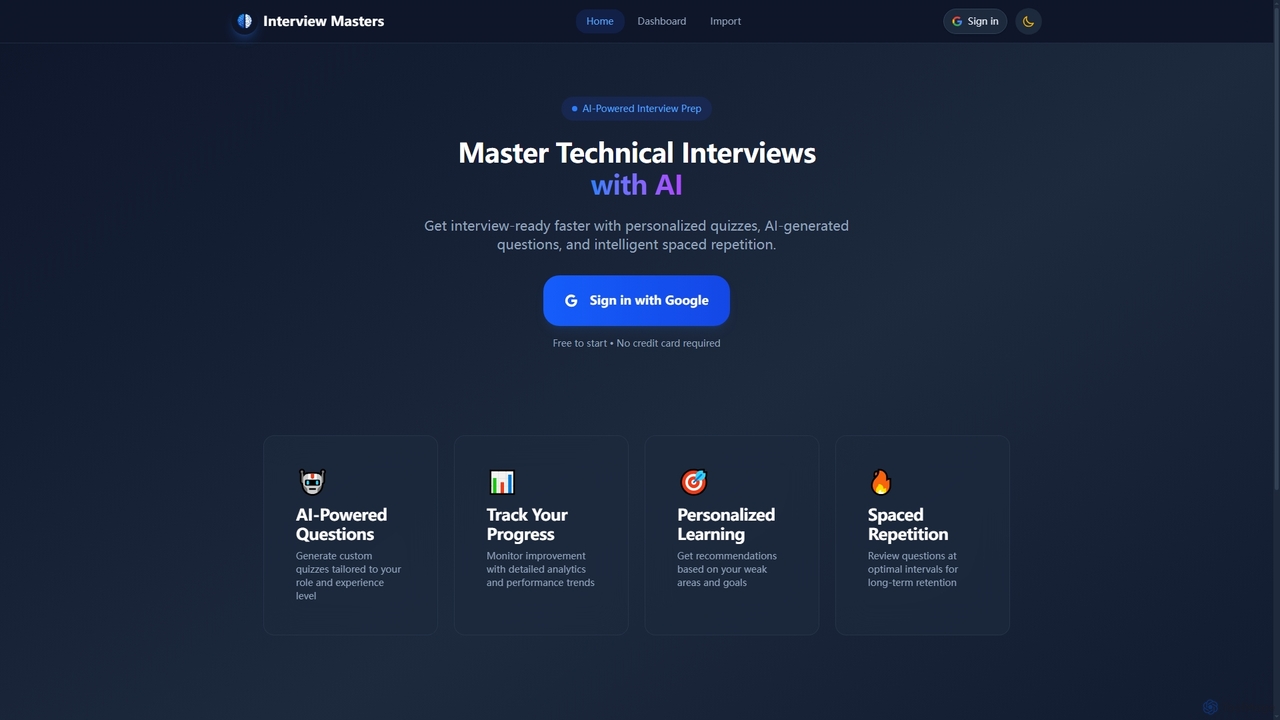
AIInterviewMasters is an AI-powered platform designed for technical interview preparation. It offers personalized quizzes, AI-generated questions, progress tracking, …
AIInterviewMasters is an AI-powered platform designed for technical interview preparation. It offers personalized quizzes, AI-generated questions, progress tracking, and intelligent spaced repetition to help developers and tech professionals excel in their interviews. The platform supports various technical domains and career roles, providing a tailored learning experience.
Skills
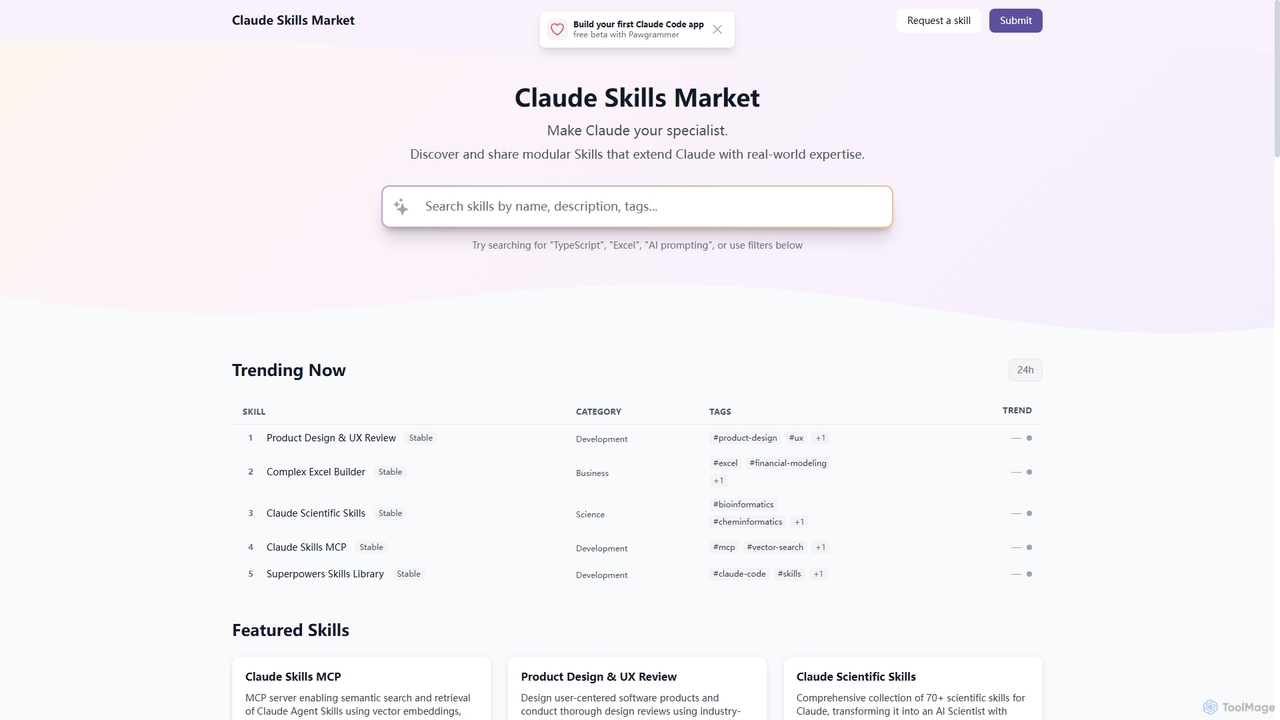
Skills is a dynamic marketplace designed to extend Claude's capabilities with specialized, real-world expertise. It offers a diverse …
Skills is a dynamic marketplace designed to extend Claude's capabilities with specialized, real-world expertise. It offers a diverse collection of modular tools, transforming Claude into a specialist across various domains like product design, financial modeling, scientific research, and software development.
About Software Engineering
Software Engineering AI tools are a category of artificial intelligence applications designed to enhance and automate various stages of the software development lifecycle (SDLC). These advanced tools leverage machine learning, natural language processing, and predictive analytics to assist developers, QA engineers, and project managers throughout their workflows. They aim to significantly improve code quality, accelerate development cycles, and streamline complex engineering processes, from initial design and coding to rigorous testing, deployment, and ongoing maintenance.
Core Features
- AI Code Generation & Completion: Automatically generates code snippets, functions, or boilerplate based on natural language prompts, existing code context, or design specifications, significantly speeding up development.
- Automated Testing & Debugging: Intelligently identifies potential bugs, suggests precise fixes, and generates comprehensive, context-aware test cases to ensure software reliability and robustness.
- Code Refactoring & Optimization: Analyzes code for inefficiencies, security vulnerabilities, and technical debt, suggesting intelligent improvements for performance, readability, and adherence to coding standards.
- Intelligent Documentation Generation: Automatically creates or updates technical documentation, API references, and inline comments directly from source code, ensuring consistency and reducing manual effort.
- Requirement Analysis Assistance: Utilizes natural language processing to help clarify, structure, and validate software requirements from informal descriptions, minimizing ambiguities early in the SDLC.
Applicable Scenarios
These tools are invaluable for development teams across various industries, from startups to large enterprises, seeking to boost productivity, maintain high code quality, and accelerate time-to-market. Individual developers use them for daily coding tasks and problem-solving, QA teams leverage them for comprehensive and efficient testing, and project leads benefit from better planning, risk assessment, and oversight of complex projects. AI in software engineering is fundamentally transforming how software is conceptualized, built, and maintained.
Key Selection Criteria
When selecting Software Engineering AI tools, consider the specific SDLC stages you want to augment, such as initial design, coding, testing, or documentation. Evaluate their integration capabilities with your existing development environment (IDEs, version control systems, CI/CD pipelines), the accuracy and relevance of their AI suggestions, and their robust security features for handling sensitive proprietary code. Additionally, assess the tool's scalability, the learning curve for your team, and the availability of strong community support or vendor assistance.

Software EngineeringUse Cases
Accelerating Feature Development with AI Code Assistants
Software developers, especially those working on complex applications, can leverage AI code generation tools to quickly produce boilerplate code, implement common design patterns, or even suggest algorithms for specific problems. By inputting natural language descriptions or existing code context, developers can receive intelligent code suggestions, significantly reducing manual coding time and allowing them to focus on more intricate logic and innovation. This accelerates the delivery of new features and product iterations.
Automating Comprehensive Test Case Generation
QA engineers and testing teams face the challenge of creating extensive test suites for new features and bug fixes. AI-powered testing tools can analyze application code, user stories, or existing test data to automatically generate a wide range of test cases, including unit, integration, and end-to-end tests. This automation ensures broader test coverage, identifies edge cases that might be missed manually, and frees up QA resources for more complex exploratory testing, leading to more robust software releases.
Enhancing Code Quality and Security through AI Review
Development teams can integrate AI code review tools into their CI/CD pipelines to automatically scan code for potential bugs, performance bottlenecks, security vulnerabilities (like SQL injection or cross-site scripting), and deviations from coding standards. These tools provide instant feedback and actionable suggestions, helping developers fix issues early in the development cycle. This proactive approach significantly improves overall code quality, reduces technical debt, and strengthens the security posture of applications before deployment.
Streamlining Technical Documentation with AI
Technical writers and developers often spend considerable time creating and updating documentation for APIs, internal libraries, and user manuals. AI documentation tools can analyze source code, extract relevant information, and automatically generate initial drafts of API references, inline comments, or even user-facing guides. This process ensures documentation consistency, reduces the burden on developers, and keeps technical specifications up-to-date with code changes, improving knowledge sharing and onboarding.
Optimizing Legacy System Refactoring and Modernization
Enterprises dealing with large, complex legacy systems often struggle with refactoring and modernization efforts. AI software engineering tools can analyze vast codebases to identify redundant code, dead code, performance bottlenecks, and areas ripe for modularization or architectural improvements. They can suggest refactoring strategies, automatically convert older syntax to modern equivalents, or even help migrate components to new frameworks, significantly reducing the risk and effort involved in modernizing critical applications.
Assisting in Software Design and Architectural Decision-Making
Software architects and lead developers can utilize AI tools to explore and evaluate different design patterns and architectural choices. By inputting system requirements, constraints, and desired outcomes, AI can suggest potential architectural components, data flow diagrams, or even evaluate the trade-offs of various design decisions (e.g., scalability, cost, performance). This provides valuable insights, helps validate design hypotheses, and accelerates the initial design phase of complex software projects.