DeepSeek V3
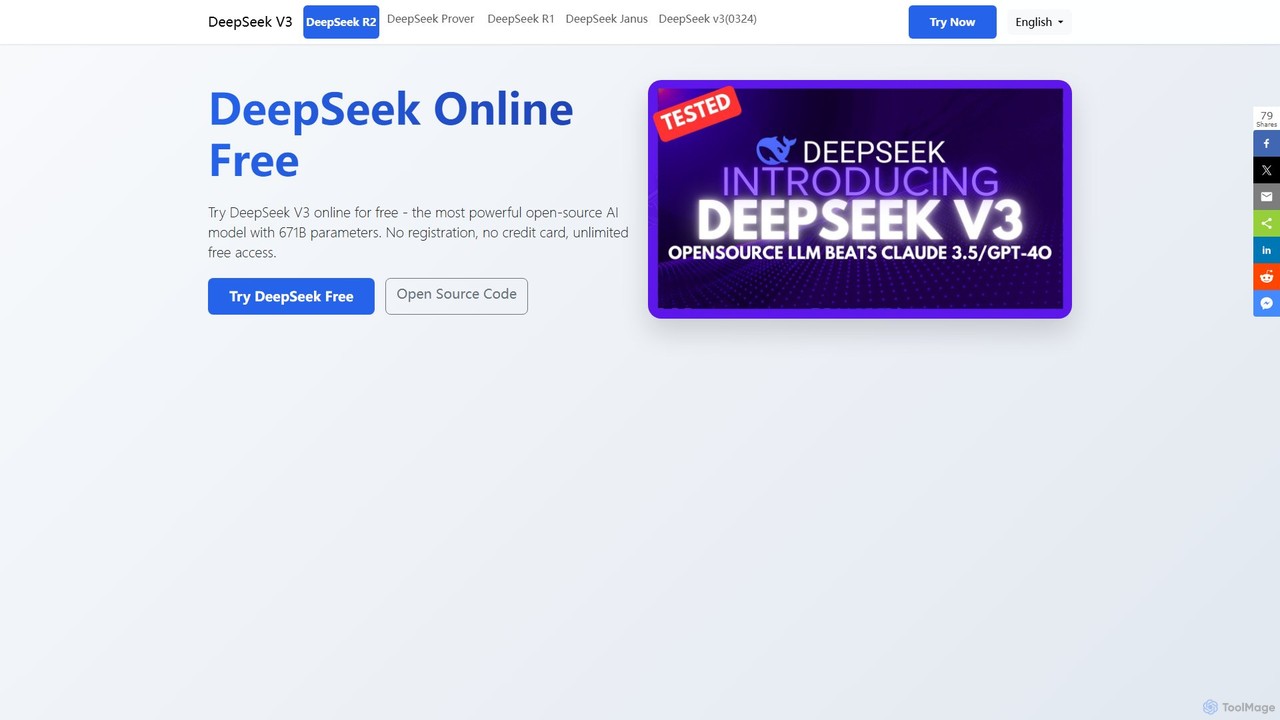
An online platform providing free, no-registration access to DeepSeek V3, a state-of-the-art open-source Mixture-of-Experts (MoE) large language model. It excels at complex reasoning, coding, and multilingual tasks.
Code AssistantPopular Ai Tutor AI tools in Education include DeepSeek V3, helping you work more efficiently.

An online platform providing free, no-registration access to DeepSeek V3, a state-of-the-art open-source Mixture-of-Experts (MoE) large language model. It excels at complex reasoning, coding, and multilingual tasks.
Code AssistantAI Tutors are intelligent learning systems designed to provide personalized, one-on-one educational support. They leverage natural language processing and machine learning to understand a student's knowledge level, adapt to their learning pace, and offer interactive guidance. This creates a dynamic learning environment that provides instant feedback, customized exercises, and step-by-step explanations. Unlike static online courses, AI Tutors engage users in a conversational dialogue, helping to deepen conceptual understanding and build confidence.
AI Tutors are widely used by students preparing for standardized tests (like SAT, GRE, or GMAT), professionals learning new technical skills such as coding or data analysis, and language learners seeking conversational practice. They also serve as valuable homework assistants for K-12 students and supplementary learning aids for complex university subjects.
When selecting an AI Tutor, consider the subject matter coverage and its depth. Evaluate the quality and style of its instructional feedback—does it simply give answers or guide you to them? Assess its adaptability and how well it personalizes the learning path. Finally, consider the user interface and the modes of interaction it supports, such as text, voice, or interactive simulations.

A high school student preparing for the SAT uses an AI Tutor to improve their math score. The tutor first administers a diagnostic test to identify weak areas, such as geometry and advanced algebra. Based on the results, it generates a personalized study plan with targeted practice problems and interactive lessons. When the student gets a question wrong, the AI provides a step-by-step explanation and offers similar problems to ensure they grasp the concept, rather than just memorizing the answer.
A marketing professional aiming for a career change into data science uses an AI Tutor to learn Python. The platform provides a structured curriculum, from basic syntax to complex libraries like Pandas and NumPy. The tutor offers interactive coding sandboxes where the user can write and execute code directly. If the code has an error, the AI not only points out the bug but also explains the underlying programming concept, accelerating the learning curve significantly compared to passive video tutorials.
A user learning Spanish wants to practice their conversational skills. They use an AI Tutor that specializes in language learning. The user can engage in simulated conversations, such as ordering food at a restaurant or asking for directions. The AI Tutor provides real-time feedback on pronunciation, grammar, and word choice. It can also adjust its speaking speed and vocabulary complexity based on the user's proficiency, creating a low-pressure environment to build speaking confidence.
A middle school student is stuck on a complex physics problem for their homework. Instead of searching for the answer online, they use an AI Tutor. The student inputs the problem, and the AI, using the Socratic method, doesn't give the solution directly. Instead, it asks guiding questions like, 'What formula do you think applies here?' or 'What is the first step to solving this?'. This process helps the student think critically and arrive at the solution on their own, leading to deeper and more lasting understanding of the subject.
A company implements an AI Tutor to train new employees on complex internal software. The tutor provides a safe, simulated environment where employees can practice tasks without affecting live data. It offers personalized modules based on job roles and provides instant, contextual help when an employee gets stuck. This approach reduces the burden on senior staff for training and allows new hires to become proficient at their own pace, 24/7.
A university student studying organic chemistry uses an AI Tutor to visualize and understand complex molecular structures and reaction mechanisms. The tutor can generate 3D models of molecules that the student can rotate and inspect. When studying a reaction, the AI can break it down into animated, step-by-step sequences, explaining the movement of electrons and the formation of bonds in a way that a static textbook cannot. This interactive visualization helps solidify abstract concepts.
An AI Tutor is a software application that uses artificial intelligence to provide personalized and interactive learning experiences. Unlike traditional educational software, it adapts to an individual's learning style and pace. Key features include instant feedback, customized learning paths, and the ability to answer complex questions through natural language conversation. They act as a 24/7 personal guide for mastering new subjects.
The key difference is interactivity and personalization. Online courses typically provide static content like videos and articles for you to consume passively. An AI Tutor, on the other hand, creates a dynamic, two-way learning dialogue. It actively assesses your understanding, asks questions, adapts to your responses, and provides tailored feedback, simulating the experience of working with a human tutor.
A wide range of learners can benefit from AI Tutors. This includes:
When selecting an AI Tutor, consider these factors:
Yes, AI Tutors can be particularly effective for complex subjects. They can break down intricate topics into smaller, manageable parts and present them in various formats, such as interactive simulations or visualizations. For subjects like advanced mathematics, physics, or programming, an AI Tutor can provide step-by-step guidance and immediate feedback on practice problems, which is crucial for building a solid foundation and overcoming learning plateaus.