PawChamp
PawChamp is an online platform offering personalized, science-based dog training, behavior solutions, and comprehensive care education. It leverages …
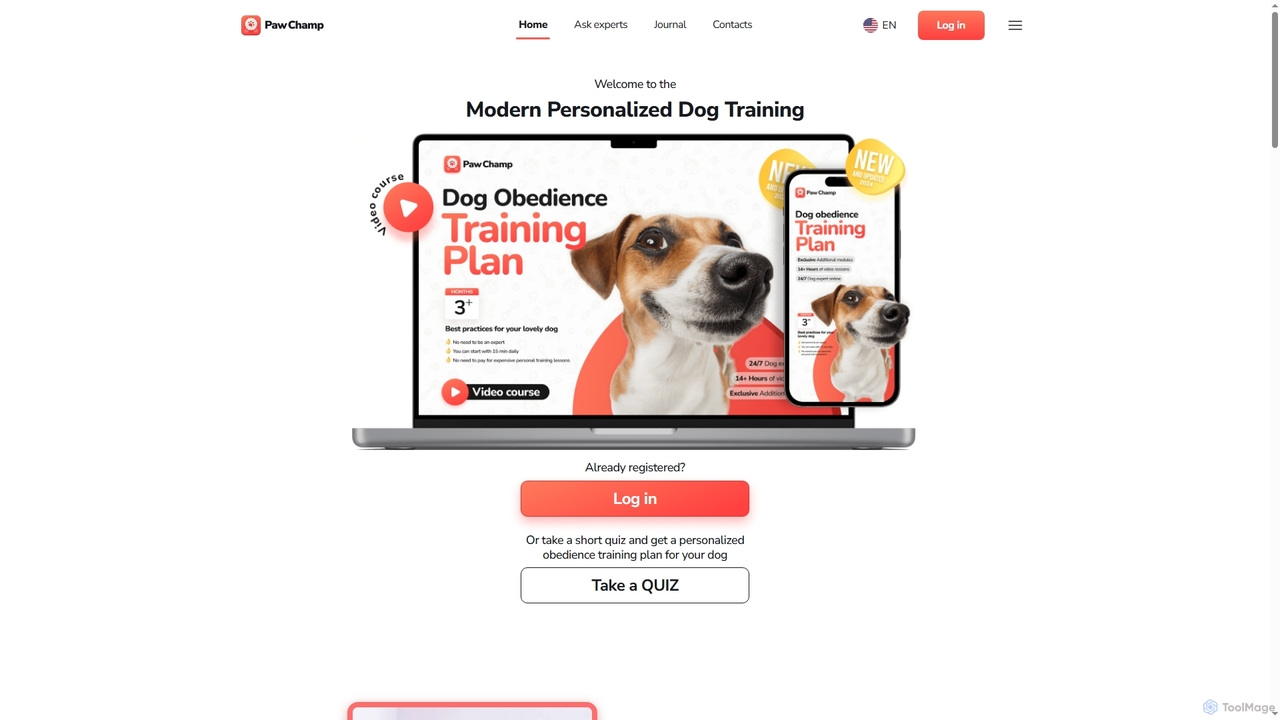
PawChamp is an online platform offering personalized, science-based dog training, behavior solutions, and comprehensive care education. It leverages positive reinforcement and expert guidance to help pet parents build stronger bonds with their dogs, accessible via web and mobile apps.
About Animal Behavior
Animal Behavior AI tools are specialized platforms that leverage artificial intelligence to observe, analyze, and interpret the actions and interactions of animals. Utilizing advanced computer vision, machine learning, and bioacoustics, these tools provide unprecedented insights into ethology, ecology, and animal welfare. They serve as crucial resources for researchers, conservationists, and educators seeking to understand complex animal patterns and improve management strategies, representing a key area within AI-driven scientific education.
Core Features
- Automated Tracking & Identification: Automatically monitors and identifies individual animals or groups in various environments.
- Behavioral Pattern Recognition: Detects and classifies specific animal actions, such as feeding, mating rituals, aggression, or play.
- Bioacoustics Analysis: Interprets animal vocalizations to understand communication, stress levels, or species presence.
- Environmental Interaction Analysis: Quantifies how animals respond to changes in their habitat or specific stimuli.
- Predictive Modeling: Forecasts potential behavioral shifts or population movements based on historical and real-time data.
Applicable Scenarios
These tools are indispensable for wildlife conservationists monitoring endangered species, veterinary professionals diagnosing subtle health issues in pets, and agricultural researchers optimizing livestock management. They enable non-invasive, large-scale data collection and analysis, transforming how we study and interact with the animal kingdom.
How to Choose
When selecting an Animal Behavior AI tool, consider its compatibility with your data sources (e.g., video, audio, sensor data), the specificity and accuracy of its behavioral recognition algorithms, and its scalability for your project size. Evaluate the user interface for ease of data input and interpretation, and assess its integration capabilities with existing research or management platforms.

Animal BehaviorUse Cases
Wildlife Population Monitoring
Conservationists and ecologists utilize Animal Behavior AI tools to automatically count and identify individual animals from camera trap footage or drone imagery. This allows for non-invasive tracking of population dynamics, migration patterns, and species distribution over vast areas, providing critical data for conservation strategies and habitat management without disturbing the animals.
Early Disease Detection in Livestock
Farmers and agricultural researchers deploy AI-powered cameras and sensors to continuously monitor the behavior of farm animals like cattle or poultry. By analyzing subtle changes in movement, posture, feeding habits, or vocalizations, the AI can detect early signs of illness, stress, or lameness, enabling timely intervention and improving animal welfare and productivity.
Pet Welfare and Health Monitoring
Pet owners and veterinarians use AI-powered devices and applications to track a pet's daily activity levels, sleep patterns, and vocalizations. The AI analyzes this data to identify deviations from normal behavior, signaling potential discomfort, anxiety, or underlying health issues, thereby enabling proactive care and improving the quality of life for companion animals.
Researching Social Structures and Interactions
Ethologists and behavioral scientists apply AI to analyze extensive video recordings of animal groups, such as primate colonies or bird flocks. The AI automatically maps social hierarchies, interaction frequencies, and communication networks, providing objective and detailed insights into complex social dynamics that would be time-consuming and prone to human bias with traditional observation methods.
Optimizing Zoo Animal Enrichment
Zoo and sanctuary staff leverage Animal Behavior AI tools to observe and quantify how captive animals interact with their environment and enrichment items. By analyzing behavioral data, the AI helps identify which enrichment strategies are most effective in promoting natural behaviors, reducing stereotypic actions, and improving overall animal welfare, leading to better habitat design and care protocols.
Automated Pest Behavior Study
Agricultural researchers and entomologists employ Animal Behavior AI tools to track and analyze the movement, feeding habits, and reproductive behaviors of insect pests in controlled laboratory settings or agricultural fields. This data-driven approach helps in developing more effective and targeted pest control strategies, reducing reliance on broad-spectrum pesticides and minimizing environmental impact.