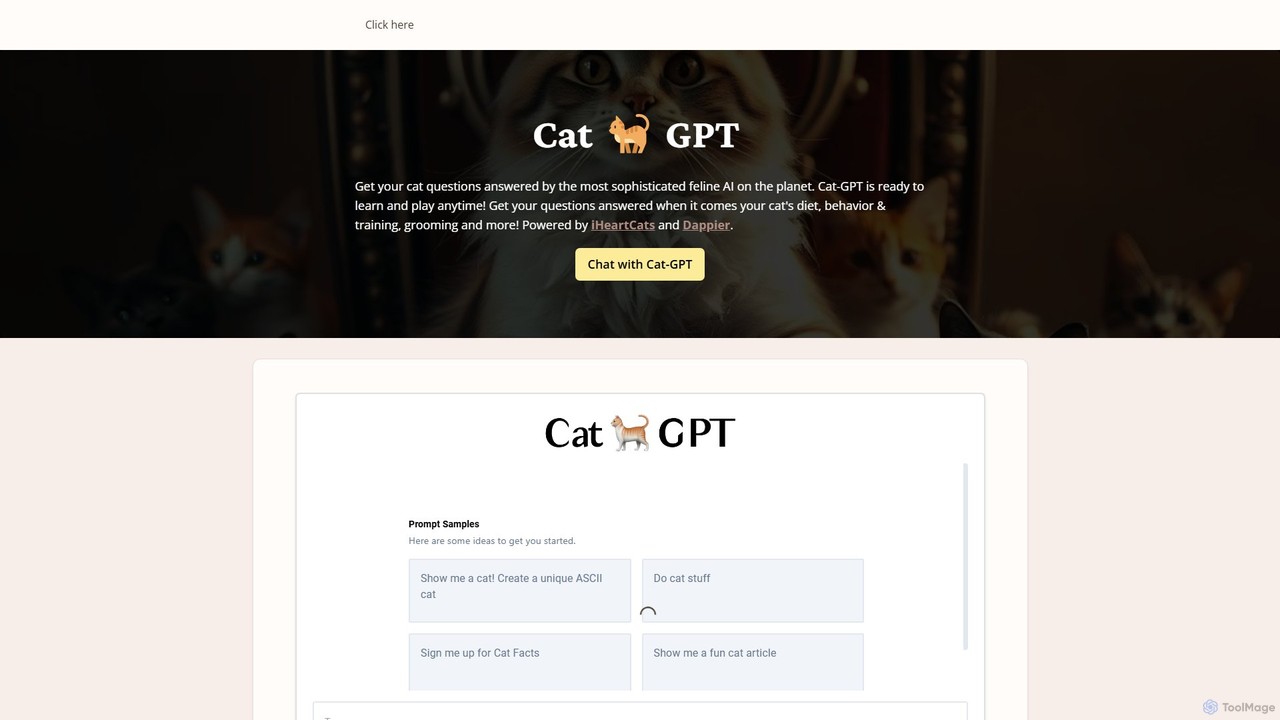
CatGPT
CatGPT is a specialized AI chatbot designed for cat owners and enthusiasts. It provides instant, expert-level answers on …
CatGPT is a specialized AI chatbot designed for cat owners and enthusiasts. It provides instant, expert-level answers on a wide range of feline topics, including diet, nutrition, behavior, training, and health. Powered by iHeartCats, this tool combines a vast database of cat knowledge with a fun, playful AI personality, making it an essential resource for understanding and caring for your cat.
About Animal Care
AI Animal Care tools are a specialized category of educational software that use artificial intelligence to monitor, analyze, and interpret animal behavior and health data. These tools leverage technologies like computer vision, sound analysis, and machine learning to translate complex data into understandable insights. They serve as powerful educational aids for veterinary students, researchers, and pet owners, helping to deepen understanding of animal welfare and identify potential issues early. By providing data-driven feedback, these applications promote more informed and proactive care for animals.
Core Features
- Behavior Analysis: Uses video or audio input to identify patterns, stress signals, or specific behaviors like barking or scratching.
- Health Monitoring: Tracks vital signs, activity levels, and other physiological data through connected sensors or cameras.
- Species Identification: Identifies animal species from images or sounds, providing educational information for students and enthusiasts.
- Symptom Triage Assistance: Guides users in observing and recording potential health symptoms to facilitate more effective veterinary consultations.
- Personalized Care Recommendations: Generates suggestions for diet, exercise, and enrichment based on an animal's specific data and profile.
Applicable Scenarios
These tools are valuable in various educational and care settings. Veterinary students use them to practice diagnostic skills on simulated cases. Pet owners utilize them for daily monitoring to better understand their companion's needs. In agriculture, they help in monitoring the health and welfare of livestock, while conservationists use them to track and study wildlife populations without invasive methods.
Selection Criteria
When choosing an AI Animal Care tool, consider the specific animal type (e.g., canine, feline, avian, livestock). Evaluate the scientific validity and accuracy of the AI models used. Assess the types of data input required (e.g., video, sensor data) and its compatibility with your existing devices. Finally, review the data privacy policy to understand how your animal's information is handled.
Animal CareUse Cases
Monitoring Pet Behavior for Early Health Alerts
A pet owner uses an AI-powered camera system to monitor their cat's daily activities. The AI analyzes video feeds to establish a baseline of normal behavior, such as eating, sleeping, and litter box usage. If the system detects a significant deviation, like a sudden decrease in activity or repeated failed attempts to use the litter box, it sends an alert to the owner's phone. This allows the owner to notice subtle changes that might indicate a health issue, prompting a timely visit to the veterinarian for a check-up, potentially catching conditions like urinary tract infections early.
Assisting Veterinary Students with Diagnostic Training
A veterinary school incorporates an AI simulation tool into its curriculum. The tool presents students with virtual animal patients exhibiting a range of symptoms generated by an AI model. Students can interact with the simulation, ordering virtual tests and analyzing AI-generated results. The AI provides instant feedback on their diagnostic process, comparing their approach to established veterinary protocols. This educational application allows students to gain practical experience in a risk-free environment, honing their clinical reasoning skills before working with live animals.
Identifying Wildlife for Conservation Research
A conservation biologist sets up camera traps in a remote forest to study a rare species. They use an AI tool to process thousands of captured images. The AI automatically identifies the target species, filters out irrelevant images (e.g., moving leaves), and can even distinguish between individual animals based on unique markings like stripe patterns. This automates a previously manual and time-consuming task, allowing the researcher to analyze population size, territory range, and behavior patterns much more efficiently, contributing valuable data to conservation efforts.
Optimizing Livestock Welfare on a Farm
A farm manager installs an AI monitoring system in a dairy barn. The system uses computer vision to track the movement and behavior of each cow. It can detect early signs of lameness by analyzing gait patterns or identify cows that are isolated from the herd, which can be an indicator of illness. The manager receives daily reports and alerts on their tablet, allowing them to provide targeted care to specific animals before a condition worsens. This data-driven approach improves overall herd health, enhances animal welfare, and can lead to better productivity.
Translating Animal Vocalizations for Deeper Understanding
A cat owner uses a mobile app that claims to translate their cat's meows into human language. While not a literal translation, the AI model, trained on a vast database of cat vocalizations, analyzes the pitch, tone, and context of each meow. It then provides a likely interpretation, such as 'I'm hungry,' 'I want to play,' or 'I'm stressed.' This serves as an educational tool, helping the owner become more attuned to their pet's different vocal cues and needs, fostering a stronger bond and more responsive care.
Enhancing Classroom Learning with Species Identification
A biology teacher takes their class on a nature walk equipped with a tablet running an AI species identification app. When a student finds an insect or a plant, they can take a picture, and the AI instantly identifies it, providing its scientific name, habitat, and interesting facts. This interactive experience transforms a simple walk into a dynamic learning session. It encourages curiosity and allows students to engage directly with their local ecosystem, making abstract biological concepts like biodiversity and classification tangible and memorable.