sopcreator
sopcreator is an AI-powered suite of tools designed to help students with their university applications. It can generate …
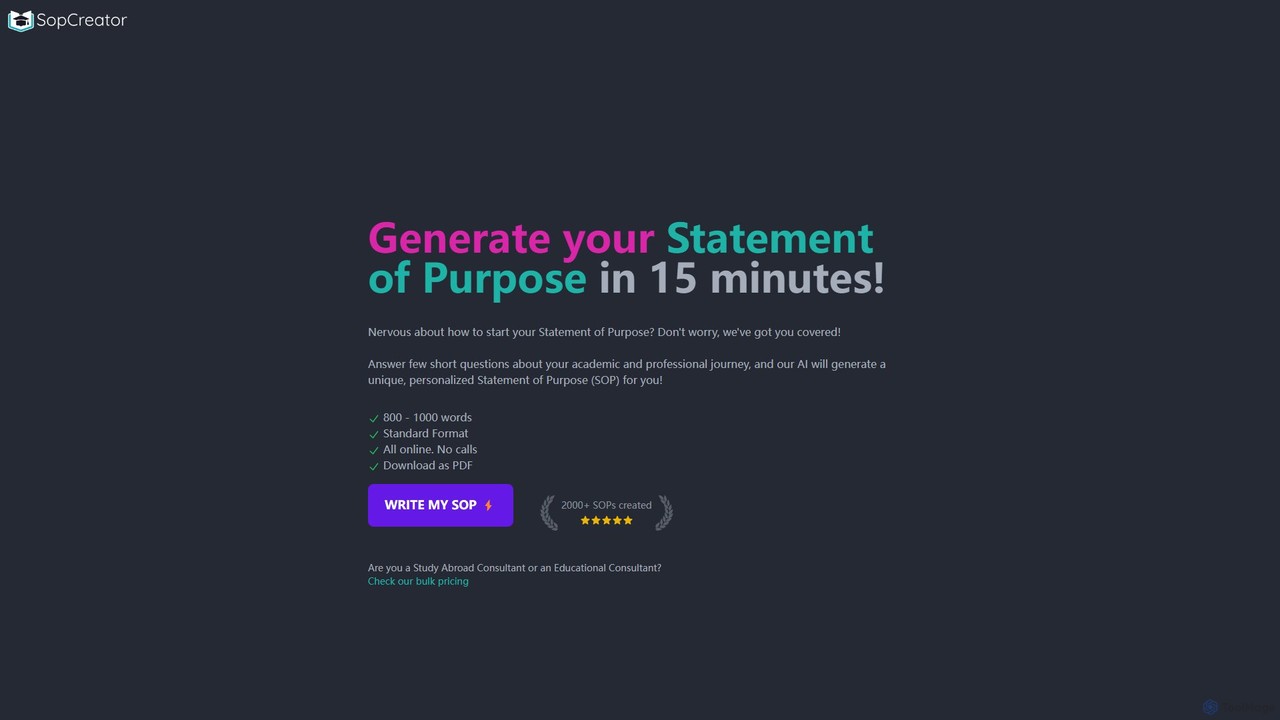
sopcreator is an AI-powered suite of tools designed to help students with their university applications. It can generate a personalized Statement of Purpose (SOP) in minutes by answering a few questions. The platform also includes a free AI SOP reviewer, an AI Letter of Recommendation (LOR) generator, and other resources to streamline the stressful application process and create high-quality, compelling documents.
About Application
AI Application tools in education are specialized software solutions that leverage artificial intelligence to enhance learning, teaching, and administrative processes. These tools utilize advanced algorithms, machine learning, and natural language processing to deliver personalized experiences, automate tasks, and provide intelligent insights. They aim to make education more accessible, engaging, and effective for students, educators, and institutions by adapting to individual needs and optimizing educational content delivery.
Core Features
- Personalized Learning Paths: Dynamically adjust curriculum and content based on a student's progress, learning style, and performance data.
- Intelligent Tutoring Systems: Provide real-time, adaptive feedback and guidance, acting as virtual tutors for various subjects.
- Automated Assessment & Grading: Efficiently evaluate assignments, quizzes, and essays, offering immediate feedback to students and saving teachers time.
- Content Curation & Recommendation: Discover, organize, and suggest relevant educational resources, articles, and videos tailored to specific learning objectives.
- Language Learning & Practice: Offer interactive conversational practice, pronunciation feedback, and grammar correction for language acquisition.
Use Cases
These AI applications are widely adopted across various educational settings. Students utilize them for self-paced learning, receiving personalized homework help, and preparing for exams. Teachers employ these tools to streamline lesson planning, differentiate instruction, and gain deeper insights into student performance. Educational institutions leverage AI applications for large-scale assessment management, curriculum development, and improving overall student engagement and retention.
How to Choose
When selecting an AI application for education, consider its pedagogical alignment with learning objectives, data privacy and security protocols, and seamless integration capabilities with existing Learning Management Systems (LMS). Evaluate the user experience for both students and educators, the scalability of the solution to accommodate varying user numbers, and the quality of support and training provided. Prioritize tools that offer clear, measurable educational outcomes and ethical AI practices.

ApplicationUse Cases
Personalized Study Plan Generation
Students struggling with time management or specific subjects can use AI education applications to generate dynamic, personalized study plans. These tools analyze past performance, learning pace, and curriculum requirements to suggest optimal study schedules, resource recommendations, and practice exercises, helping students focus on areas needing improvement and achieve academic goals more efficiently.
Automated Essay Grading & Feedback
For educators managing large classes, AI applications can significantly reduce the workload of grading written assignments. These tools automatically assess essays for grammar, style, coherence, and content relevance, providing instant, objective feedback to students. This allows teachers to focus on higher-level instruction and spend more time on individual student needs, while students receive timely insights to improve their writing skills.
Interactive Language Practice
Language learners can utilize AI-powered applications for immersive and interactive practice sessions. These tools often feature AI chatbots for conversational practice, speech recognition for pronunciation correction, and grammar checkers. This provides a safe, accessible environment for learners to practice speaking and writing in a new language at their own pace, receiving immediate feedback without the pressure of human interaction.
Curriculum Content Curation & Discovery
Educators and curriculum developers can leverage AI applications to efficiently curate and discover relevant learning materials. These tools scan vast databases of academic papers, textbooks, videos, and online courses, recommending content that aligns with specific learning objectives, grade levels, and subject areas. This saves significant time in resource gathering and ensures that students have access to up-to-date and diverse educational content.
Adaptive Learning Modules for STEM
In STEM fields, AI applications create adaptive learning modules that adjust difficulty and content based on a student's real-time understanding. For instance, a math application might provide more practice problems on fractions if a student struggles, or advance to more complex topics if mastery is shown. This ensures that each student learns at an optimal pace, preventing disengagement from overly easy material or frustration from overly difficult concepts.
Virtual Lab Simulations & Experimentation
Students can engage with AI-powered virtual lab applications to conduct complex scientific experiments without the need for physical equipment or hazardous materials. These simulations allow for interactive manipulation of variables, observation of realistic outcomes, and analysis of data, providing a safe and accessible environment for hands-on learning in subjects like chemistry, physics, and biology, enhancing practical understanding and critical thinking.