Lore
Lore is a premier media and intelligence platform for the AI era, delivering a weekly newsletter (Lore Brief) …
Lore is a premier media and intelligence platform for the AI era, delivering a weekly newsletter (Lore Brief) and podcast (The Next Wave) to over 40,000 professionals. It offers curated AI tool rankings, company profiles, and in-depth guides to help builders and innovators stay ahead.
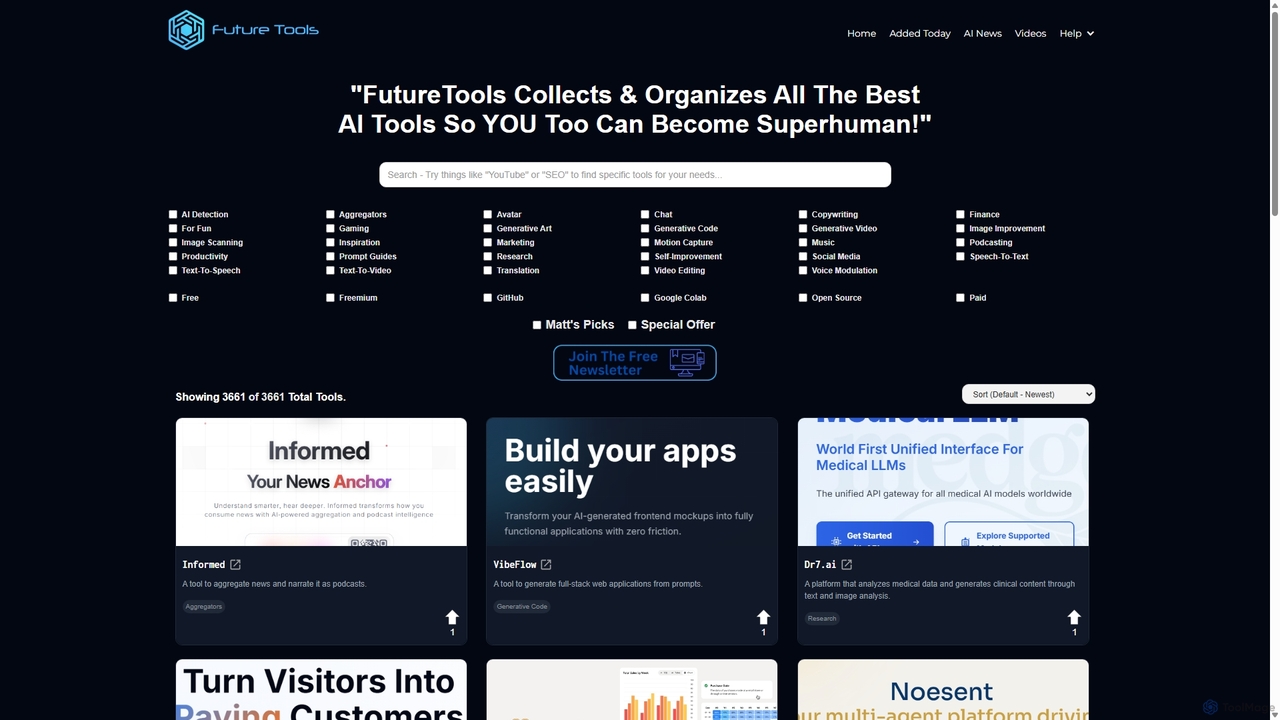
FutureTools
FutureTools is the largest and most comprehensive curated directory of AI tools. Founded by Matt Wolfe, it collects …
FutureTools is the largest and most comprehensive curated directory of AI tools. Founded by Matt Wolfe, it collects and organizes the best AI applications, helping users find the perfect solution for any need. It features thousands of tools, daily updates, community ratings, and expert picks.
Llama2.ai
A web-based chat interface for developers and AI enthusiasts to directly interact with Meta's advanced Llama language models, …
A web-based chat interface for developers and AI enthusiasts to directly interact with Meta's advanced Llama language models, such as Llama 3.1. It operates on the Replicate platform, requiring users to provide their own Replicate API key for a hands-on testing and prototyping experience.
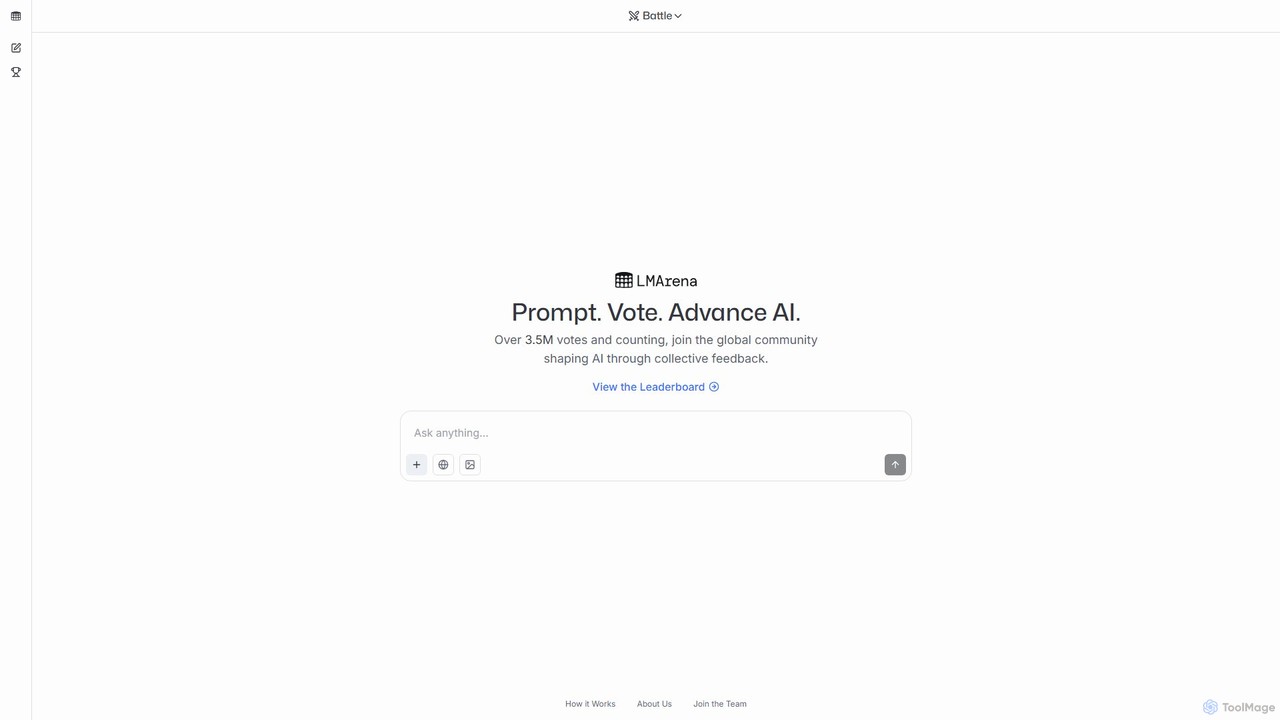
LMArena
LMArena is an open, crowdsourced platform from UC Berkeley researchers for evaluating and comparing leading AI models. Users …
LMArena is an open, crowdsourced platform from UC Berkeley researchers for evaluating and comparing leading AI models. Users anonymously test two models side-by-side, vote for the best response, and contribute to a dynamic, public leaderboard. It aims to make AI progress transparent and grounded in real-world human feedback.
About Artificial Intelligence
Artificial Intelligence tools in education are applications designed to enhance learning experiences, streamline teaching tasks, and improve administrative efficiency. They leverage technologies like machine learning and natural language processing to create personalized learning paths, automate assessments, and provide data-driven insights. These tools support educators by automating repetitive work and offer students adaptive, interactive learning environments. The primary value lies in making education more accessible, individualized, and effective for diverse learners.
Core Features
- Personalized Learning Paths: Adapts educational content and difficulty in real-time based on a student's performance and learning pace.
- Automated Grading & Feedback: Uses AI to evaluate assignments, quizzes, and essays, providing instant, constructive feedback to students.
- Intelligent Tutoring Systems: Provides one-on-one, AI-driven guidance and support to students, answering questions and explaining complex concepts.
- Educational Content Creation: Assists educators in generating lesson plans, study guides, test questions, and other learning materials.
- Predictive Analytics: Analyzes student data to identify at-risk learners and predict academic outcomes, enabling early intervention.
Use Cases
These tools are widely used by K-12 teachers, university professors, corporate trainers, and school administrators. For instance, a teacher can use an AI platform to generate differentiated homework for a mixed-ability class. A university can deploy an AI-powered system to analyze enrollment trends and optimize course scheduling.
How to Choose
When selecting an AI educational tool, consider its integration capabilities with your existing Learning Management System (LMS). Evaluate its data privacy and security policies, ensuring compliance with student protection regulations. Assess the pedagogical approach behind the AI to ensure it aligns with your educational philosophy, and consider the ease of use for both educators and students.
Artificial IntelligenceUse Cases
Automated Quiz Generation for Teachers
A high school history teacher needs to create a quiz on the American Revolution for a class with diverse learning needs. Using an AI educational tool, the teacher inputs the key topics and desired difficulty levels. The AI instantly generates multiple-choice, short-answer, and essay questions, creating three distinct versions of the quiz tailored for different student groups. This process reduces preparation time from several hours to under 30 minutes, allowing the teacher to focus more on individual student support.
AI-Powered Study Assistant for Students
A university student is struggling with complex concepts in their organic chemistry course. They use an AI tutoring application that acts as a 24/7 study partner. The student can upload their lecture notes, and the AI generates flashcards and practice problems based on the material. When they get a problem wrong, the AI provides a step-by-step explanation, not just the correct answer. This personalized, on-demand support helps the student master difficult topics at their own pace, leading to better exam performance.
Accelerating Academic Research with AI
A postgraduate researcher is conducting a literature review for their thesis, a task that involves sifting through hundreds of academic papers. They use an AI research assistant tool to automate this process. By inputting keywords and research questions, the AI scans vast databases, identifies the most relevant papers, and generates concise summaries for each. It can also visualize connections between different studies and authors, helping the researcher quickly identify key themes and gaps in the existing literature, significantly speeding up the initial research phase.
Language Learning with an AI Conversation Partner
Someone learning French wants to practice their speaking skills but lacks a native speaker to converse with. They use an AI language learning app that features a conversational chatbot. The user can engage in simulated, real-life dialogues, such as ordering at a café or asking for directions. The AI provides instant feedback on pronunciation and grammar, suggests more natural phrasing, and can adjust the conversation's complexity based on the user's proficiency. This provides a safe, non-judgmental environment for immersive practice anytime, anywhere.
Administrative Task Automation for Schools
A school administrator is tasked with creating the master schedule for the upcoming academic year, a complex process involving hundreds of students, dozens of teachers, and limited classroom space. They use an AI-powered scheduling tool. By inputting all constraints—such as teacher availability, student course requests, and room capacities—the AI algorithm generates several optimized, conflict-free schedule options in a matter of hours. This replaces weeks of manual work, reduces human error, and ensures a more balanced and efficient allocation of school resources.
Creating Accessible Learning Materials
An instructional designer at a university is tasked with making course materials accessible for students with disabilities. They use an AI tool to automatically convert lecture transcripts into structured summaries with key takeaways. The same tool can generate accurate alt text for images in presentations and create audio versions of written content. This ensures that all students, including those with visual or hearing impairments, can access and engage with the learning materials effectively, promoting a more inclusive educational environment.