ToolMage
Sign in

Best 4 Assessment Generation AI tools for Education

Popular Assessment Generation AI tools in Education include Conker, coschool, WEXT AI, and Finetune AI, helping you work more efficiently.

Finetune AI

Finetune AI

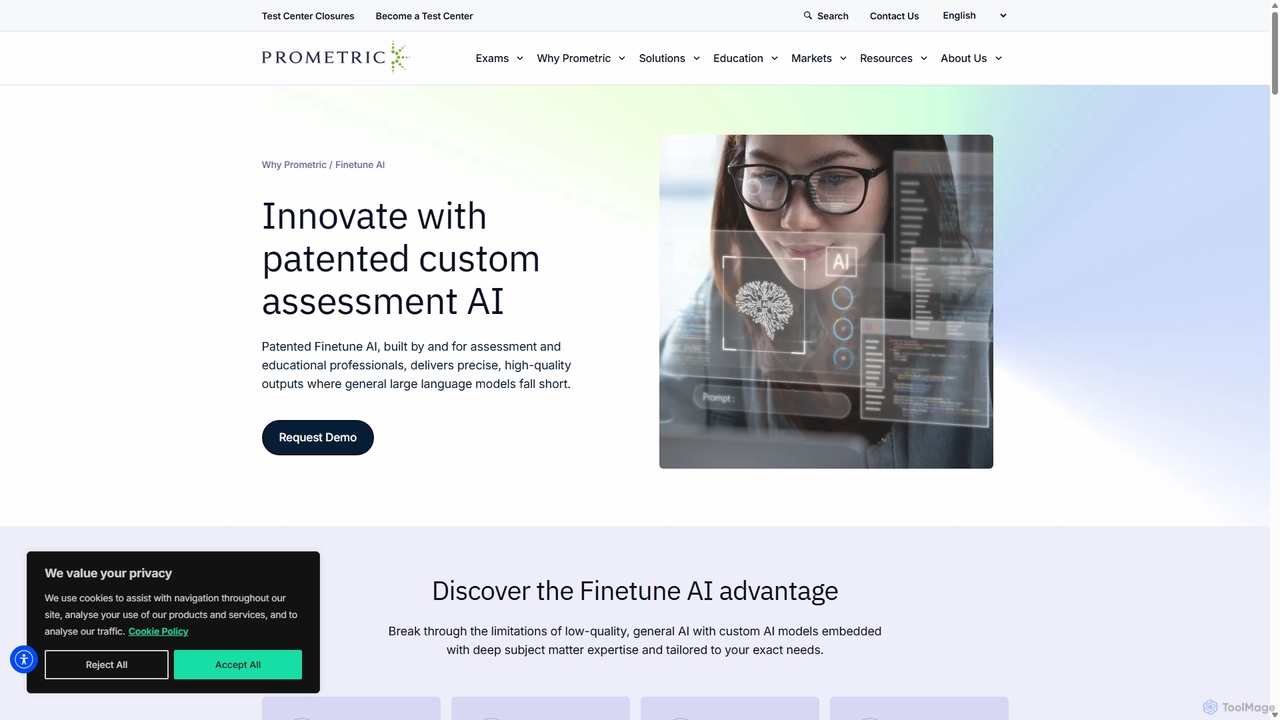
Finetune AI by Prometric is a patented, purpose-built AI platform for creating, managing, and aligning high-quality educational and professional assessments. It leverages custom-trained models to deliver precise, relevant content, overcoming the limitations of general large language models for high-stakes testing and learning.

Custom Ai Models
Visits 5.5KFavorites 122Likes 122
coschool
Freemium

coschool

coschool is an AI-powered co-pilot for educators, designed to streamline workflows and reduce administrative burdens. It helps teachers generate high-quality lesson plans, quizzes, worksheets, report card comments, and other educational materials in minutes, freeing up valuable time to focus on teaching and student engagement.

Assessment Generation
Visits 14.9KFavorites 134Likes 141
WEXT AI
Freemium

WEXT AI

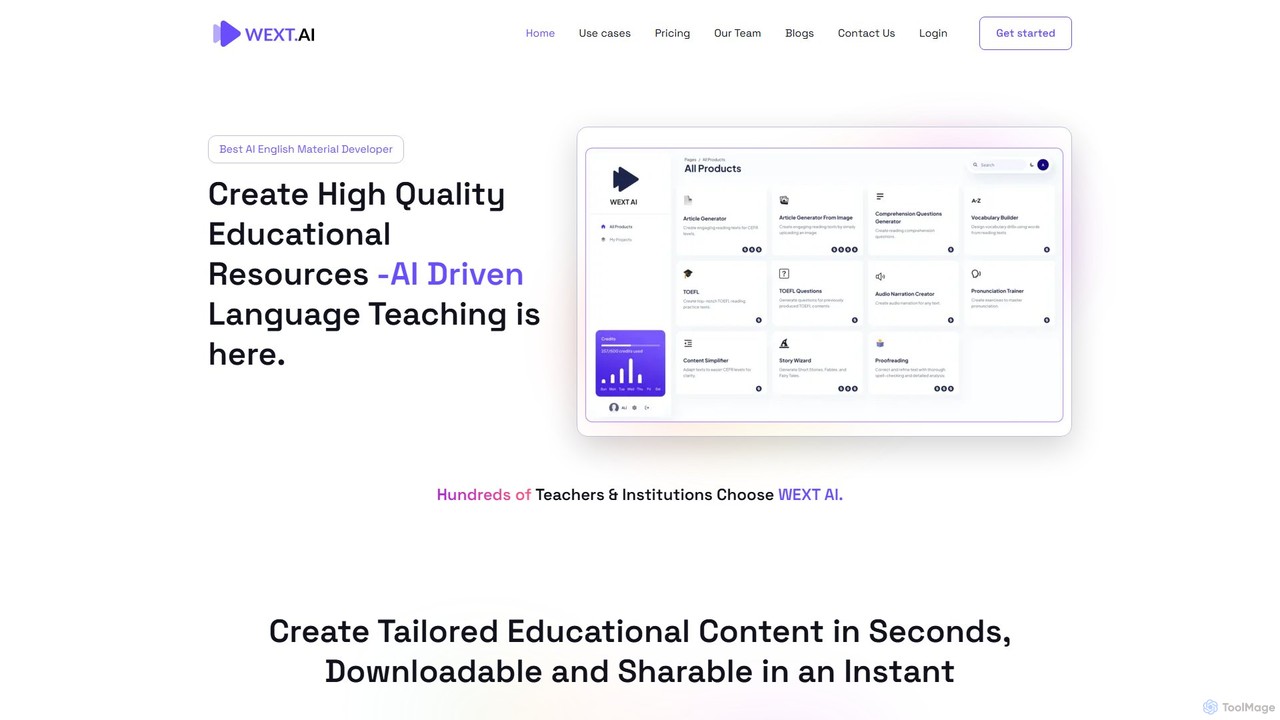
WEXT AI is an advanced AI-powered platform for English language educators, institutions, and publishers. It streamlines the creation of high-quality, CEFR-aligned teaching materials, including reading articles, vocabulary drills, TOEFL practice texts, and comprehension questions. With features like image-to-text generation, audio narration, and content simplification, WEXT AI saves hours of prep time, enabling teachers to focus on delivering engaging and personalized learning experiences.

Assessment Generation
Visits 6.5KFavorites 118Likes 126
Conker
Freemium

Conker

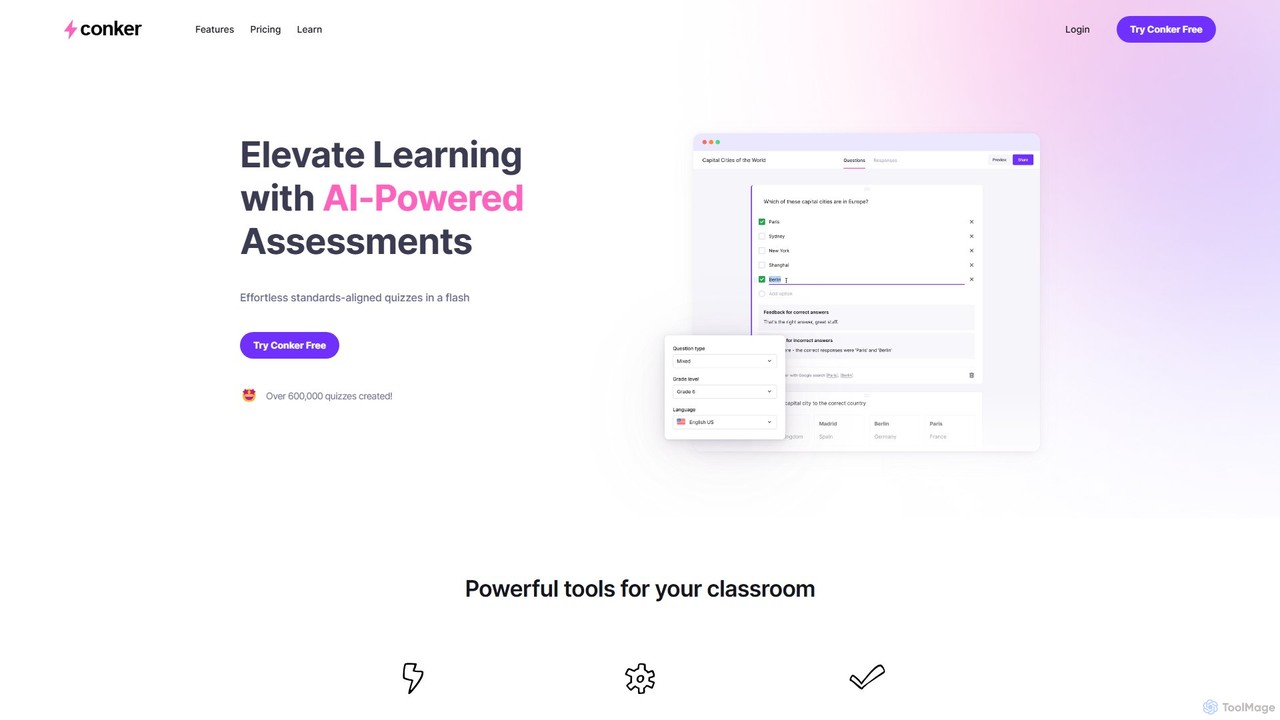
Conker is an AI-powered quiz generator designed for educators. It instantly creates customizable, standards-aligned assessments and quizzes with various question types. This tool helps teachers save time, differentiate instruction, and increase student engagement by integrating seamlessly with platforms like Google Forms and Canvas.

Assessment Generation
Visits 47.3KFavorites 172Likes 159

About Assessment Generation

Assessment Generation tools are a specialized category of AI that automatically create quizzes, tests, and evaluation materials from existing content. These platforms analyze documents, articles, videos, or any text-based source to generate relevant questions and answers. This process significantly reduces the manual effort for educators and trainers to design effective learning checks. By leveraging natural language processing (NLP), these tools can produce a variety of question formats, saving hours of preparation time and ensuring assessments are closely aligned with the source material.

Core Features

  • Multiple Question Types: Automatically generate multiple-choice, true/false, fill-in-the-blank, and open-ended questions.
  • Source Content Analysis: Ingest and understand various content formats, including PDFs, DOCX, URLs, and video transcripts.
  • Difficulty Level Customization: Allow users to set the complexity of questions, often aligned with educational frameworks like Bloom's Taxonomy.
  • Answer Key Generation: Instantly create correct answers and, in some cases, provide explanations for distractors.
  • LMS Export Options: Offer functionality to export quizzes in formats compatible with popular Learning Management Systems (LMS).

Use Cases

These tools are widely used in the education and corporate training sectors. Teachers and professors use them to quickly create formative assessments from lecture notes and reading materials. Corporate trainers and L&D professionals leverage them to build post-training knowledge checks and compliance quizzes. Online course creators also find them valuable for developing engaging assessments for their modules.

How to Choose

When selecting an Assessment Generation tool, consider the types of source content it supports (e.g., text, video, audio). Evaluate the quality and variety of the questions it generates. Check for customization options, such as the ability to edit questions and control difficulty levels. Finally, assess its integration capabilities, especially its ability to export to your existing LMS or educational platform.

Assessment Generation use cases

1

Rapid Quiz Creation for Corporate Training

A Learning and Development (L&D) manager needs to create a comprehension quiz for a new compliance training module delivered as a 50-page PDF. Manually writing thoughtful questions would take several hours. Using an AI Assessment Generation tool, the manager uploads the PDF. The AI analyzes the document and, within minutes, generates 25 multiple-choice and true/false questions covering key policies and procedures. The manager reviews, makes minor edits, and exports the quiz directly into the company's Learning Management System (LMS), reducing preparation time by over 80%.

2

Generating Chapter Quizzes for Higher Education

A university professor is teaching a complex subject and wants to provide weekly quizzes to ensure students are keeping up with the reading material. For each chapter of the textbook, the professor uses an AI assessment tool. They upload a PDF of the chapter, and the AI generates a mix of 20 questions, including multiple-choice for key concepts and short-answer questions for critical thinking. This allows the professor to create consistent, high-quality assessments in under 15 minutes per chapter, freeing up time to focus on preparing lectures and providing student support.

3

Building Assessments for Online Courses

An online course creator is developing a new course on digital marketing. To enhance learner engagement and validate understanding, they need to add a quiz at the end of each video module. They provide the AI tool with the transcript from each video. The tool generates a 10-question quiz for each module, focusing on the specific tactics and data points discussed. This automation allows the creator to build a comprehensive set of assessments for their entire 20-module course in a single afternoon, a task that would have previously taken days of manual work.

4

Creating Practice Exams for Certifications

A professional organization offers a certification for project managers. To help candidates prepare, they want to provide a large bank of practice questions based on their official study guide. The content team uploads the 200-page study guide into an AI assessment generator. The tool is configured to produce higher-order thinking questions (application and analysis). It generates over 500 unique questions, which are then curated and organized into multiple practice exams. This provides candidates with a robust and relevant study resource, created in a fraction of the time it would take to write manually.

5

Personalized Study Tools for Students

A college student is preparing for a final exam in a history course. They have dozens of lecture notes, articles, and textbook chapters to review. To test their own knowledge, the student uploads all their study materials into an AI assessment tool. They generate multiple sets of flashcards and practice quizzes focused on different topics and time periods. This allows the student to actively recall information rather than passively re-reading. They can identify weak spots in their knowledge and focus their remaining study time more effectively, leading to better exam performance.

6

Automating Recruitment Screening Questions

A recruiter is hiring for a technical role that requires specific knowledge of a programming framework. To screen a large volume of applicants, they use an AI assessment tool to create a short technical quiz. They provide the tool with the official documentation of the framework. The AI generates 15 targeted questions that test fundamental concepts and common use cases. This quiz is sent to all applicants as a first screening step, allowing the recruiter to quickly identify candidates with a genuine understanding of the required skills and focus their interview time on the most qualified individuals.

Assessment Generation FAQ

What is AI Assessment Generation?

AI Assessment Generation refers to software that uses artificial intelligence, specifically natural language processing (NLP), to automatically create tests and quizzes from existing content. Instead of manually writing each question, users provide a source material like a document, textbook chapter, or video transcript. The AI then analyzes this content to generate a variety of relevant questions, such as multiple-choice, fill-in-the-blank, and short-answer questions, often complete with answer keys. This automates a time-consuming task for educators, trainers, and content creators.

How to choose the right AI Assessment Generation tool?

To choose the right tool, consider these factors:

  • Content Sources: Ensure the tool supports the formats you use, such as PDF, DOCX, URLs, or video/audio transcripts.
  • Question Quality and Variety: Evaluate the relevance and accuracy of the generated questions. Look for tools that offer multiple question types (e.g., multiple-choice, true/false, open-ended).
  • Customization and Control: Check if you can edit generated questions, adjust difficulty levels, and specify the number of questions.
  • Integration and Export: Determine if the tool can export assessments in a format compatible with your Learning Management System (LMS) or other platforms.
  • Language Support: Verify that the tool can effectively process and generate questions in the language of your source material.
What's the difference between an AI Assessment Generator and a general AI writer?

The key difference lies in their primary function and input-output relationship. A general AI writer (like a text generator) creates new, original content based on a prompt or topic. Its goal is creative generation. In contrast, an AI Assessment Generator analyzes existing, provided content (like a PDF or article) and creates questions *about* that specific content. Its goal is comprehension and knowledge validation, not creating new narrative or informational text. An assessment generator is a specialized tool for education and training, while an AI writer is a broader content creation tool.

What types of questions can these AI tools create?

Most AI Assessment Generation tools can create a wide variety of question formats to suit different learning objectives. Common types include:

  • Multiple-Choice Questions (MCQs): A question followed by several options, with one correct answer.
  • True/False: A statement that the learner must identify as correct or incorrect.
  • Fill-in-the-Blank: A sentence with a key term removed, requiring the learner to supply the missing word.
  • Short Answer / Open-Ended Questions: Prompts that require learners to write a brief response in their own words.
  • Flashcards: Digital cards with a term on one side and its definition on the other, useful for memorization.

The specific types and the quality of the questions can vary between different tools.

Who can benefit from using AI Assessment Generation tools?

A wide range of users can benefit from these tools. Key groups include:

  • Educators (K-12 and Higher Ed): Teachers and professors can save significant time creating quizzes, homework, and exams from their teaching materials.
  • Corporate Trainers & L&D Professionals: They can quickly develop knowledge checks for training programs, onboarding materials, and compliance courses.
  • Online Course Creators: Instructors can easily build assessments to integrate into their digital courses, improving learner engagement and validation.
  • Students: Learners can use these tools to create their own practice questions and flashcards from study notes to prepare for exams.
  • Recruiters and HR Managers: They can generate initial screening quizzes to test candidates' knowledge on specific technical or subject-matter topics.