Manuscript AI
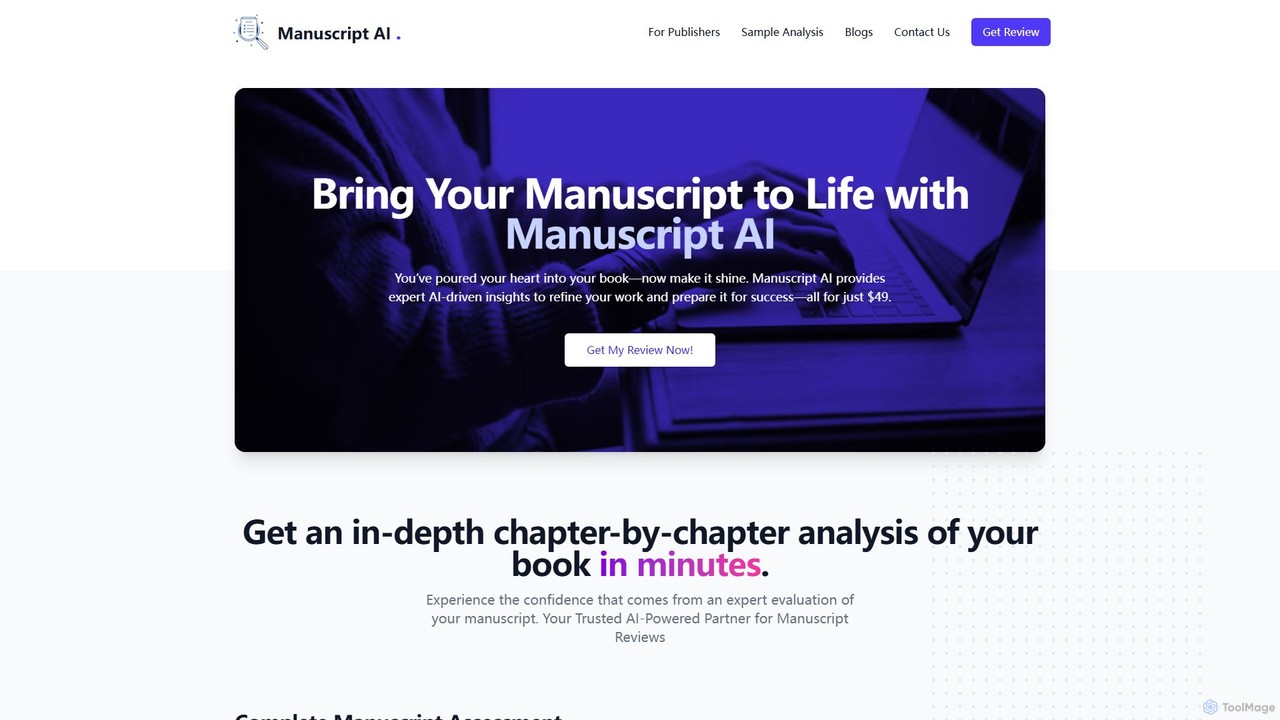
Manuscript AI is an AI-powered tool that provides authors with an in-depth, chapter-by-chapter analysis of their book manuscript …
Manuscript AI is an AI-powered tool that provides authors with an in-depth, chapter-by-chapter analysis of their book manuscript in minutes. It offers unbiased feedback on structure, flow, clarity, and readability, helping writers refine their work for publication. It is particularly effective for non-fiction authors.
About Author Tools
Author Tools are AI-powered applications specifically developed to assist writers, educators, and researchers throughout the content creation lifecycle, particularly within academic and educational contexts. Leveraging advanced natural language processing (NLP) and generation (NLG) capabilities, these tools streamline tasks from initial drafting and comprehensive editing to in-depth research and publication preparation. They significantly enhance writing quality, accelerate content development, and help ensure academic integrity, making the authoring process more efficient, accurate, and impactful for diverse educational materials.
Core Features
- AI-powered Writing Assistance: Offers grammar, style, tone, and clarity suggestions to refine written content.
- Content Generation & Summarization: Generates drafts, outlines, or summaries of complex texts, saving significant time.
- Plagiarism Detection & Originality Checks: Scans content for originality and identifies potential instances of plagiarism, crucial for academic work.
- Research & Citation Management: Assists in finding relevant sources, extracting key information, and generating citations in various formats.
- Multilingual Support & Localization: Provides translation, localization, and cross-language writing assistance for global audiences.
Applicable Scenarios
These tools are invaluable for university students drafting theses, educators creating engaging lesson plans, and researchers synthesizing vast amounts of literature. They support the entire spectrum of educational content creation, from initial concept to final publication, ensuring high-quality and academically sound output.
How to Choose
When selecting an Author Tool, consider its specific writing assistance features (e.g., academic vs. creative), integration capabilities with existing platforms (LMS, word processors), the accuracy and reliability of its plagiarism detection, and its pricing model relative to your usage needs. Prioritize tools that align with your specific authoring workflow and academic standards.

Author ToolsUse Cases
Drafting Academic Papers and Theses
A PhD student uses an Author Tool to generate initial drafts of literature reviews, methodology sections, or abstract summaries. By inputting research questions and key findings, the AI can quickly produce structured text, saving hours of initial writing time and allowing the student to focus on refining arguments and analysis. This accelerates the research publication cycle and improves the coherence of complex academic documents.
Academic Paper Drafting & Refinement
A university student uses an AI author tool to draft sections of their research paper, receive real-time grammar and style suggestions, and ensure proper academic tone. The tool also helps in paraphrasing sources correctly and checking for originality before submission, significantly reducing editing time and improving the paper's overall quality.
Developing Comprehensive Course Materials
An educator leverages Author Tools to create engaging and structured course content. The AI can assist in outlining new modules, generating diverse quiz questions, summarizing complex topics into digestible formats, or even suggesting relevant case studies. This capability allows instructors to rapidly develop high-quality learning materials tailored to specific learning objectives, significantly reducing the time spent on content creation and ensuring consistency across lessons.
Developing Engaging Lesson Plans
An educator leverages an author tool to generate creative ideas for lesson activities, structure curriculum outlines, and summarize complex topics into digestible content for students. This allows them to focus more on pedagogical strategies and student interaction, while the AI handles the initial content generation and refinement, making lesson preparation more efficient.
Streamlining Textbook Chapter Development
Textbook authors utilize Author Tools to accelerate the creation of new chapters or revisions. The AI can generate initial outlines based on learning objectives, suggest examples or analogies to explain difficult concepts, and ensure consistent terminology throughout the book. This not only speeds up the writing process but also helps maintain a uniform pedagogical approach and ensures that the content is accessible and engaging for the target student audience.
Synthesizing Research for Literature Reviews
A researcher utilizes an AI author tool to quickly summarize dozens of academic articles, identify key themes, and extract relevant data points for a comprehensive literature review. The tool helps organize findings, generate preliminary discussion points, and manage citations, drastically accelerating the research synthesis process and ensuring thoroughness.
Enhancing Research Proposal Clarity and Impact
Researchers employ Author Tools to refine their grant applications and research proposals. The AI can analyze the proposal for clarity, conciseness, and adherence to specific funding body guidelines. It can suggest rephrasing for stronger impact, identify areas needing more detail, or even help generate compelling problem statements. This ensures that proposals are well-articulated, persuasive, and have a higher chance of securing funding or approval.
Creating Accessible Educational Materials
An instructional designer employs an author tool to automatically generate captions for video lectures, convert complex text into simpler language for diverse learners, and create audio descriptions for visual content. This ensures that educational resources are inclusive and accessible to students with varying learning needs, broadening the reach and impact of learning materials.
Creating Accessible Educational Content
Content creators in education use Author Tools to ensure their materials are accessible to a wider audience, including those with disabilities. The AI can automatically generate descriptive alt-text for images, transcribe audio lectures into text, or even simplify complex language for learners with cognitive differences. This proactive approach to accessibility helps educational institutions meet compliance standards and fosters a more inclusive learning environment for all students.
Grant Proposal Writing Assistance
A scientist uses an author tool to structure a compelling grant proposal, refine the language for clarity and impact, and ensure all required sections are addressed. The AI can suggest improvements for conciseness, highlight areas needing more detail, and even help in drafting preliminary budget justifications, increasing the likelihood of securing funding.
Localizing Educational Content for Global Audiences
Educational publishers and institutions use Author Tools to adapt their content for diverse linguistic and cultural contexts. The AI can translate course materials, textbooks, and assessments while maintaining pedagogical accuracy and cultural relevance. Beyond direct translation, these tools can help adjust examples, idioms, and references to resonate with local audiences, enabling broader dissemination of educational resources and supporting global learning initiatives effectively.
Multilingual Content Adaptation for Global Learning
An educational institution uses author tools to translate and localize course materials, textbooks, and online modules into multiple languages. The AI ensures cultural relevance and linguistic accuracy, enabling the institution to offer high-quality learning experiences to a global student body without extensive manual translation efforts, expanding their international presence.