SaaStr
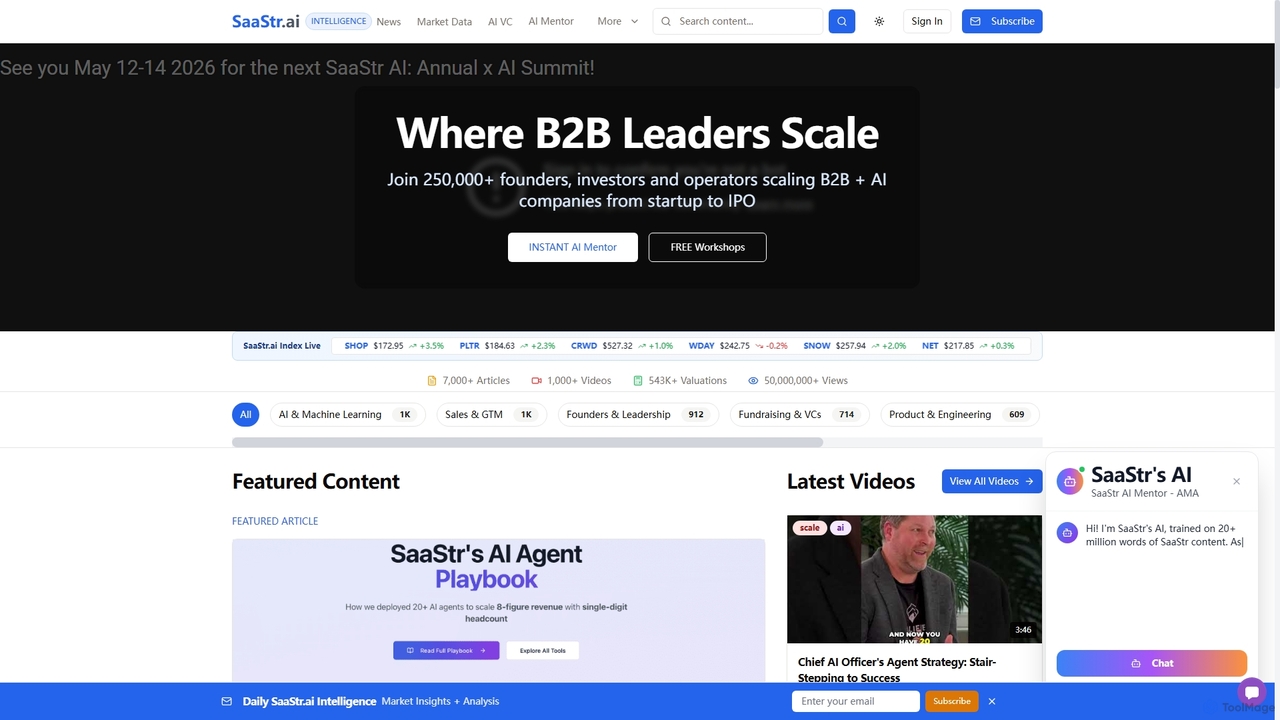
SaaStr is an AI-powered intelligence platform for B2B SaaS leaders, founders, and investors, offering specialized tools for market …
SaaStr is an AI-powered intelligence platform for B2B SaaS leaders, founders, and investors, offering specialized tools for market analysis, fundraising, and strategic growth. It leverages extensive SaaStr content and real-time data to provide expert insights and foster a vibrant community.
About Business Learning
AI Business Learning tools are specialized platforms that use artificial intelligence to create, personalize, and scale corporate training and professional development. These tools leverage machine learning algorithms to analyze individual skill gaps and learning styles, delivering customized educational content. Their primary value lies in enhancing employee upskilling, improving knowledge retention, and directly linking training efforts to business performance outcomes. This approach moves beyond traditional one-size-fits-all training to a more dynamic, data-driven model.
Core Features
- Personalized Learning Paths: AI assesses an employee's current skills and career goals to automatically generate a tailored learning curriculum.
- AI-Powered Coaching and Simulation: Provides real-time feedback and practice in simulated environments for skills like sales, leadership, and communication.
- Automated Content Curation and Creation: Aggregates relevant learning materials or generates new content, such as quizzes and summaries, from existing company documents.
- Skills Gap Analysis: Identifies knowledge deficiencies within teams and across the organization to inform training strategy.
- Performance Analytics: Tracks learner progress and measures the impact of training on key performance indicators (KPIs).
Use Cases
These tools are primarily used in corporate environments by Human Resources (HR) and Learning & Development (L&D) departments. Common applications include automating new employee onboarding, delivering scalable leadership and management training, providing continuous sales enablement, and ensuring company-wide compliance with regulations.
How to Choose
When selecting an AI Business Learning tool, consider its integration capabilities with your existing HRIS or LMS. Evaluate the quality and relevance of its content library, the sophistication of its analytics and reporting features, and its ability to customize learning paths. Finally, assess the pricing model (e.g., per user, per course) and the level of technical support provided.

Business LearningUse Cases
Automated Employee Onboarding
HR managers use AI Business Learning tools to streamline the new hire process. The AI platform automatically assigns a personalized onboarding curriculum based on the employee's role and department. It delivers foundational training modules, company policy videos, and initial software tutorials. New hires can interact with an AI chatbot to get instant answers to common questions, reducing the burden on HR staff and ensuring a consistent, efficient onboarding experience for everyone.
Scalable Sales Training Simulation
Sales enablement teams deploy AI tools to provide realistic, on-demand practice for their sales representatives. The AI simulates various customer personas and common objections, allowing reps to practice their pitches, negotiation skills, and product knowledge in a safe environment. The system provides instant, data-driven feedback on tone, clarity, and effectiveness, helping to identify areas for improvement and standardize best practices across the entire sales force without requiring constant one-on-one coaching.
Personalized Leadership Development
Learning & Development (L&D) teams use AI platforms to create bespoke development plans for current and future leaders. The AI analyzes performance reviews, 360-degree feedback, and self-assessments to identify specific leadership competencies needing improvement, such as strategic thinking or conflict resolution. It then curates a mix of micro-learning modules, articles, and simulated coaching sessions tailored to the individual's needs, allowing for continuous, personalized growth that is more effective than generic management courses.
Company-Wide Compliance Training
A compliance officer in a regulated industry, such as finance or healthcare, uses an AI learning platform to manage mandatory annual training. The system automatically enrolls all employees, tracks completion rates in real-time, and sends automated reminders. To ensure comprehension, the AI generates varied quiz questions for each user, preventing simple answer sharing. For failed attempts, the platform re-assigns only the specific modules related to incorrect answers, making remediation more efficient and targeted.
Developing Technical Skills with AI Tutors
An engineering team needs to adopt a new programming language for an upcoming project. Instead of generic online courses, they use an AI-powered learning platform. The platform provides interactive coding exercises with an AI tutor that offers real-time hints, explains complex concepts, and debugs code snippets. It adapts the difficulty level based on each developer's progress, ensuring they master foundational concepts before moving on. This accelerates the learning curve and ensures the entire team reaches a consistent level of proficiency more quickly.
Improving Soft Skills with AI Feedback
A professional aiming to improve their public speaking and communication skills uses an AI coaching tool. They record practice presentations or meeting conversations, and the AI analyzes their speech for factors like pace, use of filler words, tone of voice, and clarity. The tool provides a detailed report with specific, actionable feedback, such as suggesting areas to slow down or rephrase for better impact. This allows for frequent, private practice and objective feedback that is difficult to obtain otherwise, leading to faster improvement in crucial soft skills.