Constitucion.ai
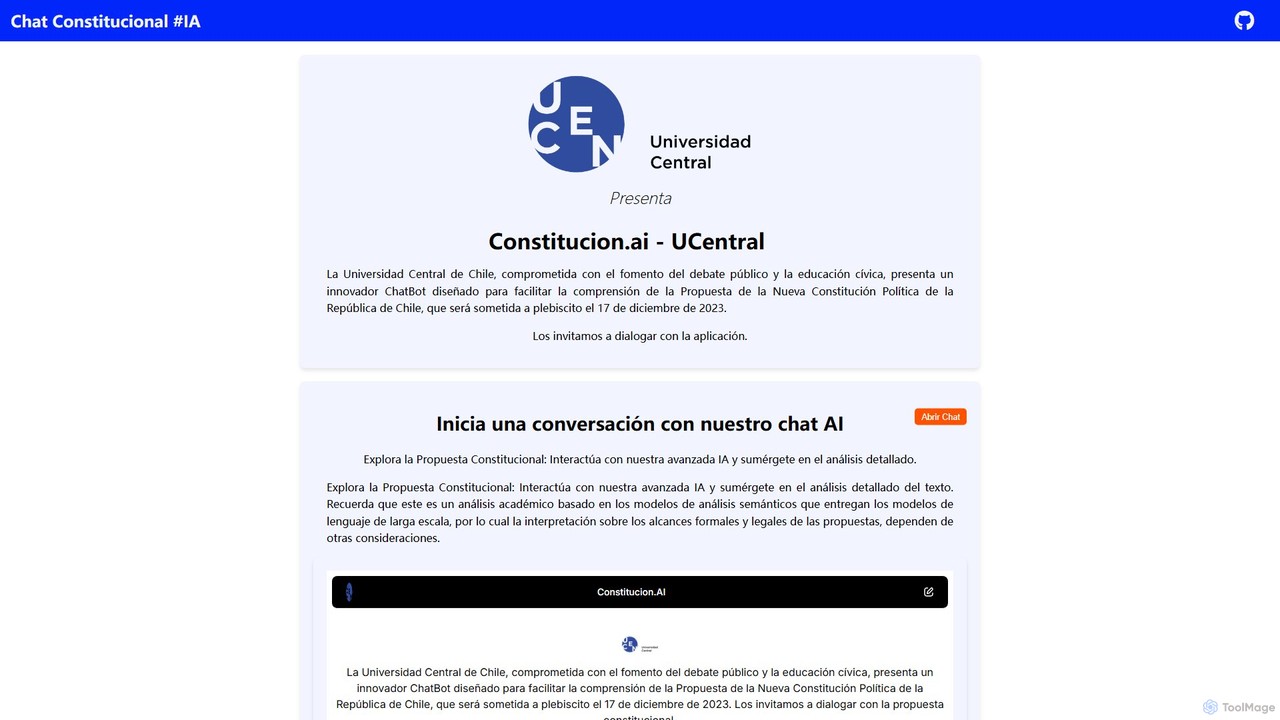
Constitucion.ai is an AI-powered chatbot developed by the Central University of Chile to help citizens understand the proposed …
Constitucion.ai is an AI-powered chatbot developed by the Central University of Chile to help citizens understand the proposed new Chilean Constitution. Using GPT-4, it breaks down complex legal text into simple, conversational language. It provides detailed analysis and answers questions, making constitutional information accessible to everyone, regardless of their legal background.
About Civic Education
AI Civic Education tools are specialized platforms designed to teach and simulate concepts of governance, citizenship, and social responsibility. These tools leverage AI to create interactive models of political systems, analyze public discourse, and deliver personalized learning experiences on complex societal issues. Their primary value lies in transforming abstract civic concepts into engaging, practical exercises, fostering critical thinking and informed participation in democratic life. They help learners understand the mechanics of law, politics, and community engagement in a dynamic way.
Core Features
- System Simulations: Models democratic processes like elections, legislative procedures, or judicial systems for hands-on learning.
- Discourse Analysis: Analyzes political texts, speeches, or media content for sentiment, bias, and rhetorical patterns.
- Personalized Learning Paths: Adapts educational content on topics like constitutional law or history to individual student comprehension levels.
- Ethical Scenario Generation: Creates complex ethical dilemmas and case studies for students to debate and resolve.
- Misinformation Detection Training: Provides exercises to help users identify fake news, propaganda, and biased reporting.
Use Cases
These tools are primarily used in academic settings, from high schools to universities, to supplement traditional civics and political science curricula. Government agencies and non-profit organizations also use them for public awareness campaigns, voter education programs, and training for civil servants. They are effective for teaching media literacy, explaining policy impacts, and engaging youth in civic matters.
How to Choose
When selecting an AI Civic Education tool, consider its curriculum alignment and adaptability to your specific learning objectives. Evaluate the neutrality and sourcing of its data to avoid political bias. Assess the complexity of the simulations to ensure they are age-appropriate. Finally, prioritize platforms with strong data privacy policies, especially when used with students.
Civic EducationUse Cases
Simulating a Legislative Process in a Classroom
A high school history teacher uses an AI Civic Education tool to create a mock legislative session. Students are assigned roles as representatives, propose bills on current issues like environmental policy, and use the platform to debate, form coalitions, and vote. The AI acts as a moderator, tracking procedural rules and providing real-time data on the potential impacts of proposed amendments. This transforms a theoretical lesson into a dynamic, hands-on experience, helping students understand the complexities and compromises of lawmaking.
Analyzing Media Bias in a Journalism Course
University journalism students use an AI tool to analyze news coverage of a political event from multiple sources. They upload articles and broadcast transcripts, and the AI generates reports highlighting differences in language, sentiment, and framing. The tool identifies loaded terms, quantifies the focus on different actors, and visualizes the data to reveal potential biases. This enables students to develop critical media literacy skills by moving beyond subjective impressions to data-driven analysis of journalistic neutrality.
Personalized Tutoring for a Citizenship Test
An individual preparing for a naturalization or citizenship test uses an AI-powered study application. The platform first assesses their knowledge of the country's history, laws, and government structure through a diagnostic quiz. Based on the results, the AI creates a personalized study plan, focusing on weak areas with interactive flashcards, short video explanations, and mock test questions. The system adapts in real-time, presenting more challenging questions as the user's proficiency grows, ensuring efficient and targeted preparation.
Exploring Policy Impacts with a Community Group
A local community advocacy group uses an AI simulation tool to understand the potential effects of a proposed zoning law change. Group members input different variables into the model, such as changes to housing density or commercial use permissions. The AI simulates the likely long-term impacts on traffic, local school enrollment, and property values, presenting the outcomes in easy-to-understand charts and maps. This empowers the group to formulate a data-informed stance and present a more compelling case to city council members.
Developing Ethical Reasoning through Dilemmas
A university ethics professor uses an AI tool that generates complex civic and ethical dilemmas. For a module on public service ethics, the AI creates a scenario where a city official must balance budget constraints with the needs of a vulnerable population. Students interact with the scenario, making choices that lead to different outcomes. The AI provides feedback on the ethical frameworks (like utilitarianism or deontology) that align with their decisions, prompting deeper reflection and class discussion on the nuances of public responsibility.
Interactive Exhibit on Judicial History
A law museum or civic center designs an interactive exhibit using an AI platform. Visitors can select a landmark Supreme Court case and engage with an AI chatbot role-playing as a key historical figure, like a justice or lawyer involved in the case. The AI answers questions about the legal arguments, historical context, and societal impact of the decision, using a knowledge base curated by historians. This creates a more personal and memorable learning experience than static text displays, making complex legal history accessible to a general audience.