
ToolMage
Sign in

Best 1 Coding Assessment AI tools for Education

Popular Coding Assessment AI tools in Education include QuizzViz, helping you work more efficiently.

QuizzViz
Freemium

QuizzViz

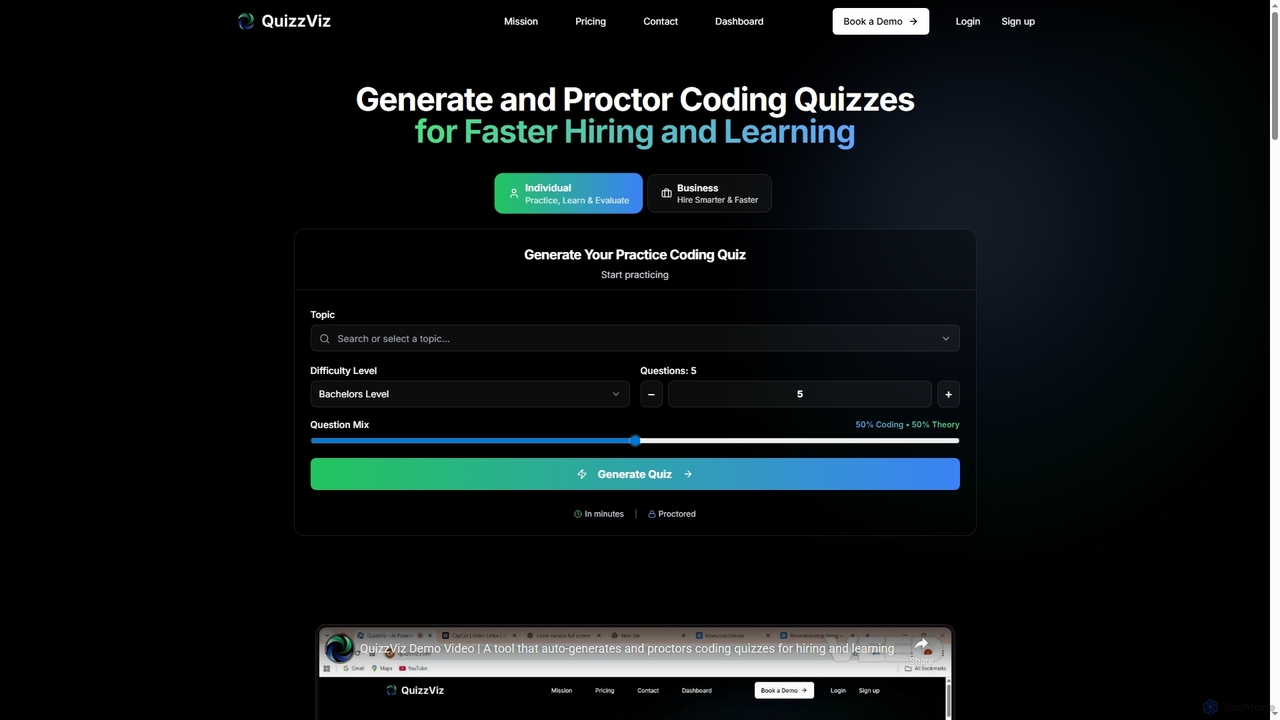
QuizzViz is an AI-powered platform designed to generate and proctor secure, real-world scenario-based coding quizzes. It helps individuals practice and evaluate their skills, and enables businesses to hire smarter and faster by efficiently screening technical talent.

Quiz Generation
Visits 3.7KFavorites 169Likes 171

About Coding Assessment

Coding Assessment tools are AI-powered platforms designed to automatically evaluate programming skills and code quality. These tools leverage advanced algorithms, including static and dynamic analysis, to provide objective and scalable assessments. They are primarily used in educational and professional settings to streamline technical recruitment, enhance developer training, and facilitate academic evaluations.

Core Features

  • Automated Code Analysis: Automatically checks code for correctness, efficiency, style, and potential bugs.
  • Customizable Challenges: Allows creation of tailored coding problems and projects to match specific skill requirements.
  • Plagiarism Detection: Identifies similarities in code submissions to ensure academic integrity and fair evaluation.
  • Performance Metrics & Feedback: Provides detailed reports on code execution time, memory usage, and offers constructive feedback for improvement.

Applicable Scenarios

These tools are invaluable for organizations and institutions needing to efficiently gauge programming proficiency. They are widely adopted in technical recruitment to screen candidates, in corporate training programs to identify and address skill gaps among developers, and in universities for grading programming assignments at scale.

How to Choose

When selecting a Coding Assessment tool, consider its support for various programming languages, the types of assessment challenges it offers (e.g., multiple-choice, coding tasks, projects), the level of customization available for questions and rubrics, the depth and clarity of its reporting features, and its integration capabilities with existing HR or learning management systems.

Featured tool rankings

Coding Assessment use cases

1

Streamlining Technical Candidate Screening

Recruitment teams utilize AI coding assessment platforms to efficiently pre-screen a large volume of technical job applicants. Candidates complete standardized or custom coding challenges, and the AI automatically evaluates their solutions for correctness, efficiency, and adherence to best practices, providing objective scores and detailed reports. This significantly reduces the manual effort in the initial screening phase, allowing recruiters to focus on top-tier candidates.

2

Identifying & Addressing Developer Skill Gaps

Engineering managers and team leads deploy coding assessment tools to evaluate the current skill sets of their development teams. By assigning specific coding tasks or projects, they can pinpoint individual and team-wide strengths and weaknesses in various programming languages or frameworks. The detailed feedback helps in creating personalized training plans and targeted upskilling initiatives, ensuring the team's capabilities align with project requirements.

3

Automating & Standardizing Academic Programming Exams

University professors and educators use AI coding assessment tools to administer and grade programming assignments and exams for large student cohorts. The platform automates the evaluation process, checking code against test cases, style guides, and even detecting plagiarism. This ensures consistent, fair, and unbiased grading, freeing up instructors' time from manual review and providing students with immediate, actionable feedback on their submissions.

4

Personalized Learning & Practice for Aspiring Developers

Individual learners and aspiring developers leverage these tools for self-paced practice and skill development. They can access a vast library of coding challenges, receive instant feedback on their solutions, and track their progress over time. The AI-driven insights help them understand areas for improvement, guiding their learning journey and preparing them for technical interviews by simulating real-world coding environments.

5

Evaluating Freelance & Contractor Developer Proficiency

Project managers and businesses hiring freelance or contract developers use coding assessment platforms to verify the technical skills of potential candidates before engagement. By assigning relevant coding tasks, they can objectively assess a freelancer's ability to deliver quality code, understand problem statements, and adhere to coding standards. This minimizes hiring risks and ensures that external talent possesses the necessary expertise for specific projects.

6

Benchmarking & Improving Team Coding Standards

Organizations implement AI coding assessments to establish and maintain high coding standards across their engineering teams. Regular assessments can benchmark the team's performance against internal goals or industry standards, identifying common areas where code quality or efficiency can be improved. This fosters a culture of continuous improvement, leading to more robust, maintainable, and scalable software solutions.

Coding Assessment FAQ

What are AI Coding Assessment tools?

AI Coding Assessment tools are software platforms that use artificial intelligence to automate the evaluation of programming skills. They analyze submitted code for correctness, efficiency, style, and adherence to requirements, providing objective scores and detailed feedback. These tools are widely used in technical recruitment, developer training, and academic settings to streamline the assessment process and ensure fair, consistent evaluations.

How do AI Coding Assessment tools work?

AI Coding Assessment tools typically work by combining several techniques. They use static analysis to examine code structure and style without execution, dynamic analysis to run the code against predefined test cases and measure performance (like execution time and memory usage), and sometimes natural language processing (NLP) to understand problem descriptions and user solutions. This allows for comprehensive and automated grading, identifying bugs, inefficiencies, and even potential plagiarism.

What are the key benefits of using AI for coding assessments?

The primary benefits include enhanced objectivity, scalability, and efficiency. AI tools eliminate human bias in grading, allowing for consistent evaluation across thousands of candidates or students. They significantly reduce the time and resources required for manual review, providing instant feedback. Additionally, they offer detailed, data-driven insights into a candidate's or learner's strengths and weaknesses, facilitating targeted development.

How do I choose the right AI Coding Assessment platform for my needs?

To choose the right platform, consider several factors: the range of programming languages and frameworks it supports, the types of assessment questions available (e.g., multiple-choice, debugging, full coding projects), its customization options for creating specific challenges and rubrics, the quality and depth of its reporting and analytics, and its ability to integrate with your existing HR, ATS, or LMS systems. Also, evaluate its user interface for both assessors and candidates.

What's the difference between AI Coding Assessment and traditional manual code review?

AI Coding Assessment offers automation, scalability, and objectivity, whereas traditional manual code review relies on human expertise. AI tools can instantly evaluate thousands of submissions with consistent criteria, providing immediate, data-driven feedback on performance metrics and code quality. Manual review, while offering nuanced human insight, is time-consuming, prone to bias, and difficult to scale, making it less efficient for initial screening or large-scale evaluations.