TimeComplexity.ai
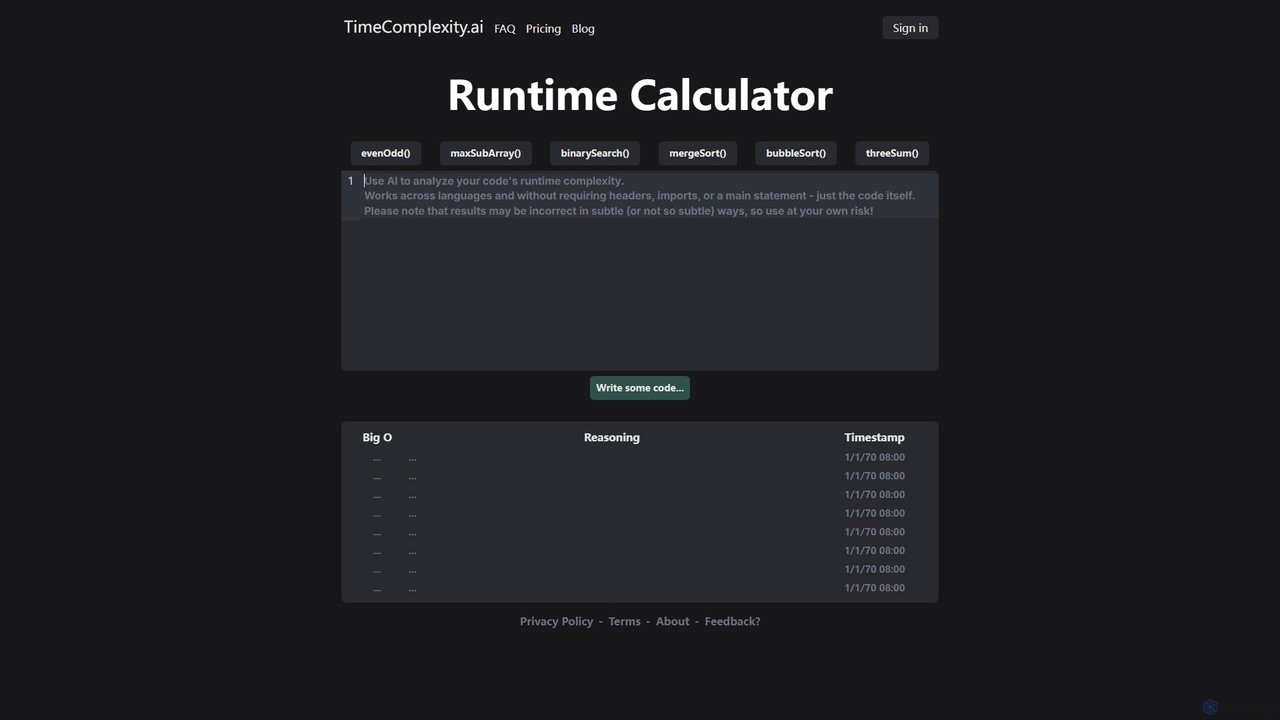
TimeComplexity.ai is an AI-powered tool that analyzes the runtime complexity of your code. It supports various programming languages …
TimeComplexity.ai is an AI-powered tool that analyzes the runtime complexity of your code. It supports various programming languages and provides instant Big O notation along with detailed reasoning. Ideal for developers, students, and anyone preparing for technical interviews to understand and optimize algorithm efficiency.
About Computer Science
Computer Science AI tools are specialized applications that leverage artificial intelligence to assist in the study, research, and practical application of computer science principles. These tools utilize advanced algorithms and machine learning models to explain complex concepts, automate coding tasks, analyze data structures, and simulate computational systems. They empower students, educators, researchers, and developers to deepen their understanding, accelerate development workflows, and solve intricate problems more efficiently within various computer science domains.
Core Features
- Intelligent Code Generation: Automatically produces code snippets, functions, or boilerplate for various programming languages based on natural language prompts.
- Algorithm Visualization & Analysis: Provides interactive graphical representations of algorithms and data structures, explaining their execution flow and performance characteristics.
- Automated Debugging & Code Review: Identifies logical errors, syntax issues, and potential vulnerabilities in code, offering suggestions for correction and optimization.
- Personalized Learning Paths: Adapts educational content, exercises, and assessments to individual learning styles and progress in specific computer science topics.
- System Simulation & Modeling: Allows users to design, simulate, and analyze the behavior of complex computer systems, networks, or software architectures.
Applicable Scenarios
These tools are invaluable across academic and professional settings. Students utilize them for interactive learning of algorithms and data structures, practicing coding challenges, and understanding theoretical concepts. Software developers integrate them into their workflows for rapid prototyping, automated testing, and optimizing existing codebases. Researchers employ AI tools for simulating novel computational models, analyzing large scientific datasets, and validating complex theoretical frameworks.
How to Choose
When selecting Computer Science AI tools, prioritize accuracy and reliability of the AI's outputs, especially for code generation and explanations. Evaluate the tool's domain coverage to ensure it supports your specific area of interest, such as AI, cybersecurity, or software engineering. Consider its integration capabilities with your existing development environments or learning platforms. Finally, assess its interactivity and explainability, as tools that clearly articulate their reasoning or provide interactive learning experiences offer greater educational and practical value.

Computer ScienceUse Cases
Automated Code Generation for Prototypes
Software developers can rapidly generate initial code structures, API integrations, or functional prototypes for new projects. By providing high-level natural language descriptions of desired features, the AI tool produces ready-to-use code snippets, significantly accelerating the early stages of development and allowing for quicker iteration and concept validation.
Algorithm Visualization for Students
Computer science students use these tools to interactively visualize complex algorithms, such as sorting (e.g., Merge Sort, Quick Sort) or graph traversal (e.g., BFS, DFS). This visual representation helps them understand the step-by-step execution, data manipulation, and underlying logic, making abstract concepts more concrete and improving comprehension.
Debugging and Optimization of Legacy Code
Experienced engineers leverage AI tools to analyze large, potentially undocumented legacy codebases. The AI can identify subtle bugs, suggest performance bottlenecks, and recommend refactoring strategies, reducing the time spent on manual debugging and improving the maintainability and efficiency of older systems.
Personalized Learning for Data Structures
Learners studying data structures like linked lists, trees, or hash tables receive tailored exercises and explanations. The AI adapts to their progress, identifies areas of weakness, and provides targeted resources or practice problems, ensuring a deeper and more efficient understanding of fundamental computer science concepts.
Simulating Network Topologies for Cybersecurity Training
Cybersecurity professionals and students can design and simulate complex network topologies within a virtual environment. These tools allow them to test various attack vectors, understand system vulnerabilities, and practice defensive strategies without risking real-world infrastructure, enhancing practical skills and incident response capabilities.
Automated Unit Test Generation
Developers utilize AI to automatically generate comprehensive unit tests for their code functions. By analyzing the function's logic and potential edge cases, the AI creates robust test suites, ensuring code quality, catching regressions early, and significantly reducing the manual effort required for thorough testing.