ToolMage
Sign in

Best 1 Course Generation AI tools for Education

Popular Course Generation AI tools in Education include oomka, helping you work more efficiently.

oomka
Freemium

oomka

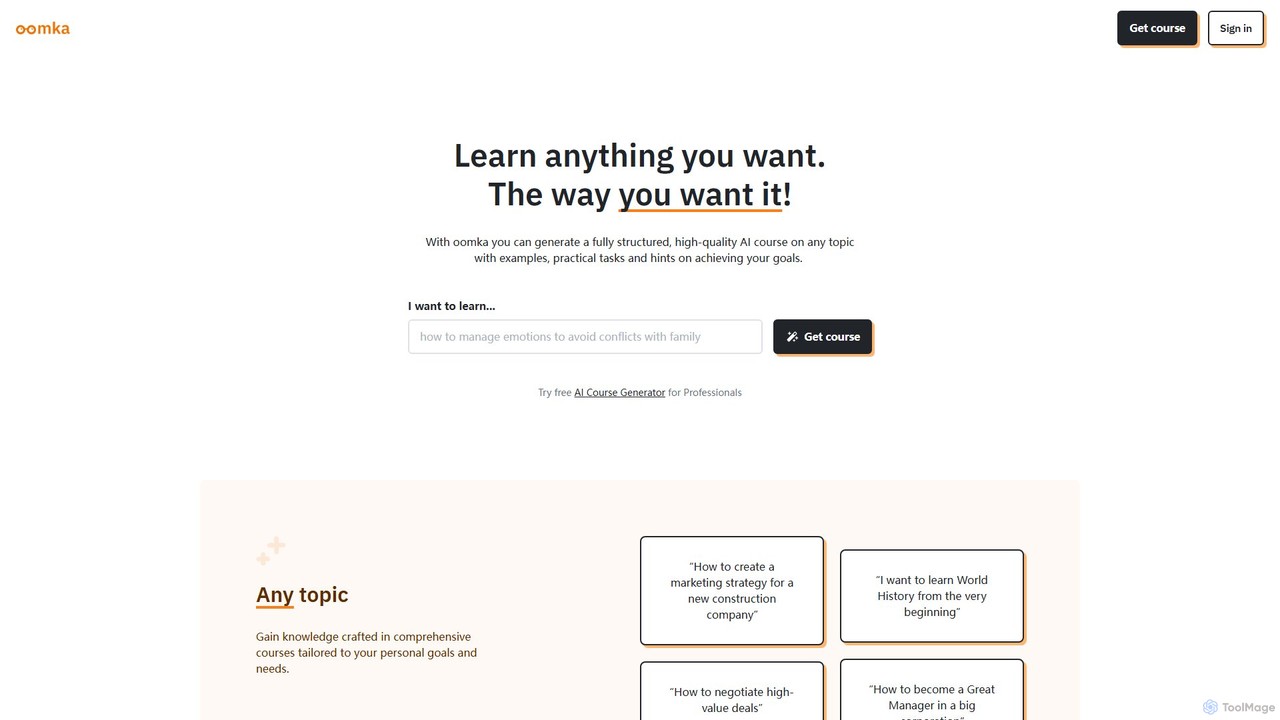
oomka is an AI-powered learning platform that generates personalized, structured courses on any topic. Simply state what you want to learn, and oomka creates a comprehensive curriculum with examples, practical tasks, and hints tailored to your goals. It's designed for professionals, students, and lifelong learners who want an efficient and customized way to acquire new skills and knowledge, moving beyond scattered online resources to a unified, goal-oriented learning experience.

Course Generation
Visits 4.9KFavorites 116Likes 128

About Course Generation

Course Generation tools are AI-powered platforms designed to automate and streamline the creation of educational content, training modules, and learning materials. Leveraging advanced natural language processing and machine learning, these tools can rapidly draft lesson plans, generate quizzes, and structure entire courses, significantly enhancing efficiency for educators and trainers. They empower users to develop engaging and personalized learning experiences with unprecedented speed and scale within the broader field of education technology.

Core Features

  • Automated Content Drafting: Generates lesson outlines, module content, and learning objectives from prompts or existing materials.
  • Quiz and Assessment Creation: Automatically designs various question types, including multiple-choice, true/false, and open-ended, based on course content.
  • Multimedia Integration Suggestions: Recommends or helps integrate relevant images, videos, and interactive elements to enrich learning.
  • Personalized Learning Path Design: Adapts course structure and content to individual learner needs and progress.
  • Content Localization: Facilitates translation and adaptation of course materials for diverse linguistic audiences.

Applicable Scenarios

These tools are invaluable for e-learning developers creating new online courses, corporate trainers needing to quickly onboard employees with compliance modules, and academic institutions designing blended learning curricula. They also assist independent educators in scaling their content production and content creators in rapidly prototyping educational resources for various platforms.

How to Choose

When selecting a Course Generation tool, consider its content quality and accuracy, the level of customization offered for generated materials, integration capabilities with existing Learning Management Systems (LMS), and the range of output formats supported. Evaluate the AI's ability to understand complex topics and generate contextually relevant, pedagogically sound content, alongside ease of use and pricing structure.

Course Generation use cases

1

Rapidly Develop Corporate Training Modules

Corporate trainers can utilize AI course generation tools to quickly create comprehensive training modules for new employee onboarding, compliance updates, or skill development. By inputting key topics and learning objectives, the AI drafts content, designs interactive quizzes, and suggests relevant case studies, drastically reducing development time from weeks to days and ensuring consistent, high-quality training across departments.

2

Create Engaging Online Courses for E-learning Platforms

Independent educators and e-learning platforms leverage these tools to scale their content offerings. They can input a subject area, target audience, and desired learning outcomes, and the AI generates structured course outlines, lesson content, and assessment questions. This enables the rapid production of multiple courses, allowing creators to focus on refining pedagogical approaches and marketing rather than initial content drafting.

3

Personalize Learning Paths for Individual Students

Educational institutions or tutors can use AI course generation to tailor learning experiences for individual students. Based on a student's pre-assessment results, learning style, or specific knowledge gaps, the AI can generate customized modules, supplementary materials, and practice exercises, ensuring a highly personalized and effective learning journey that addresses unique needs and accelerates comprehension.

4

Prototype Educational Content for New Curricula

Curriculum developers and subject matter experts can quickly prototype new educational content or explore different pedagogical approaches. By providing high-level concepts, the AI generates various versions of lesson plans, activities, and assessment ideas. This iterative process allows for rapid experimentation and refinement before committing to full-scale content development, saving significant resources and time.

5

Generate Quizzes and Assessments Automatically

Teachers and instructors often spend considerable time creating quizzes and exams. AI course generation tools can automate this process by analyzing existing course materials or specific topics to generate a diverse range of question types, including multiple-choice, short answer, and essay prompts. This ensures assessments are aligned with learning objectives and frees up educators to focus on instruction.

6

Localize Course Content for Global Audiences

Organizations expanding their educational reach globally face the challenge of localizing content. AI course generation tools can assist by translating course materials into multiple languages while also adapting cultural nuances and examples. This ensures that learning content is not only linguistically accurate but also culturally relevant and engaging for diverse international learners, facilitating broader accessibility.

Course Generation FAQ

What are AI Course Generation tools?

AI Course Generation tools are software applications that use artificial intelligence to automate and assist in the creation of educational courses and learning materials. They leverage technologies like natural language processing (NLP) and machine learning to generate content outlines, lesson drafts, quizzes, and even multimedia suggestions from simple prompts or existing data. Their primary goal is to accelerate content development, enhance personalization, and improve the efficiency of educators and trainers.

How do AI Course Generation tools differ from traditional LMS?

AI Course Generation tools focus specifically on the *creation* of course content, automating the drafting of lessons, quizzes, and outlines. In contrast, a traditional Learning Management System (LMS) is primarily designed for the *delivery, management, and tracking* of courses, providing features like student enrollment, progress monitoring, and communication tools. While an LMS hosts the generated content, AI course generation tools are the engine for producing it, making them complementary rather than competing solutions.

What are the key benefits of using AI for course generation?

The key benefits include significant time and cost savings in content development, as AI can rapidly draft materials that would otherwise take hours or days. These tools also enable greater personalization, allowing courses to be tailored to individual learner needs. Furthermore, they can help maintain content consistency, suggest diverse learning activities, and facilitate quick updates or localization of materials, leading to more engaging and effective learning experiences at scale.

What features should I look for in an AI Course Generation tool?

When choosing an AI Course Generation tool, look for robust content drafting capabilities that can generate accurate and relevant text from various inputs. Essential features include automated quiz and assessment creation, suggestions for multimedia integration, and the ability to customize generated content. Consider tools that offer integration with your existing LMS, support multiple output formats (e.g., SCORM, HTML), and provide options for personalizing learning paths. User-friendliness and the quality of AI-generated output are also crucial.

Who can benefit most from AI Course Generation tools?

A wide range of users can benefit significantly. This includes corporate trainers and HR departments needing to develop internal training rapidly, e-learning content creators and instructional designers aiming to scale their course production, and academic educators looking to streamline lesson planning and assessment creation. Independent tutors and subject matter experts can also leverage these tools to efficiently create and market their own educational products, reaching a broader audience with high-quality content.