ToolMage
Sign in

Best 2 Current Events AI tools for Education

Popular Current Events AI tools in Education include Nourish (formerly OneSub) and Eto News, helping you work more efficiently.

Nourish (formerly OneSub)
Freemium

Nourish (formerly OneSub)

Nourish is an AI-powered news platform designed for a healthier information diet. It delivers personalized, ad-free, and clickbait-free news summaries from multiple sources, helping you stay informed in less time and with less stress. Take control of your news consumption and expand your understanding with curated, intelligent content.

Current Events
Visits 4.8KFavorites 119Likes 134
Eto News
Freemium

Eto News

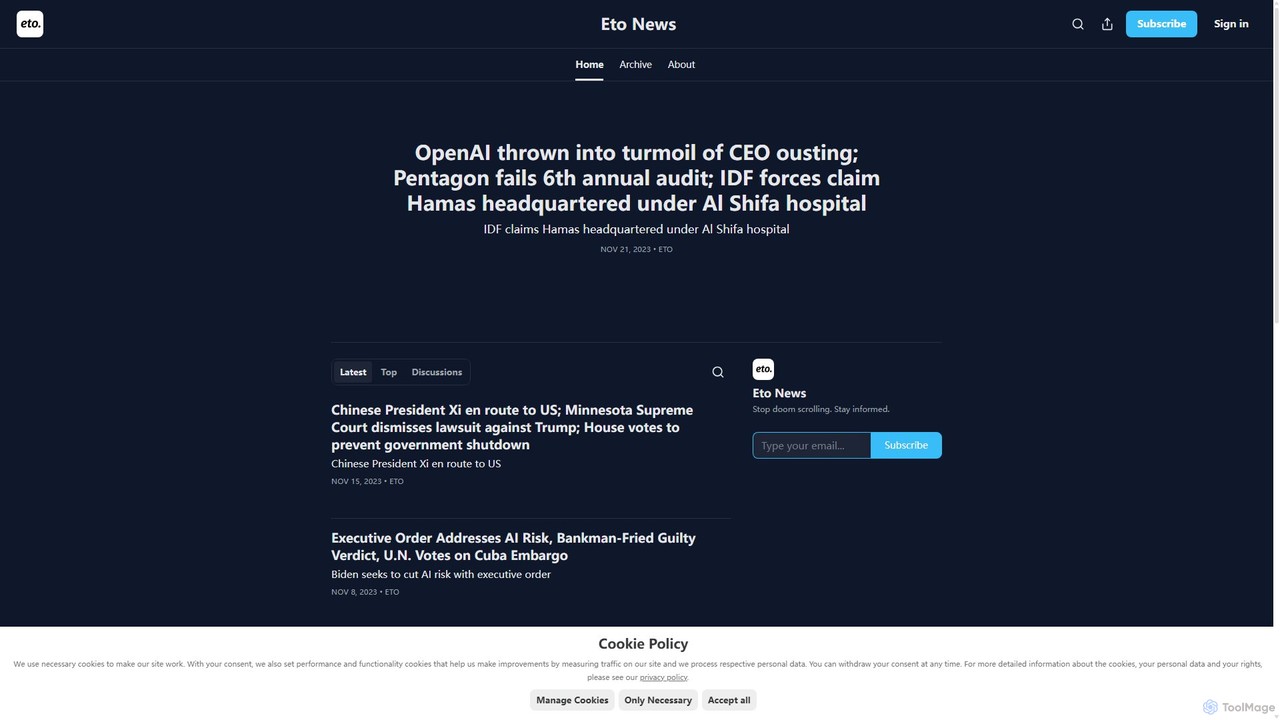
Eto News is an AI-powered newsletter on Substack designed to combat information overload and media bias. It delivers concise, factual summaries of global news, stripping away sensationalism and partisan narratives. By focusing on objective reporting, Eto News helps you stay informed without the stress of "doom scrolling," providing a clear and neutral perspective on important world events directly to your inbox.

Current Events
Visits 4.7KFavorites 112Likes 121

About Current Events

Current Events AI tools are specialized applications that leverage artificial intelligence to integrate real-time global and local events into educational settings. These tools utilize natural language processing and data aggregation to curate, summarize, and analyze news, making complex information accessible for learning. They enhance critical thinking, global awareness, and subject matter relevance for students and educators, transforming how current affairs are taught and understood.

Core Features

  • Real-time News Aggregation: Automatically collects and updates information from diverse news sources globally.
  • Content Summarization: Generates concise summaries of complex news articles, making them digestible for various age groups.
  • Bias Detection & Analysis: Identifies potential biases in news reporting, fostering critical media literacy.
  • Educational Content Generation: Creates quizzes, discussion prompts, and learning modules based on current events.
  • Personalized Learning Paths: Adapts news content and learning activities to individual student interests and comprehension levels.

Applicable Scenarios

Educators can use these tools to quickly prepare lesson plans on breaking news, while students can engage with interactive modules that connect classroom topics to real-world events. Researchers also benefit from AI-driven analysis of historical and ongoing event trends.

How to Choose

When selecting Current Events AI tools, consider the breadth and reliability of news sources, the accuracy of summarization and bias detection, and the flexibility of educational content generation. Evaluate integration capabilities with existing learning management systems and the level of customization for different age groups or subjects.

Current Events use cases

1

Creating Dynamic Lesson Plans

Teachers use AI to quickly find, summarize, and integrate breaking news into daily lessons, ensuring content relevance and engaging students with real-world examples. For instance, a history teacher can instantly pull up articles on a recent geopolitical event, summarize key points, and generate discussion questions to connect it with historical precedents, saving hours of manual research and preparation time.

2

Fostering Critical Media Literacy

Students utilize AI tools to analyze multiple news sources on a single event, identifying different perspectives, potential biases, and verifying facts to develop informed opinions. A high school student researching a controversial social issue can use AI to compare how various news outlets (e.g., liberal vs. conservative) frame the story, highlighting rhetorical differences and underlying assumptions, thereby enhancing their ability to critically evaluate information.

3

Personalized Current Affairs Learning

Individual students receive AI-curated news feeds and learning activities tailored to their academic interests and reading levels, making global events more relatable and understandable. A university student studying environmental science can get a personalized feed of news articles and research updates on climate change policies and innovations, along with interactive quizzes to test their comprehension, ensuring a highly relevant and engaging learning experience.

4

Simulating Geopolitical Scenarios

University students and researchers employ AI to model potential outcomes of ongoing international conflicts or economic shifts, enhancing strategic thinking and policy analysis skills. For example, a political science class can use an AI simulation tool to input various policy decisions related to a current trade dispute and observe the projected economic and diplomatic consequences, providing a hands-on approach to complex global dynamics.

5

Developing Debate & Discussion Prompts

Educators leverage AI to generate thought-provoking questions and structured debate topics based on recent social or political events, encouraging active classroom participation. A civics teacher can input a news article about a new legislative proposal, and the AI can generate a series of pro/con arguments and debate questions, facilitating a lively and informed classroom discussion without extensive manual preparation.

6

Tracking & Analyzing Historical Event Trends

Researchers and advanced students use AI to analyze patterns and long-term impacts of past current events, connecting historical context to contemporary issues. A graduate student studying economic history can employ AI to process decades of news archives related to financial crises, identifying recurring themes, policy responses, and their long-term effects, providing deeper insights than manual data review.

Current Events FAQ

What are Current Events AI tools?

Current Events AI tools are specialized applications that use AI to integrate real-time news and global events into educational contexts. They curate, summarize, and analyze current affairs, transforming complex information into accessible learning materials. These tools aim to enhance critical thinking, global awareness, and subject relevance for students and educators by providing dynamic, up-to-date content for learning and discussion.

How do Current Events AI tools differ from general news aggregators?

Unlike general news aggregators that simply collect articles, Current Events AI tools specifically process and adapt news for educational purposes. They often include features like bias detection, content summarization tailored for different age groups, and the generation of quizzes or discussion prompts. Their primary focus is on pedagogical value and integrating current affairs into curriculum, rather than just delivering raw information.

What are the key benefits of using AI for current events in education?

Using AI for current events in education offers several key benefits. It keeps curriculum content fresh and relevant, directly connecting classroom learning to real-world issues. It significantly enhances students' critical thinking and media literacy skills by exposing them to diverse perspectives and aiding in bias detection. Furthermore, these tools foster global awareness, personalize learning experiences, and save educators considerable time in content preparation and analysis.

How can educators ensure the reliability of information from these AI tools?

Educators should prioritize tools that source from reputable news organizations and offer transparency regarding their data sources. It's crucial to use AI tools as a starting point for discussion and critical analysis, encouraging students to cross-reference information and evaluate sources independently. While AI can aid in content curation and bias detection, human oversight and critical engagement remain essential to ensure accuracy and foster media literacy.

Who can benefit most from Current Events AI tools?

Current Events AI tools primarily benefit K-12 teachers and university professors seeking to integrate real-time events into their curriculum, making lessons more engaging and relevant. Students from middle school to higher education can also benefit by engaging with personalized, interactive content that fosters critical thinking and global awareness. Additionally, researchers, curriculum developers, and educational content creators can use these tools for content analysis, trend tracking, and efficient material generation.