ToolMage
Sign in

Best 1 Hackathons AI tools for Education

Popular Hackathons AI tools in Education include lablab.ai, helping you work more efficiently.

lablab.ai
Free

lablab.ai

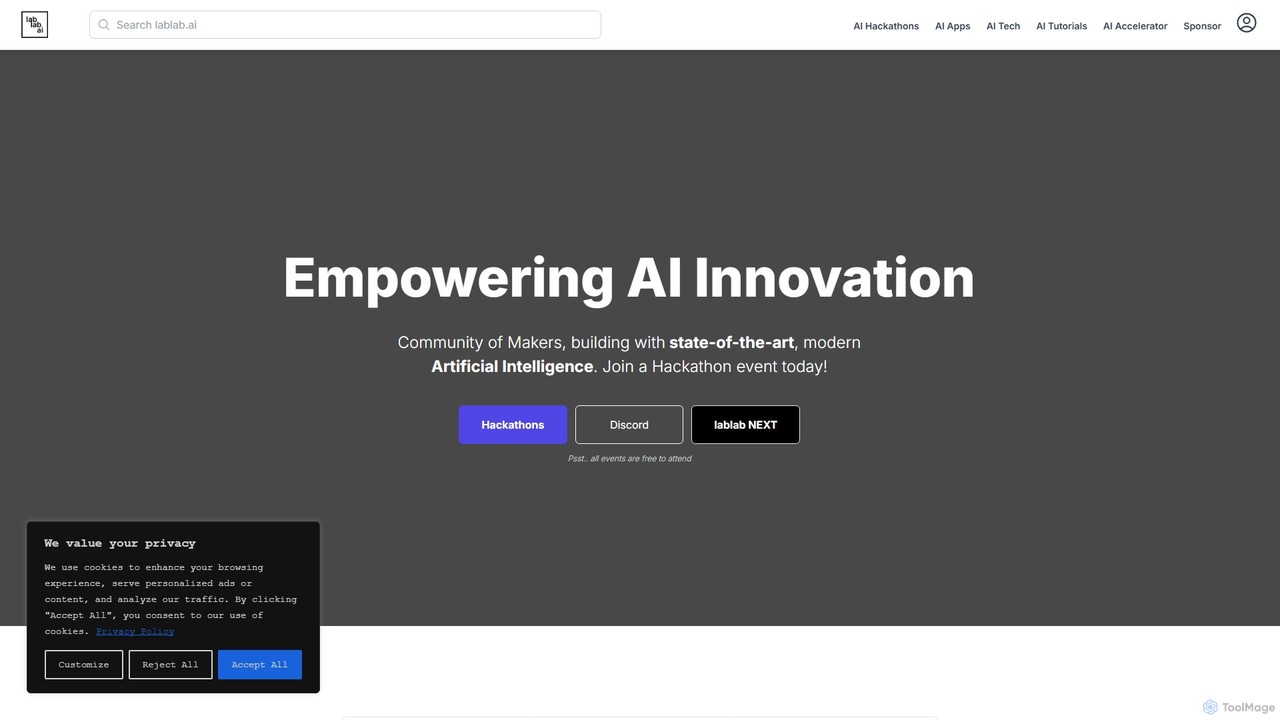
lablab.ai is a global community platform that hosts AI hackathons, empowering creators, developers, and entrepreneurs to build innovative applications with state-of-the-art AI technologies from partners like OpenAI, Google, and Meta. Participate for free to learn, collaborate, and turn ideas into prototypes with expert mentorship.

Developer Communities
Visits 645.7KFavorites 154Likes 153

About Hackathons

Hackathons are time-bound, competitive events where individuals and teams collaborate intensively to build a software or hardware project from scratch. Functioning as a form of project-based learning, these events challenge participants to solve specific problems or develop innovative ideas within a short timeframe, typically 24 to 48 hours. This compressed format accelerates learning, fosters rapid prototyping, and promotes practical skill application in a real-world context. Hackathons serve as dynamic platforms for education, innovation, and talent discovery.

Core Features

  • Themed Challenges: Events centered around specific technologies (e.g., AI, Blockchain) or social issues, providing a clear focus for participants.
  • Team Formation: Mechanisms to help individuals find teammates with complementary skills like coding, design, and business strategy.
  • Mentorship Access: Direct access to industry experts and mentors who provide guidance and technical support throughout the event.
  • Structured Judging Criteria: Clear and transparent rules for project evaluation, often based on innovation, technical execution, and presentation.
  • Resource Provision: Access to APIs, software development kits (SDKs), and cloud credits to facilitate project development.

Use Cases

Hackathons are widely used in academic institutions to supplement theoretical knowledge with hands-on experience. Tech companies leverage them for internal innovation, employee training, and recruiting top talent. Startups and entrepreneurs also use hackathons to validate ideas, build minimum viable products (MVPs), and find potential co-founders in a high-energy environment.

How to Choose

When selecting a hackathon, consider the event's theme and ensure it aligns with your interests and skills. Evaluate the quality of the mentors and judges, as they significantly impact the learning experience. Also, consider the format (virtual, in-person, or hybrid), the technology stack required, and your personal goals, whether it's learning a new skill, networking, or competing for prizes.

Hackathons use cases

1

University Student Skill Building

A computer science student participates in an AI-themed hackathon to bridge the gap between theory and practice. They join a team with a designer and a business student, collaborating to build a functional prototype of a recommendation engine. Throughout the weekend, they apply algorithms learned in class, learn new APIs from mentors, and practice version control under pressure. The final project becomes a key piece in their portfolio, demonstrating practical skills to potential employers and providing a tangible outcome of their university education.

2

Corporate Innovation and Prototyping

A large financial services company hosts an internal hackathon to foster innovation and quickly test new product ideas. Cross-functional teams of developers, product managers, and marketers collaborate to build solutions addressing customer pain points. One team develops an AI-powered tool to automate fraud detection in real-time. The prototype, built in 48 hours, is so compelling that management decides to fund its development into a full-fledged product, accelerating the company's innovation cycle significantly.

3

Startup Idea Validation and Team Formation

An aspiring entrepreneur with a business idea for a sustainable tech solution joins a weekend hackathon. They pitch their idea during the opening session and attract a developer and a UX designer to form a team. Over the next 48 hours, they build a minimum viable product (MVP) and a business plan. Presenting to a panel of venture capitalists and industry leaders, they receive valuable feedback that helps refine their concept. The experience not only validates their idea's potential but also solidifies the founding team for their new venture.

4

Career Transition and Networking

A marketing professional aiming to transition into a data science role joins a data-focused hackathon. Despite having limited coding experience, their domain expertise in marketing analytics is highly valuable. They team up with experienced data scientists and contribute by defining the problem, interpreting results, and shaping the final presentation. This immersive experience allows them to learn data science workflows, build connections with professionals in their target field, and demonstrate their analytical abilities to recruiters from sponsoring companies.

5

Solving Social and Environmental Challenges

A non-profit organization hosts a 'Hackathon for Good' focused on climate change solutions. They provide datasets on deforestation and carbon emissions. Teams of developers, environmental scientists, and policy students collaborate to create tools for social impact. One team builds a web application using satellite imagery and machine learning to monitor illegal logging activities in real-time. The project wins the 'Social Impact' award and the non-profit adopts the open-source tool to support their conservation efforts, demonstrating how hackathons can drive tangible solutions for global issues.

6

Open-Source Community Contribution

An open-source project for a popular machine learning library organizes a virtual hackathon to engage its community and accelerate development. The event focuses on specific goals, such as improving documentation, fixing known bugs, and adding a new module. Participants, ranging from seasoned contributors to newcomers, collaborate on GitHub, receive guidance from core maintainers in dedicated channels, and submit pull requests. The hackathon results in dozens of merged contributions, significantly improving the library and onboarding new, long-term contributors to the project.

Hackathons FAQ

What are Hackathons?

Hackathons are intensive, time-bound events where participants collaborate to create a functional software or hardware project that solves a specific problem. Functioning as a form of high-impact, project-based education, they typically last from 24 hours to a weekend. The core process involves forming teams, brainstorming ideas, coding or building a prototype, and presenting the final project to a panel of judges. They provide a practical environment for learning new technologies, developing problem-solving skills, and networking with peers and industry experts.

How do hackathons differ from traditional courses?

Hackathons and traditional courses are both educational but differ significantly in their approach. A hackathon is a short-term, intensive, and practical experience focused on application, while a course is a long-term, structured process focused on building foundational knowledge.

  • Pace & Duration: Hackathons are sprints (e.g., 48 hours); courses are marathons (e.g., a semester).
  • Learning Style: Hackathons emphasize collaborative, project-based learning by doing; courses often involve lectures, assignments, and individual study.
  • Outcome: The goal of a hackathon is a functional prototype; the goal of a course is mastery of a subject, often measured by exams.

They are complementary: courses provide the theoretical foundation, and hackathons offer a platform to apply that theory to real-world problems.

Do I need to be a coder to join a hackathon?

No, you don't necessarily need to be a coder. While developers are essential, successful hackathon teams require a diverse range of skills. Many events actively encourage participants with different backgrounds to form well-rounded teams. Roles like UX/UI designers, project managers, business strategists, marketers, and subject matter experts are often crucial for developing a complete and compelling project. Your unique expertise can be invaluable for idea generation, user research, business model creation, and the final presentation.

How should I prepare for my first hackathon?

Preparation can significantly enhance your first hackathon experience. First, clarify your goals: are you there to learn a specific technology, network, or win? Second, research the event's theme and potential technologies you might use. It can be helpful to familiarize yourself with the basics of a relevant API or framework beforehand. Third, prepare a brief 'personal pitch' explaining your skills and what you hope to contribute. Finally, remember to pack essentials for comfort and productivity, such as your laptop, chargers, and any necessary software pre-installed. Most importantly, come with an open mind, ready to collaborate and learn.

What are the key benefits of participating in a hackathon?

Participating in a hackathon offers numerous benefits beyond just the chance to win prizes. Key advantages include:

  • Accelerated Learning: The intense, hands-on environment forces you to learn and apply new skills rapidly.
  • Portfolio Building: You leave with a tangible project to showcase to potential employers or collaborators.
  • Networking Opportunities: It's an excellent way to meet like-minded peers, experienced mentors, and representatives from sponsoring tech companies.
  • Teamwork and Collaboration: You gain valuable experience working in a diverse team under pressure, honing communication and collaboration skills.
  • Innovation and Creativity: It provides a low-risk space to experiment with new ideas and technologies, fostering a creative problem-solving mindset.