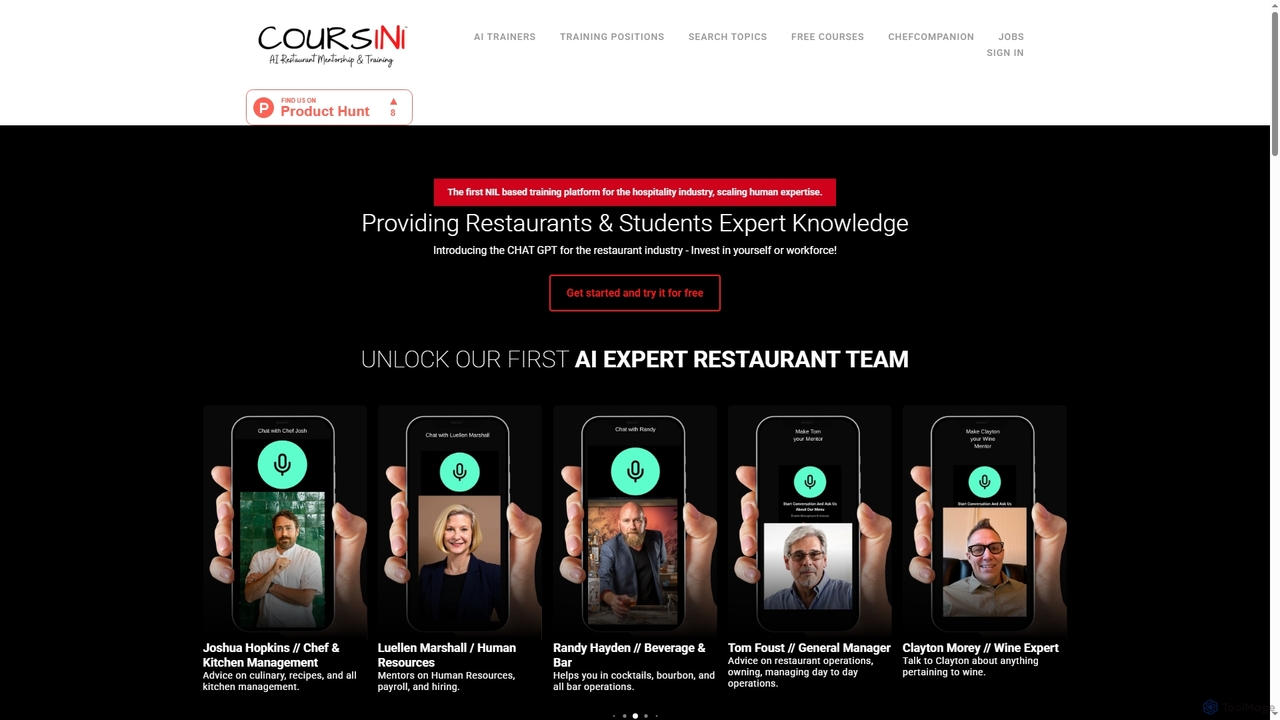
Coursini Concierge
Coursini Concierge is an AI-powered conversational platform for the hospitality industry, offering instant, on-demand expert advice and training. …
Coursini Concierge is an AI-powered conversational platform for the hospitality industry, offering instant, on-demand expert advice and training. It connects users with virtual AI agents specializing in various restaurant roles, providing immediate answers and guidance in multiple languages, akin to having a personal industry mentor available 24/7.
About Hospitality Training
AI Hospitality Training tools are specialized platforms that use artificial intelligence to create interactive and realistic training simulations for hotel and service industry staff. These tools leverage technologies like natural language processing (NLP) and virtual reality (VR) to simulate guest interactions, operational tasks, and critical service scenarios. They provide a scalable and consistent way to train employees in areas such as customer service, problem-solving, and compliance, ultimately enhancing guest satisfaction and operational efficiency. The data-driven feedback allows for personalized learning paths tailored to individual employee needs.
Core Features
- Interactive Role-Playing Scenarios: Simulates realistic guest interactions, such as check-ins, complaints, and special requests, allowing staff to practice in a risk-free environment.
- Personalized Learning Paths: Adapts training content and difficulty based on an individual's performance, role, and identified skill gaps.
- Performance Analytics and Feedback: Provides detailed metrics on employee performance, completion rates, and decision-making, offering instant, data-driven feedback.
- Compliance and Safety Modules: Delivers standardized training on health, safety, and regulatory compliance protocols required in the hospitality industry.
- Multilingual Content Delivery: Supports training for a diverse, global workforce by offering content and simulations in multiple languages.
Applicable Scenarios
These tools are widely used by hotel chains, resorts, cruise lines, and large restaurant groups to standardize service quality across multiple locations. They are particularly effective for onboarding new hires, providing continuous professional development, and upskilling staff on new procedures or upselling techniques. Hospitality management schools also use them to provide practical, hands-on experience to students.
Selection Criteria
When choosing an AI Hospitality Training tool, consider the breadth and realism of its scenario library and the ability to customize content for your brand standards. Evaluate the depth of its analytics and reporting features to track employee progress effectively. Also, assess its integration capabilities with your existing Learning Management Systems (LMS) or HR software, and consider the user interface's ease of use for non-technical staff.
Hospitality TrainingUse Cases
Onboarding New Front Desk Staff with Realistic Simulations
A hotel manager is tasked with training a new group of front desk receptionists. Instead of relying solely on shadowing senior staff, they use an AI training platform. New hires engage in VR-based simulations where they practice the entire check-in process, handle overbooking situations, and respond to common guest inquiries. The AI provides instant feedback on their communication tone, accuracy of information, and adherence to brand standards. This allows trainees to build confidence and competence in a controlled environment before interacting with actual guests, reducing initial errors by up to 40%.
Standardizing Complaint Handling Across a Hotel Chain
A corporate training director for a global hotel chain needs to ensure consistent service recovery standards across all properties. They deploy an AI training module focused on complaint resolution. Managers and staff interact with AI-powered avatars that simulate various angry or disappointed guests. The system analyzes their responses for empathy, problem-solving effectiveness, and adherence to the company's L.E.A.R.N. (Listen, Empathize, Apologize, Resolve, Notify) model. Dashboards provide corporate oversight, highlighting properties or regions that may need additional coaching, ensuring a uniform, high-quality guest experience globally.
Improving F&B Upselling and Menu Knowledge
A restaurant manager wants to increase average check size by improving the staff's upselling skills. They use an AI training tool with modules on menu knowledge and suggestive selling. Waitstaff interact with a simulated customer who asks questions about wine pairings, daily specials, and ingredients. The AI scores them on their ability to confidently recommend higher-margin items, describe dishes appealingly, and answer allergen questions correctly. The platform tracks progress, showing a 15% increase in the average check size within three months of implementation due to more effective selling techniques.
Conducting Mandatory Safety and Compliance Training
An HR manager at a large resort needs to certify all 500+ employees on annual fire safety and data privacy (GDPR) protocols. Using an AI training platform, they assign interactive modules to all staff. Employees complete the training at their own pace on mobile devices. The modules include simulations of identifying security threats and quizzes on emergency procedures. The system automatically tracks completion, sends reminders to those who are overdue, and generates compliance reports for auditing purposes, saving the HR department dozens of administrative hours.
Developing Leadership Skills for Duty Managers
A hotel's general manager identifies a need to develop the soft skills of junior and duty managers. They enroll them in an advanced AI training program focused on leadership. The program includes complex scenarios such as mediating conflicts between staff members, de-escalating tense situations with guests, and delivering constructive performance feedback. The AI provides a detailed analysis of their communication style, decision-making process, and emotional intelligence. This targeted coaching helps accelerate their development into more effective leaders, improving team morale and operational smoothness.
Multilingual Training for a Diverse Housekeeping Team
A luxury resort employs a housekeeping team with staff from five different native language backgrounds. To ensure everyone understands critical cleaning standards and chemical safety protocols, the training coordinator uses an AI platform. The platform delivers identical, visually-rich training modules in each staff member's native language. Interactive quizzes and visual simulations confirm comprehension, overcoming language barriers. This ensures that every team member, regardless of their primary language, is fully trained to the same high standard, improving both safety and service consistency.