
CuriosityXR
CuriosityXR is an immersive AI-powered learning platform for Meta Quest that transforms education into an interactive 3D experience. …
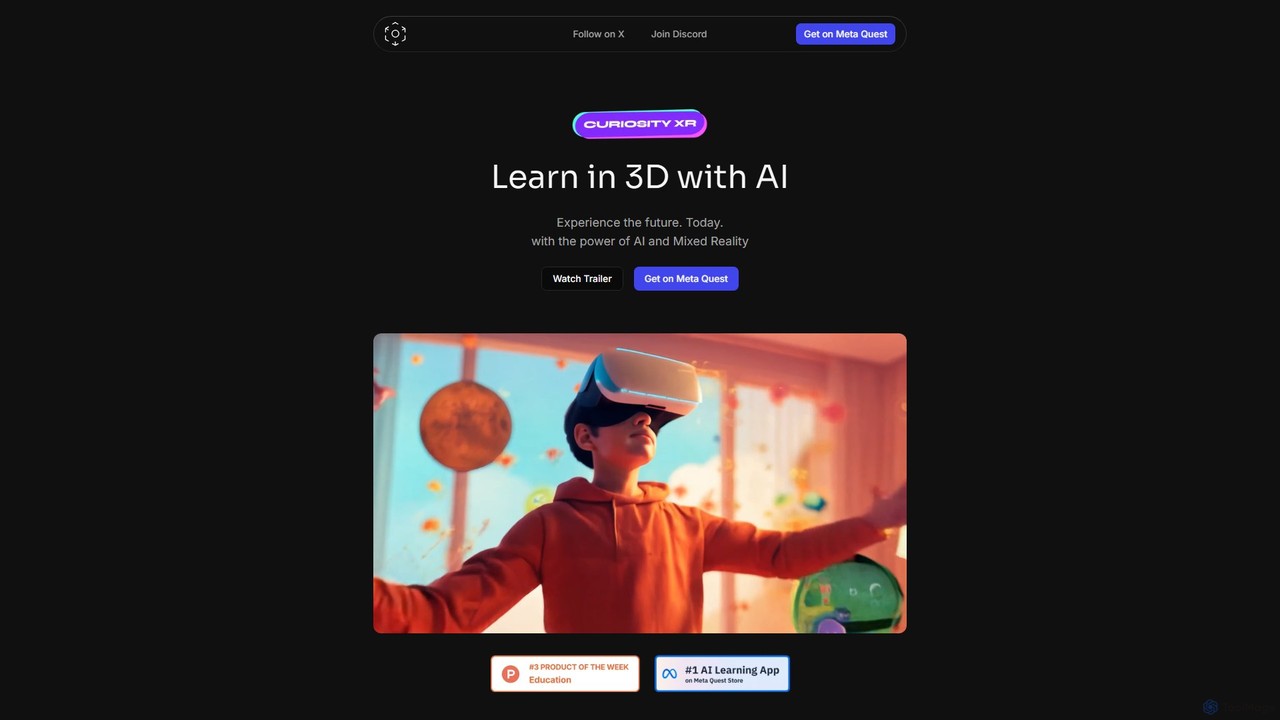
CuriosityXR is an immersive AI-powered learning platform for Meta Quest that transforms education into an interactive 3D experience. It acts as a personal AI teacher, allowing users to explore over a million 3D models, ask questions using natural voice commands, and create personalized learning journeys. It's designed to make learning active, contextual, and engaging for students, homeschoolers, and lifelong learners.
About Immersive Learning
Immersive Learning tools are AI-powered educational platforms that create interactive, simulated environments for skill development. Leveraging technologies like Virtual Reality (VR) and Augmented Reality (AR), these tools place users in realistic scenarios to learn by doing. They are highly effective for hands-on training in complex fields, offering a safe and repeatable space to master procedures. Unlike traditional e-learning, AI-driven immersive learning provides personalized feedback and dynamically adapts scenarios based on user performance.
Core Features
- Realistic Simulations: Creates true-to-life virtual environments for hands-on practice and skill application.
- Interactive Scenarios: Allows users to make decisions within the simulation and observe immediate consequences.
- AI-Powered Feedback: Delivers real-time, personalized guidance and performance analysis to accelerate learning.
- Multi-sensory Engagement: Utilizes visual, auditory, and sometimes haptic feedback for deeper cognitive engagement.
- Safe Practice Environment: Enables learning of high-risk or complex skills without real-world danger or cost.
Use Cases
These tools are widely used in industries where practical experience is critical. For example, in healthcare for surgical training, in manufacturing for safety protocol drills, in aviation for flight simulations, and in customer service for practicing difficult conversations with AI avatars.
How to Choose
When selecting an Immersive Learning tool, consider the level of realism required for your training needs. Evaluate the platform's content authoring capabilities to see if you can create custom scenarios. Check for hardware compatibility (e.g., specific VR headsets, mobile devices) and assess the depth of its analytics for tracking learner progress.
Immersive LearningUse Cases
Virtual Surgical Training for Medical Students
Medical students and residents use immersive learning platforms to prepare for complex surgical procedures. Within a VR environment, they can use haptic controllers to simulate handling surgical instruments and navigate 3D anatomical models. The AI provides real-time feedback on precision and technique. This allows for unlimited, risk-free practice, helping to build muscle memory and procedural confidence before entering a real operating room, ultimately reducing training costs and improving patient safety.
Safety Protocol Training for Industrial Workers
Manufacturing and energy companies deploy immersive learning to train employees on critical safety procedures. A worker can enter a virtual replica of their factory floor and face AI-generated emergency scenarios, such as a chemical spill or equipment malfunction. They must correctly identify hazards and follow safety protocols in a timed, high-pressure simulation. This method ensures higher knowledge retention and faster real-world response times compared to reading manuals, significantly reducing workplace accidents.
Realistic Customer Service Role-Playing
Customer service teams use immersive learning for soft skills training. An agent interacts with an AI-powered virtual customer who can display a range of emotions and present complex problems. The AI analyzes the agent's tone of voice, word choice, and problem-solving approach, providing instant feedback. This allows agents to practice de-escalation techniques and empathy in a controlled environment, leading to improved confidence and higher customer satisfaction scores in real interactions.
Interactive Language and Culture Immersion
Language learners use immersive platforms to practice conversational skills in a realistic context. They can enter a virtual environment, such as a Parisian café or a Tokyo market, and interact with AI characters in the target language. The AI understands spoken input, corrects pronunciation, and responds naturally, creating a dynamic conversation. This provides contextual, real-time practice that is more engaging and effective than traditional flashcards or textbook exercises for achieving fluency.
Complex Equipment Operation and Maintenance Simulation
Engineers and technicians in fields like aerospace or energy learn to operate and repair complex machinery using immersive tools. An AR application can overlay digital instructions and 3D animations onto physical equipment, guiding the user step-by-step. In VR, a user can practice assembling a virtual jet engine or troubleshooting a wind turbine. This reduces the need for access to expensive physical equipment for training, minimizes the risk of damage, and accelerates the learning curve for technical procedures.
Gamified Historical Event Exploration for K-12 Education
In K-12 education, immersive learning tools bring abstract subjects to life. Students can take a virtual field trip to ancient Rome, walk on the surface of Mars, or witness a key historical event firsthand. These gamified experiences allow students to interact with the environment, solve puzzles, and engage with AI-driven historical figures. This active, exploratory approach fosters deeper understanding and curiosity, making learning more memorable and engaging than traditional classroom lectures or textbook reading.