KisanAI
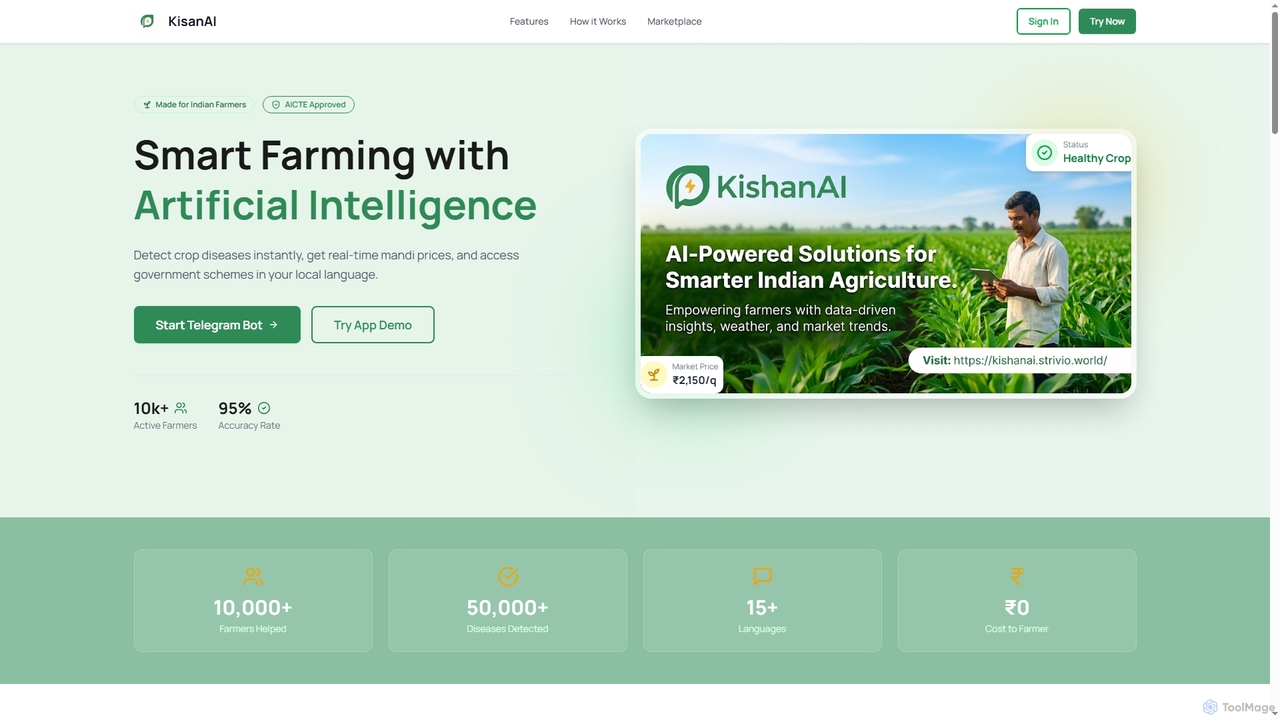
KisanAI is India's first AI-powered agricultural assistant designed for Indian farmers. It provides instant crop disease detection, real-time …
KisanAI is India's first AI-powered agricultural assistant designed for Indian farmers. It provides instant crop disease detection, real-time market (mandi) prices, weather forecasts, and information on government schemes, all accessible in over 15 local Indian languages via a Telegram bot and app.
Pawmenow
Pawmenow is an AI-powered pet care assistant offering instant guidance on your pet's health, behavior, and nutrition. Get …
Pawmenow is an AI-powered pet care assistant offering instant guidance on your pet's health, behavior, and nutrition. Get reliable advice by describing symptoms or asking questions, helping you make informed decisions for your furry friend's well-being, 24/7.
Songbird
Songbird is an AI-powered news platform that transforms written articles into high-quality, natural-sounding audio. It aggregates news from …
Songbird is an AI-powered news platform that transforms written articles into high-quality, natural-sounding audio. It aggregates news from various sources, provides concise AI-generated summaries, and allows users to create personalized audio playlists. Stay informed on the go, whether you're commuting, exercising, or multitasking.
About Information Consumption
Information Consumption tools are AI-powered applications designed to help users efficiently process, understand, and retain vast amounts of information. Leveraging technologies like Natural Language Processing (NLP), these tools can summarize long texts, answer questions directly from documents, and extract key insights. They are particularly valuable for students, researchers, and professionals in educational settings who need to quickly grasp complex topics or stay updated in their fields. Unlike simple reading aids, these tools transform passive content consumption into an active, interactive learning experience.
Core Features
- AI-Powered Summarization: Condenses lengthy articles, reports, or textbook chapters into concise, digestible summaries.
- Document Q&A: Allows users to ask questions in natural language and receive precise answers sourced directly from the provided text.
- Key Concept Extraction: Automatically identifies and highlights main ideas, terminology, and important entities within a document.
- Content Analysis: Provides deeper insights by analyzing sentiment, identifying themes, and mapping relationships between concepts.
Use Cases
These tools are widely used in academic and professional learning environments. For instance, students use them to summarize dense academic papers for literature reviews, while researchers quickly vet large volumes of studies to find relevant information. Professionals also leverage them for continuous education, digesting industry reports and online courses to keep their skills current.
How to Choose
When selecting an Information Consumption tool, consider the types of content it supports (PDF, URL, audio). Evaluate the accuracy and quality of its summaries and answers. Check for integration capabilities with note-taking apps like Notion or Zotero. Finally, assess the user interface for ease of use and whether its features align with your specific learning or research workflow.
Information ConsumptionUse Cases
Accelerate Academic Literature Reviews
A graduate student working on their thesis needs to review over 50 academic papers. Instead of spending weeks reading each one, they upload the PDFs to an Information Consumption tool. The tool generates concise summaries for each paper, extracts key findings and methodologies, and allows the student to ask specific questions like 'What statistical methods were used?'. This process reduces the initial review time by over 80%, enabling the student to quickly identify the most relevant papers and focus on in-depth analysis.
Efficient Preparation for Exams
A college student is preparing for a final exam covering multiple textbook chapters and lecture notes. They use an Information Consumption tool to upload all their study materials. The AI identifies key concepts, definitions, and important themes across all documents. The student then uses the Q&A feature to quiz themselves on specific topics and generates a master summary sheet, consolidating all critical information into one place. This streamlines their study process, helping them focus on understanding concepts rather than just rereading material.
Market Intelligence for Business Analysts
A business analyst needs to stay informed about market trends, competitor activities, and industry news. They set up an Information Consumption tool to monitor a list of industry blogs, news sites, and financial reports. Each morning, the tool delivers a personalized digest summarizing the key developments from the past 24 hours. This allows the analyst to quickly absorb critical information and identify emerging opportunities or threats without manually sifting through dozens of sources, saving hours of work each day.
Lifelong Learning for Professionals
A software developer wants to learn a new programming framework. They gather various resources, including official documentation, tutorials, and technical blog posts. Using an Information Consumption tool, they create a single knowledge base. The tool helps them understand complex concepts by allowing them to ask questions like 'Explain the difference between framework A and B' and get synthesized answers from all the provided sources. This interactive approach makes self-directed learning more engaging and effective than traditional reading.
Rapid Legal Document Review
A paralegal is tasked with reviewing hundreds of pages of case files to find precedents and specific clauses. This traditionally takes days of meticulous reading. By using an AI Information Consumption tool, they can upload all documents and use the search and Q&A functions to instantly locate relevant information. They can ask 'Show all clauses related to intellectual property' and get a list in seconds. This not only dramatically speeds up the research process but also reduces the risk of human error in overlooking critical details.
Synthesizing Information for Content Creation
A content creator writing a blog post on a complex scientific topic gathers numerous research papers, articles, and expert interviews. They feed all this information into an AI tool. The tool helps them identify recurring themes, contradictory points of view, and key statistics across all sources. This allows the creator to build a well-structured, comprehensive, and accurate article by synthesizing diverse information efficiently, ensuring their content is both informative and trustworthy for their audience.